
Somewhere Between Burnout and Freedom, People Started Building Websites
Not flashy startups.
Not venture-backed tech companies.
Just quiet little websites built in spare bedrooms, late at night, after work.
A few pages turned into search traffic.
Search traffic turned into affiliate commissions.
Commissions turned into recurring income.
And over time, those websites became something far more important than a side hustle.
They became leverage.
That’s the part most people miss when they search phrases like:
- “how to build a passive-income website”
- “best website business for beginners”
- “make money online with SEO”
- “affiliate marketing for beginners”
- “how to start an online business from scratch”
They think they’re searching for money.
Usually, they’re searching for breathing room.
A way out of dependence.
A way to own something.
A way to stop rebuilding income from zero every single month.
That’s why passive-income website businesses continue to explode inside the creator economy, SEO industry, and digital entrepreneurship world. Not because they’re easy—but because they scale differently than almost anything else a beginner can start.
And once you understand how the system actually works, the internet starts looking less like noise and more like infrastructure.
What a Passive-Income Website Business Really Is
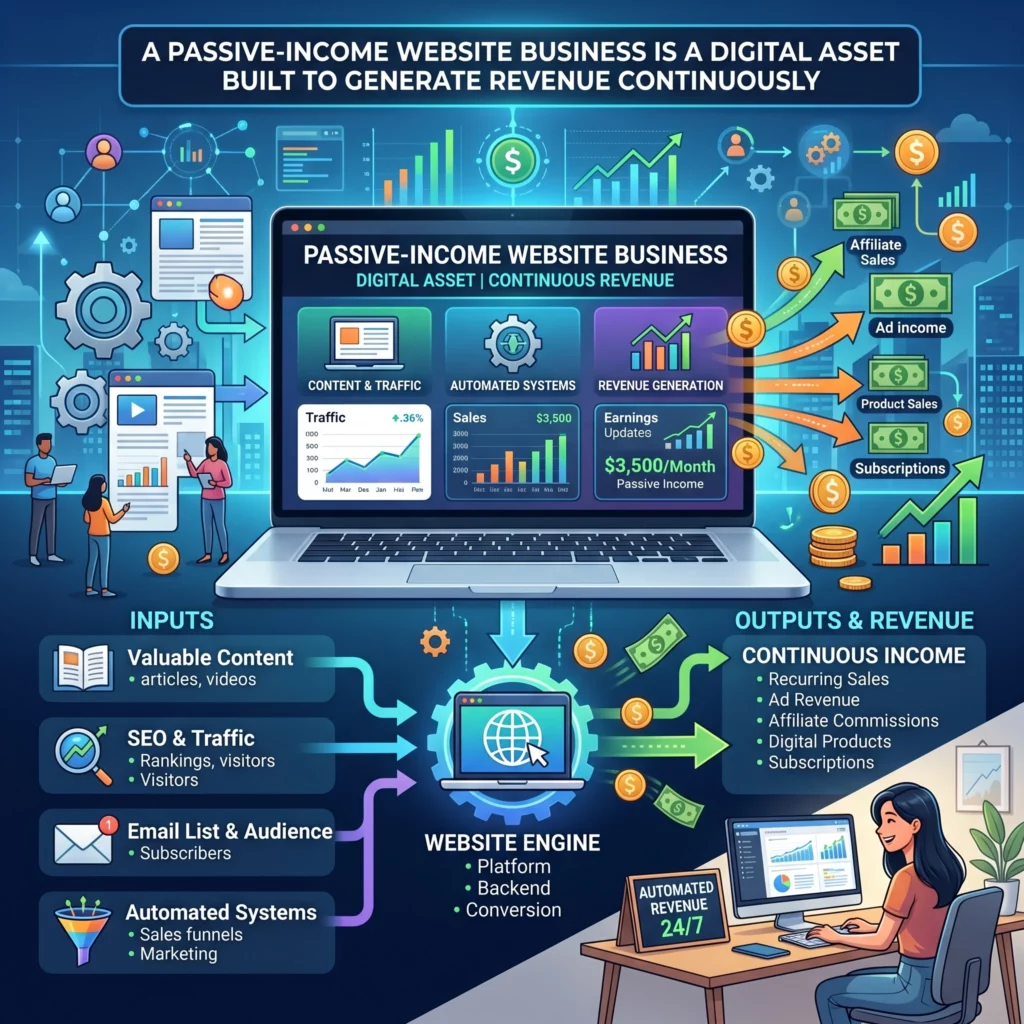
A passive-income website business is a digital asset built to generate revenue continuously through content, traffic, products, or automated systems.
At first glance, that sounds simple.
In practice, it changes the entire relationship between effort and income.
Traditional work stops paying the second you stop showing up.
Website businesses don’t.
An article written once can bring traffic for years.
A comparison page can generate affiliate commissions while you sleep.
A digital product can sell thousands of times without inventory, shipping, or customer meetings.
That’s the real attraction.
Not “easy money.”
Leverage.
Most successful passive-income websites earn through a combination of:
- affiliate marketing
- display advertising
- SEO traffic
- email newsletters
- digital products
- memberships
- local lead generation
- content ecosystems
Individually, these models are powerful. Together, they compound.
And compounding changes everything.
Why Website Businesses Feel Different From Normal Side Hustles
Most beginners accidentally choose businesses that trap them inside constant labor.
Freelancing. Delivery apps. Hourly consulting. Task-based gigs.
The money can be fast, but the structure never changes:
time in → money out.
Website businesses work differently.
You build systems once, then improve them over time.
A single SEO article can:
- rank in Google Search
- appear in AI-generated summaries
- attract backlinks
- build topical authority
- collect email subscribers
- generate recurring revenue
without requiring daily manual effort.
That’s why search-driven businesses have become one of the most scalable beginner opportunities online.
The internet rewards assets now—not just activity.
The Real Reason Passive Income Is So Emotionally Powerful
People rarely admit this out loud, but most passive-income searches are emotionally charged.
Someone types:
“how to make passive income online”
But underneath that search is usually another thought entirely.
Maybe:
- “I’m tired.”
- “I can’t keep doing this forever.”
- “I want more control.”
- “I need something that belongs to me.”
Passive-income website businesses resonate because they represent ownership in a world built on dependence.
Ownership of:
- traffic
- audience
- attention
- systems
- digital real estate
That emotional layer matters more than most SEO experts realize.
Search engines increasingly reward content that fully satisfies intent—not just informational intent, but emotional intent too.
And the emotional intent behind passive income is almost always transformation.
Why Most Beginners Never Make It Past the Starting Line
Not because they lack intelligence.
Not because the opportunity disappeared.
Most fail because they drown in fragmented information before momentum ever has a chance to form.
One video says start a blog.
Another says launch a YouTube channel.
Then someone on social media claims AI automation is the future.
Then another creator pushes dropshipping.
Then newsletters.
Then faceless brands.
Eventually the beginner stops building and starts circling.
Research becomes procrastination disguised as productivity.
The Internet Rewards Focus More Than Talent
This is one of the hardest truths for beginners to accept.
The websites that grow aren’t usually built by the smartest people. They’re built by the people who stay in one lane long enough for authority to compound.
Google’s ranking systems increasingly reward:
- topical depth
- semantic relevance
- entity relationships
- content consistency
- user satisfaction signals
In other words: clarity wins.
A scattered website rarely becomes authoritative.
A focused one often does.
The Website Business Models That Actually Make Sense for Beginners
There are thousands of ways to make money online.
Most are noisy.
Some are temporary.
A few become long-term digital assets.
These are the models that consistently work for beginners because they align naturally with SEO, scalable traffic, and low startup costs.
1. Affiliate Authority Websites
This is where many people begin.
An affiliate website recommends products, software, or services and earns commissions when users make purchases through referral links.
Simple in theory. Surprisingly powerful in execution.
Think about how people search online:
- “best project management software”
- “best beginner camera”
- “top email marketing tools”
- “best budget laptop for students”
Those aren’t casual searches.
They’re buying-intent searches.
The user is already close to making a decision.
That’s why affiliate marketing integrates so naturally with SEO.
A strong affiliate site typically builds clusters around:
- product reviews
- comparisons
- tutorials
- alternatives
- pricing guides
- use-case breakdowns
This semantic structure helps search engines understand contextual expertise across an entire topic ecosystem.
2. Content Websites Monetized With Display Ads
Some websites don’t sell anything directly.
They simply attract attention at scale.
These sites earn through advertising networks by generating consistent traffic around informational content.
Common examples include:
- parenting blogs
- travel guides
- DIY websites
- educational resources
- hobby communities
This model thrives on long-tail keywords because long-tail traffic compounds quietly over time.
One article might bring 30 visitors a day.
Another brings 80.
Another ranks months later unexpectedly.
Eventually those small streams become a river.
3. Digital Product Websites
Digital products are one of the cleanest business models on the internet.
No shipping.
No inventory.
No warehouses.
No physical overhead.
Just value packaged digitally.
Examples include:
- templates
- Notion systems
- eBooks
- design assets
- printables
- online courses
- paid research libraries
What makes digital products especially powerful is margin.
Once the product exists, the delivery becomes almost frictionless.
And when combined with SEO traffic, the system starts feeding itself.
4. Membership and Community Businesses
People often underestimate the power of belonging online.
Membership websites work because recurring communities create emotional gravity.
Subscribers don’t just pay for information.
They pay for proximity, access, accountability, identity, and momentum.
That’s why communities around:
- investing
- fitness
- entrepreneurship
- productivity
- niche education
continue scaling even in crowded markets.
The stronger the identity connection becomes, the stronger retention becomes.
And recurring revenue changes the stability of a business completely.
5. Local Lead Generation Websites
Quietly, this remains one of the most overlooked online business models.
The concept is straightforward:
build SEO-focused local websites targeting service searches like:
- roofing
- plumbing
- landscaping
- tree removal
- home cleaning
Then sell the incoming leads to local businesses.
Why does this work so well?
Because local businesses care about customers, not content.
If your website consistently produces calls and leads, the value becomes immediately tangible.
And compared to national SEO, local search competition is often dramatically weaker.
Why SEO Still Sits at the Center of Passive-Income Businesses
Every few years someone announces SEO is dead.
Then search traffic quietly keeps printing money for people who understand intent.
SEO today is no longer about stuffing keywords onto pages.
Modern search systems evaluate:
- context
- semantic relationships
- topical authority
- behavioral engagement
- content depth
- user satisfaction
- entity mapping
Search engines are becoming interpretation systems.
That changes how content must be built.
Topical Authority Is the New Domain Authority
Random articles don’t build meaningful authority anymore.
Connected ecosystems do.
Imagine a website centered on passive-income businesses.
Instead of publishing disconnected content, the site expands through related topic clusters:
- affiliate marketing
- SEO basics
- keyword research
- email marketing
- monetization strategies
- content marketing
- AI tools
- website growth systems
Each article strengthens the others through semantic alignment and internal linking.
This creates what search engines increasingly recognize as topical authority.
The website stops looking like isolated content and starts resembling an expertise network.
That distinction matters enormously in modern ranking systems.
Search Intent Matters More Than Keywords
A keyword alone tells you very little.
Intent tells you everything.
Someone searching:
“best passive-income website ideas”
may actually be looking for:
- financial hope
- realistic opportunity
- low-risk entry points
- beginner reassurance
- proof that this still works
The strongest SEO content satisfies all those layers simultaneously.
That’s why high-performing content feels emotionally complete—not just informationally complete.
The Beginner Tech Stack Is Simpler Than Most People Think
A lot of beginners imagine they need expensive tools before they can start.
They don’t.
A lean website business can launch with:
- a domain
- affordable hosting
- WordPress
- basic SEO tools
- email software
- AI productivity tools
often for less than the cost of a gym membership.
The goal early on isn’t complexity.
It’s traction.
Tools That Actually Help in the Beginning
Website Platforms
- WordPress
- Webflow
- Shopify
SEO and Search Optimization
- Google Search Console
- Ahrefs
- Semrush
- Surfer SEO
Email Marketing
- ConvertKit
- Beehiiv
- MailerLite
AI and Automation Tools
- AI writing assistants
- image generation tools
- workflow automation platforms
Most beginners delay launching because they think they need the perfect stack.
They don’t.
They need movement.
The Content Structure Search Engines Quietly Reward
There’s a rhythm to content that performs well in modern search.
It resolves tension quickly.
Then expands naturally.
Then deepens context without losing clarity.
The strongest SEO content usually does four things exceptionally well.
It Answers Fast
People search because they want clarity now.
Strong introductions reduce uncertainty immediately.
If readers feel lost in the opening moments, engagement collapses.
It Expands Semantically
Modern search engines interpret relationships between entities and supporting concepts.
That means comprehensive content naturally references:
- adjacent terminology
- related systems
- supporting frameworks
- practical examples
- contextual nuance
Semantic depth creates algorithmic trust.
It Feels Experienced
This is where E-E-A-T signals become powerful.
Readers—and increasingly search systems—can feel the difference between generic summaries and content shaped by real strategic understanding.
Nuance matters.
Specificity matters.
Texture matters.
It Creates Curiosity Momentum
The best content keeps opening small psychological loops:
- future payoff hints
- unanswered questions
- subtle tension
- identity progression
- transformation framing
That momentum increases:
- dwell time
- scroll depth
- engagement signals
which indirectly strengthen search performance over time.
The Timeline Nobody Wants to Hear—But Needs to
Most website businesses grow slower than social media promises.
And faster than traditional businesses.
That tension is important.
The early months often feel invisible.
You publish content.
Traffic barely moves.
Nothing seems to happen.
Then pages start indexing.
Long-tail rankings appear.
Clicks trickle in.
Eventually the compounding becomes visible.
That’s the phase where many people suddenly call a website “successful,” even though the foundation was built months earlier in silence.
SEO rewards consistency asymmetrically.
Tiny efforts feel meaningless until suddenly they don’t.
The Shift That Changes Everything
At some point, successful website owners stop thinking like content creators.
They start thinking like asset builders.
That mental shift changes how decisions get made.
Because a website is not just content.
It’s:
- traffic infrastructure
- audience ownership
- monetization leverage
- digital equity
- searchable intellectual property
And once multiple systems connect together—SEO, email, products, audience—the business becomes surprisingly resilient.
That’s when websites evolve into ecosystems.
When a Website Stops Being a Website
The strongest online businesses rarely stay “just blogs.”
They expand naturally into:
- newsletters
- YouTube channels
- premium memberships
- digital products
- consulting
- software tools
- communities
- educational ecosystems
Each layer strengthens the others.
Search traffic feeds email.
Email feeds products.
Products strengthen authority.
Authority improves rankings.
The entire system compounds.
Quietly at first.
Then aggressively.
Questions People Usually Ask Right Before They Start
“Can someone with zero experience actually build a passive-income website?”
Yes—but beginners who succeed usually focus on consistency instead of shortcuts.
The technical barriers are lower than ever. The harder part is staying committed long enough for authority and traffic to compound.
“Do I need a lot of money upfront?”
Not really.
Many successful beginners launch with minimal costs:
- hosting
- domain registration
- basic SEO tools
- email software
The bigger investment is usually patience.
“Is SEO still worth learning now that AI can answer questions instantly?”
Absolutely.
AI-generated answers still rely on authoritative source ecosystems. Search engines and AI systems continue pulling information from trusted websites with strong semantic depth and topical authority.
That makes high-quality SEO content more valuable—not less.
“What’s the easiest website business model for beginners?”
Affiliate marketing and informational content websites tend to have the lowest operational complexity.
They’re relatively simple to start, scalable over time, and naturally aligned with search intent.
“How long before a website actually makes money?”
Long enough to discourage impatient people.
Short enough to change your life if you stay consistent.
That’s the honest answer.
Products / Tools / Resources
Website Hosting
- Bluehost
- SiteGround
- Cloudways
- Kinsta
SEO Research Tools
- Ahrefs
- Semrush
- LowFruits
- Keywords Everywhere
AI Writing & Productivity
- ChatGPT
- Claude
- Notion AI
- Grammarly
Website Builders & CMS Platforms
- WordPress
- Webflow
- Shopify
- Ghost
Email Marketing Platforms
- ConvertKit
- Beehiiv
- Mailchimp
- MailerLite
Affiliate Networks
- Amazon Associates
- Impact
- ShareASale
- PartnerStack
Learning Resources for Beginners
Content Optimization Tools
- Surfer SEO
- Clearscope
- Frase
- MarketMuse
Analytics & Tracking
- Google Analytics
- Google Search Console
- Hotjar
- Microsoft Clarity
Best Beginner-Friendly Website Niches
- personal finance
- productivity
- home improvement
- fitness
- software reviews
- remote work
- education
- parenting
- AI tools
- digital entrepreneurship