
Part 1: The Moment I Stopped Chasing Money and Started Building an Asset
Most people don’t wake up one morning and decide to build a passive income website.
I certainly didn’t.
Like a lot of people, I started with a much simpler goal: earn a little extra money online.
Nothing ambitious. Nothing revolutionary.
Just enough to create breathing room.
At the time, my thinking was trapped inside a familiar equation. Work more hours. Earn more money. Stop working. Income stops.
Simple.
Predictable.
And surprisingly fragile.
Every dollar depended on my next action. Every month began at zero. Every break felt expensive.
What bothered me wasn’t the workload itself. It was the realization that I was building nothing that could outlive my effort.
The internet was full of people talking about freedom, passive income, financial independence, and lifestyle design. Most of it sounded exaggerated. Some of it sounded completely disconnected from reality.
But hidden underneath all the noise was a pattern I couldn’t ignore.
The people creating long-term online income weren’t necessarily smarter.
They weren’t always more talented.
In many cases, they weren’t even working harder.
They were building assets.
And among all the online assets available, one kept appearing over and over again:
What Is a Passive Income Website?
A passive income website is a website designed to attract visitors from search engines and convert that attention into revenue through methods such as affiliate marketing, display advertising, lead generation, sponsorships, or digital products.
At first glance, that sounds almost disappointingly simple.
Get traffic.
Earn money.
But that’s like saying a forest is simply a collection of trees.
Technically true.
Practically incomplete.
What makes a passive income website powerful isn’t the website itself.
It’s the compounding effect.
One article brings in ten visitors.
Ten articles bring in one hundred.
One hundred articles begin creating an ecosystem.
Eventually, your content starts working while you’re doing something else entirely.
Sleeping.
Traveling.
Working on another project.
Living your life.
That’s when the shift happens.
The website stops behaving like a project.
It starts behaving like an asset.
The Myth That Almost Stopped Me Before I Started
For months, I carried around a belief that turned out to be completely wrong.
I assumed building a successful website required expensive software.
Premium SEO tools.
Paid keyword research platforms.
Professional designers.
Developers.
Complex marketing systems.
The more I researched, the more intimidating the entire process felt.
Every tutorial seemed to end with a list of subscriptions.
Every strategy appeared attached to another monthly expense.
And if you’re starting from scratch, those costs create a dangerous mental barrier.
Because suddenly you’re not evaluating an opportunity.
You’re calculating risk.
“What if I spend all this money and nothing happens?”
That question keeps thousands of people frozen.
It nearly kept me frozen too.
Then I noticed something interesting.
Many of the creators generating meaningful traffic weren’t succeeding because of their tools.
They were succeeding because they understood search intent.
They understood content.
They understood people.
The software simply helped them execute.
That realization changed everything.
Why Free Tools Were Actually an Advantage
There’s a strange benefit to starting with nothing.
You become obsessed with fundamentals.
When you don’t have expensive software, you learn how search engines actually work.
When you don’t have advanced automation, you learn how users think.
When you don’t have endless resources, you become selective.
Intentional.
Focused.
Looking back, I genuinely believe free tools forced me to develop better habits.
Instead of hiding behind dashboards and metrics, I spent time studying actual search results.
Instead of obsessing over complicated SEO scores, I paid attention to the questions people were asking.
Instead of chasing shortcuts, I focused on usefulness.
And usefulness, more than any ranking factor, became the foundation of everything that followed.
The Reality Nobody Talks About
If you’re searching for how to build a passive income website, there’s a good chance you’re carrying an expectation that sounds something like this:
Publish a few articles.
Wait a few weeks.
Watch traffic arrive.
Start earning money.
That’s not how this works.
Not even close.
Search engines move slowly.
Trust develops slowly.
Authority develops slowly.
At the beginning, progress feels invisible.
You’ll publish content that nobody reads.
You’ll refresh analytics pages that barely move.
You’ll wonder whether the entire experiment is failing.
This stage is where most websites die.
Not because the strategy is broken.
Because humans struggle with delayed rewards.
We are wired to seek immediate feedback.
Search traffic doesn’t care about our wiring.
It rewards consistency.
It rewards patience.
It rewards depth.
The people who eventually earn passive income from websites are often the same people who simply stayed in the game long enough to see the compounding effect begin.
The Shift That Changed Everything
The breakthrough wasn’t discovering some secret SEO technique.
It wasn’t finding a hidden traffic source.
It wasn’t using artificial intelligence.
It was changing one fundamental question.
Instead of asking:
“How can I make money online?”
I started asking:
“How can I create something genuinely useful that searchers will continue finding six months from now?”
That subtle shift changed every decision that followed.
Every article became an asset.
Every keyword became a problem to solve.
Every piece of content became a long-term investment.
And that’s where the real story begins.
Because once I understood that principle, I needed a way to turn it into a functioning website without spending money I didn’t have.
That’s when I started assembling the exact free tool stack that would become the foundation of everything else.
Part 2: The Free Tool Stack That Built the Foundation
The internet has a habit of making simple things look complicated.
Spend enough time researching how to build a passive income website and you’ll eventually find yourself staring at endless software recommendations, premium subscriptions, expensive SEO platforms, and marketing systems that seem designed for companies rather than beginners.
For a while, I thought I needed all of it.
I was convinced there was a hidden toolkit successful website owners were using—something I didn’t have access to.
But after weeks of research, one uncomfortable truth emerged.
Most of the tools weren’t creating success.
They were simply amplifying strategies that already worked.
Without a solid niche, useful content, and clear search intent, the most expensive software in the world wouldn’t save a website.
So instead of trying to replicate someone else’s tech stack, I built something far simpler.
A lean system built entirely on free tools.
And surprisingly, that became one of my biggest advantages.
The Website Platform: Choosing Function Over Perfection
Most beginners spend too much time thinking about design.
I understand why.
Design feels productive.
It’s visible.
You can spend hours adjusting colors, testing layouts, and rearranging menus.
The problem?
Search engines don’t rank websites because they have beautiful buttons.
They rank websites because they solve problems.
So my first goal wasn’t building the perfect website.
It was building a website I could actually publish on.
Free Website Platforms Worth Using
Several options stood out immediately:
- WordPress.com
- Blogger
- GitHub Pages
- Medium
- Substack
Each platform had strengths and weaknesses.
WordPress offered flexibility.
Blogger offered simplicity.
GitHub Pages offered speed.
Medium offered built-in exposure.
Substack offered newsletter integration.
Instead of obsessing over tiny differences, I focused on one question:
Can this platform help me publish useful content consistently?
The answer was yes.
That was enough.
Because at this stage, momentum matters far more than optimization.
Why Search Intent Became More Important Than Software
One of the biggest misconceptions in SEO is that rankings come from technical wizardry.
Certainly, technical SEO matters.
Site speed matters.
Structure matters.
User experience matters.
But before any of those factors can help, Google must understand something much more important:
What problem is this page solving?
This is where search intent enters the picture.
Search intent is the reason behind a search.
Not the words themselves.
The reason.
And once I understood that distinction, keyword research started making sense.
The Free Keyword Research Process I Used
At the beginning, I couldn’t justify paying for premium SEO software.
So I built a research system using tools anyone can access.
Google Search
This became my primary research tool.
Not because it provided data.
Because it revealed behavior.
Every search result is evidence.
Evidence of what Google believes users want.
Instead of looking for keywords, I started looking for patterns.
What questions kept appearing?
What content formats dominated?
What problems seemed unsolved?
Those observations became content opportunities.
Google Trends
Google Trends helped answer an important question:
Is interest growing or disappearing?
A keyword with 10,000 searches sounds attractive.
Until you discover demand has been declining for three years.
Meanwhile, a smaller topic might be quietly growing every month.
That’s often where the best opportunities hide.
Google Keyword Planner
Although designed primarily for advertisers, Keyword Planner provides valuable insight into:
- Search volume
- Topic variations
- Related keyword opportunities
More importantly, it reveals language.
And language matters because successful SEO often comes down to matching how real people think.
People Also Ask
This became one of my favorite research methods.
Every question inside Google’s People Also Ask section represents genuine curiosity.
Real people.
Real concerns.
Real search intent.
Those questions often became entire article outlines.
Sometimes they became entire content clusters.
The Tool That Changed Everything: Google Search Console
Most beginners discover Search Console after building a website.
I wish I had understood its value sooner.
Because Search Console isn’t just an analytics platform.
It’s a direct communication channel between your website and Google.
It reveals:
- Which keywords generate impressions
- Which pages receive clicks
- Which content deserves expansion
- Which opportunities are hiding beneath the surface
Many of my best-performing articles began as small clues inside Search Console data.
A page ranking on page two.
A keyword receiving impressions but few clicks.
A topic attracting unexpected attention.
Those signals often led to content breakthroughs.
Content Creation Without Spending a Dollar
Once the research process was established, another challenge appeared.
Content production.
This is where many aspiring website owners become overwhelmed.
Not because writing is difficult.
Because consistency is difficult.
Creating one article is manageable.
Creating fifty is something entirely different.
I needed a system that reduced friction.
So I built a simple workflow.
Google Docs
Every article started here.
No distractions.
No complicated setup.
Just ideas turning into drafts.
The simplicity was part of the advantage.
Because the less effort required to begin writing, the more likely I was to actually publish.
ChatGPT for Research and Ideation
Used correctly, AI can accelerate content creation dramatically.
But I quickly learned something important.
The goal isn’t generating articles.
The goal is generating insights.
I used AI to:
- Brainstorm angles
- Explore subtopics
- Identify entity relationships
- Discover supporting concepts
The final content still required expertise, judgment, and originality.
But the research process became significantly faster.
Grammarly for Clarity
Good writing doesn’t require perfection.
It requires readability.
Grammarly helped identify friction points, awkward phrasing, and simple mistakes that might distract readers.
Because every interruption weakens engagement.
And engagement influences everything from dwell time to user trust.
The Moment I Realized Niche Selection Matters More Than Content
At this stage, I had a website.
I had research tools.
I had a content process.
But none of it mattered if I chose the wrong niche.
And this is where many passive income websites quietly fail.
Not because their content is bad.
Because their market is weak.
You can publish extraordinary articles in a niche nobody cares about.
The result will still be disappointing.
Traffic follows demand.
Revenue follows traffic.
Everything begins with the niche.
Which meant the next decision carried more weight than any tool I had chosen so far.
I needed to find a topic with long-term search demand, commercial potential, and enough depth to support years of content.
Not a trend.
Not a temporary opportunity.
And that search ended up reshaping the entire trajectory of the website.
Part 3: Finding the Right Niche Before Writing a Single Article
There’s a moment that arrives in almost every online business journey.
A deceptively simple question.
“What should my website be about?”
At first, it feels exciting.
A blank canvas.
Unlimited possibilities.
You imagine future traffic, future income, future freedom.
Then reality arrives.
Because choosing a niche isn’t just choosing a topic.
It’s choosing the market you’ll spend months—or potentially years—building authority inside.
And the truth is, most passive income websites don’t fail because their content is bad.
They fail because the foundation was weak from the beginning.
I almost made that mistake myself.
The Dangerous Trap of Choosing a Niche You Love
Conventional advice sounds appealing.
“Follow your passion.”
It feels inspiring.
It sounds logical.
And occasionally it works.
But passion alone is a terrible business model.
I learned that quickly.
Because there are thousands of subjects people love discussing that generate almost no meaningful search traffic.
Even worse, some topics attract traffic but have virtually no monetization potential.
You can become an expert in a subject nobody pays for.
You can create incredible content for an audience that never buys anything.
And unfortunately, neither traffic nor passion automatically creates income.
That realization forced me to approach niche selection differently.
Not emotionally.
Strategically.
The Three Filters Every Profitable Niche Must Pass
As I researched successful passive income websites, a pattern emerged.
The strongest niches consistently shared three characteristics.
Miss one, and the entire model becomes unstable.
Filter #1: Consistent Search Demand
This sounds obvious.
But it’s astonishing how many people overlook it.
A passive income website relies on search traffic.
No searches means no visitors.
No visitors means no income.
So before evaluating anything else, I wanted evidence that people were actively searching for information.
Not once.
Not occasionally.
Consistently.
Month after month.
Year after year.
This is what separates evergreen niches from temporary trends.
Evergreen Niches Typically Include Topics Like:
- Personal finance
- Investing
- Productivity
- Career development
- Fitness
- Nutrition
- Software tutorials
- Home improvement
- Gardening
- Education
Why?
Because the underlying human problems never disappear.
People will always want to save money.
Improve their health.
Advance their careers.
Learn new skills.
Search demand remains remarkably stable because human behavior remains remarkably stable.
Filter #2: Commercial Intent
Traffic is valuable.
But traffic alone doesn’t pay bills.
A website needs some mechanism for converting attention into revenue.
This is where commercial intent becomes essential.
Commercial intent exists when visitors are likely to purchase something related to the topic.
For example:
Someone searching:
“How to brew coffee”
May eventually purchase:
- Coffee beans
- Grinders
- Espresso machines
- Brewing equipment
Every one of those products creates monetization opportunities.
Affiliate marketing becomes possible.
Display advertising becomes more profitable.
Digital products become easier to sell.
Lead generation becomes viable.
The ecosystem supports revenue.
Without commercial intent, monetization becomes significantly harder.
Filter #3: Topic Depth
This was the filter that changed everything.
Most beginners choose niches.
Successful websites build topical ecosystems.
There’s a huge difference.
Let’s compare.
Weak Topic Example
“Running Shoes”
At first glance, it looks promising.
But topic depth is limited.
Soon you run out of content opportunities.
Strong Topic Example
“Running”
Suddenly the possibilities expand.
Now you can create content around:
- Marathon training
- Injury prevention
- Nutrition
- Running gear
- Recovery
- Strength training
- Shoe reviews
- Race preparation
One topic becomes hundreds.
Hundreds become authority.
Authority becomes rankings.
Rankings become traffic.
Traffic becomes income.
This is the compounding effect in action.
Understanding Topical Authority
At this point, I stumbled onto a concept that would eventually influence every content decision I made.
Topical authority.
If you understand topical authority, modern SEO starts making far more sense.
Search engines aren’t simply evaluating individual articles.
They’re evaluating expertise.
They’re trying to determine:
“Does this website genuinely understand this subject?”
The easiest way to demonstrate expertise isn’t through claims.
It’s through coverage.
Comprehensive coverage.
Connected coverage.
Deep coverage.
The kind of coverage that mirrors how knowledge naturally exists.
How Search Engines See Topics
Humans often think in keywords.
Search engines increasingly think in entities.
This distinction matters.
For example:
A beginner might see the keyword:
“SEO”
Google sees a network.
SEO connects to:
- Search intent
- Keyword research
- Internal linking
- Technical SEO
- Content marketing
- Analytics
- User experience
- Website architecture
These relationships form an entity graph.
The stronger your content graph becomes, the easier it is for search engines to recognize authority.
That’s why random articles rarely outperform structured content ecosystems.
The Niche Validation Process I Used
Before committing to a niche, I asked four questions.
Every single time.
Question 1:
Can I identify at least 100 content ideas?
If the answer was no, I moved on.
A passive income website requires depth.
Depth requires content opportunities.
Question 2:
Do people spend money in this market?
If nobody buys products, services, tools, memberships, or education related to the topic, monetization becomes difficult.
Question 3:
Can beginners and experts both exist here?
This matters more than most people realize.
Healthy niches contain audiences at multiple stages.
Beginners search foundational questions.
Experienced users search advanced topics.
That creates long-term content expansion.
Question 4:
Will people still search this topic in five years?
This became my favorite filter.
Because it immediately eliminated trend chasing.
Search trends rise.
Search trends fall.
Evergreen demand compounds.
The Niche I Finally Chose
Interestingly, the final niche wasn’t the one I initially expected.
It wasn’t the most exciting.
It wasn’t the trendiest.
It wasn’t the niche with the biggest promises.
It was simply the niche that checked every box.
Strong search demand.
Clear monetization.
Significant topic depth.
Long-term relevance.
The choice felt almost boring.
Which, in hindsight, was a very good sign.
Boring often wins.
Because boring usually means stable.
And stability compounds.
The Mistake That Nearly Cost Me Months
Even after choosing the niche, I almost made another critical mistake.
I was ready to start publishing random articles.
Whatever seemed interesting.
Whatever came to mind.
Whatever looked easy to write.
Thankfully, I paused before hitting publish.
Because random content creates random outcomes.
And random outcomes rarely build passive income websites.
If I wanted rankings, traffic, and authority, I needed something more deliberate.
A system.
A framework that connected every article to a larger strategy.
That’s when I discovered content clusters, pillar pages, internal linking, and the architecture behind topical authority.
And once those pieces came together, the website stopped looking like a collection of articles.
It started looking like a growing knowledge ecosystem.
Part 4: The Content Strategy That Turned a Website Into an Authority
By the time I had chosen my niche, I felt ready.
I had a website.
I had free tools.
I had a growing list of content ideas.
On paper, everything looked promising.
But there was one problem.
I still didn’t understand how successful websites actually grow.
Like most beginners, I assumed traffic came from publishing more articles.
Write enough content.
Cover enough keywords.
Eventually Google notices.
At least that was the theory.
The reality was much different.
Because publishing content isn’t the same thing as building authority.
And authority is what search engines reward.
That distinction became one of the most important lessons of the entire journey.
The Day I Realized Random Content Doesn’t Compound
I remember looking at several successful websites in my niche and noticing something strange.
None of them felt random.
Every article seemed connected.
Every topic led naturally into another topic.
Every page strengthened the pages around it.
Reading one article often led to three more.
Three more led to five more.
Five more led deeper into the ecosystem.
The entire experience felt intentional.
Almost architectural.
That’s when I realized something important:
The websites winning organic search weren’t publishing isolated content.
They were building knowledge networks.
And that changes everything.
Understanding Content Clusters
A content cluster is a group of related articles organized around a central topic.
Think of it like a solar system.
The pillar page becomes the sun.
Supporting articles become planets orbiting around it.
Each article serves a specific purpose.
Each article strengthens the others.
Together they create topical authority.
This structure helps both users and search engines understand exactly what your website knows.
Example Content Cluster
Let’s imagine a website about home coffee brewing.
The pillar page might be:
Complete Guide to Home Coffee Brewing
Supporting articles could include:
- Best Coffee Grinders for Beginners
- French Press Brewing Guide
- Espresso vs Pour Over
- Coffee Bean Storage Tips
- Water Temperature for Brewing Coffee
- Common Coffee Brewing Mistakes
Individually, each article answers a question.
Collectively, they establish expertise.
And expertise is what Google increasingly measures.
Why Google Loves Content Clusters
Search engines have evolved.
Years ago, ranking often felt heavily keyword-driven.
Today, understanding topics matters far more.
Google wants confidence.
When someone searches for information about a topic, Google wants to recommend a source that demonstrates comprehensive understanding.
Not a website that happened to write one decent article.
A website that understands the entire landscape.
Content clusters provide that signal.
They show depth.
They show breadth.
They show relationships between concepts.
Most importantly, they mirror how knowledge naturally exists.
Pillar Pages: The Authority Center of Every Cluster
The first major structural change I made was creating pillar pages.
Before that, every article existed independently.
Once pillar pages entered the picture, everything became organized.
What Is a Pillar Page?
A pillar page is a comprehensive resource covering a broad topic.
Its goal isn’t to answer every question in exhaustive detail.
Its goal is to create a central hub.
A place where users—and search engines—can understand the entire topic landscape.
For example:
Instead of creating dozens of unrelated SEO articles, you might create:
The Complete Guide to SEO
Then connect it to specialized content covering:
- Keyword research
- Search intent
- Technical SEO
- Internal linking
- Link building
- Content optimization
- Analytics
The pillar page becomes the foundation.
The supporting content becomes the structure built on top of it.
The Internal Linking Strategy That Changed Everything
Internal linking sounds boring.
It certainly isn’t the most exciting part of SEO.
Yet it became one of the highest-leverage changes I made.
Because links don’t simply move users.
They move context.
They move authority.
They move understanding.
Every internal link tells Google:
“These topics are connected.”
Enough of those connections create a clear knowledge graph.
How I Structured Internal Links
Each supporting article linked back to its pillar page.
Each pillar page linked to supporting articles.
Related supporting articles linked to one another whenever relevant.
Nothing forced.
Nothing excessive.
Just natural pathways that helped users continue learning.
Over time, the website began behaving differently.
Visitors viewed more pages.
Session duration increased.
Topic relevance strengthened.
Search visibility improved.
The entire ecosystem became easier for Google to understand.
Writing for Search Intent Instead of Keywords
This was another breakthrough.
And honestly, it took me longer than it should have.
When most people begin learning SEO, they become obsessed with keywords.
I certainly did.
But keywords are only clues.
Intent is the destination.
Informational Intent
Users want answers.
Examples:
- How does affiliate marketing work?
- What is passive income?
- How do backlinks help SEO?
The goal here is education.
Commercial Intent
Users are evaluating options.
Examples:
- Best blogging platforms
- Best keyword research tools
- Top email marketing software
The goal is comparison.
Transactional Intent
Users are ready to act.
Examples:
- Buy SEO course
- Start blog today
- Sign up for hosting
The goal is conversion.
Navigational Intent
Users already know where they want to go.
Examples:
- Google Search Console login
- WordPress dashboard
The goal is accessibility.
Every Article Needed a Purpose
Before publishing anything, I started asking a simple question:
“What is the reader actually trying to accomplish?”
Not:
“What keyword am I targeting?”
But:
“What outcome is the user seeking?”
That subtle shift transformed the quality of my content.
Because people don’t search for keywords.
They search for progress.
Every search represents a gap between where someone is and where they want to be.
Great content closes that gap.
The Structure I Used for Every Article
As the website grew, I developed a repeatable framework.
Every article followed a similar flow.
Immediate Answer
Give readers what they came for quickly.
Don’t make them work for basic information.
Context
Explain why the answer matters.
Create understanding, not just information.
Step-by-Step Guidance
Break complexity into manageable actions.
People stay engaged when progress feels achievable.
Supporting Examples
Examples create clarity.
They transform abstract ideas into practical understanding.
Related Topics
Connect users to additional resources.
Encourage exploration.
Strengthen topical authority.
Improve internal linking naturally.
The First Signs That the Strategy Was Working
For weeks, nothing happened.
At least that’s how it felt.
Traffic remained low.
Clicks were inconsistent.
Growth was difficult to notice.
Then subtle signals started appearing.
A few impressions became dozens.
Dozens became hundreds.
Pages that previously ranked nowhere began appearing on page two.
Some reached page one.
Search Console started revealing opportunities I hadn’t expected.
The website wasn’t exploding.
It was compounding.
Quietly.
Gradually.
Almost invisibly.
Which is often exactly how sustainable growth begins.
And once content clusters, pillar pages, and internal linking were in place, there was only one thing left to solve.
Traffic.
Not theoretical traffic.
Not future traffic.
Actual visitors arriving from search.
Because a passive income website doesn’t become an asset until people can find it.
And that’s where the next stage began: getting Google’s attention without paying for ads, buying backlinks, or relying on social media luck.
Part 5: The First Visitors, The First Rankings, and the Long Wait Nobody Warns You About
If building the website felt exciting, and creating content felt productive, the next phase felt something else entirely.
Quiet.
Uncomfortably quiet.
Because after publishing those first articles, after organizing content clusters, after carefully building internal links, I found myself staring at a reality that every website owner eventually encounters:
Nothing seemed to happen.
No flood of visitors.
No sudden rankings.
No dramatic notifications announcing that Google had discovered my work.
Just silence.
The kind of silence that makes you question every decision you’ve made.
And honestly, this is where most passive income websites disappear.
Not because they’re poorly built.
Because people mistake a lack of immediate results for a lack of future potential.
The Invisible Stage of SEO
One of the biggest misconceptions surrounding search engine optimization is that rankings happen quickly.
They usually don’t.
Especially for a brand-new website.
Before Google can trust your content, it needs data.
Before it can recommend your pages, it needs context.
Before it can view your website as an authority, it needs evidence.
That process takes time.
Far more time than most beginners expect.
The frustrating part is that much of this work happens behind the scenes.
Search engines are evaluating.
Comparing.
Testing.
Learning.
Meanwhile, website owners are refreshing analytics dashboards wondering if anything is working at all.
I did exactly that.
More times than I’d like to admit.
The Tool That Became My Daily Obsession
During those early months, one platform became more valuable than any other.
Google Search Console.
Most people think of Search Console as a reporting tool.
I started seeing it differently.
It became my roadmap.
My feedback loop.
My window into how Google was interpreting the website.
Because unlike traffic analytics, Search Console reveals something even more important:
Potential.
Why Impressions Matter More Than Most Beginners Realize
The first meaningful metric I watched wasn’t clicks.
It was impressions.
An impression occurs when your page appears in search results.
Even if nobody clicks.
At first glance, impressions seem insignificant.
They’re not.
They’re evidence.
Evidence that Google knows your page exists.
Evidence that your content is entering relevant conversations.
Evidence that rankings may eventually improve.
The first time I saw impressions increasing across multiple pages, something shifted.
The traffic wasn’t there yet.
But the foundation was.
And foundations matter.
My First Search Console Breakthrough
One morning, I opened Search Console expecting the usual small fluctuations.
Instead, I noticed something interesting.
Several pages were beginning to rank for keywords I hadn’t intentionally targeted.
That observation changed my entire approach.
Because it revealed an important truth about modern SEO.
Google often understands your content more broadly than you do.
A well-written article doesn’t rank for one keyword.
It ranks for dozens.
Sometimes hundreds.
Related searches.
Supporting concepts.
Entity relationships.
Semantic variations.
This is where topical authority starts revealing its power.
The deeper your coverage, the wider your visibility becomes.
How Search Intent Started Generating Unexpected Traffic
One article in particular taught me this lesson.
I wrote it to answer a very specific question.
Nothing ambitious.
Just a focused, useful piece of content.
Over time, Search Console revealed that the article was attracting impressions for dozens of related queries.
Questions I never included explicitly.
Terms I never optimized directly.
Yet Google recognized the relationship.
Because search engines increasingly understand topics, not just keywords.
The article wasn’t ranking because it repeated phrases.
It was ranking because it solved a problem comprehensively.
That realization reinforced everything I’d learned about search intent.
Users don’t care about keywords.
They care about outcomes.
And Google’s goal is matching those outcomes to the most useful content available.
The Internal Linking Effect Nobody Talks About
Around the same time, something else happened.
Pages that weren’t ranking suddenly began gaining visibility.
At first, I couldn’t explain it.
Then the pattern became obvious.
Many of those pages had recently received additional internal links.
This wasn’t magic.
It was structure.
When pillar pages linked to supporting content—and supporting content linked back—the entire cluster became stronger.
Authority flowed throughout the ecosystem.
Search engines gained more context.
Users discovered additional resources.
Engagement improved.
The website started behaving less like a collection of pages and more like a connected knowledge base.
That’s when I began understanding why content clusters work so well.
They’re not simply organizational tools.
They’re trust signals.
Why I Ignored Social Media (At Least in the Beginning)
Whenever people talk about growing a website, social media inevitably enters the conversation.
And while social platforms absolutely have value, I deliberately chose a different path.
I focused on search traffic.
The reason was simple.
Social traffic is often temporary.
Search traffic compounds.
A social media post might perform well for a few hours.
Maybe a few days.
Then attention moves elsewhere.
Search traffic behaves differently.
A strong article can continue attracting visitors months or years after publication.
That’s the power of evergreen content.
The work happens once.
The visibility continues.
For someone building a passive income website, that distinction matters enormously.
Because passive income isn’t created by constant activity.
It’s created by durable assets.
The First Click That Changed My Perspective
I still remember seeing one of my articles receive its first meaningful organic clicks.
Not because the numbers were impressive.
They weren’t.
Compared to established websites, the traffic was tiny.
But the significance wasn’t in the volume.
It was in the validation.
Someone searched for information.
Google recommended my page.
A real person clicked.
That single interaction proved the system worked.
The process wasn’t theoretical anymore.
It was real.
And once something works once, repetition becomes easier.
Confidence replaces uncertainty.
Momentum replaces hesitation.
Progress becomes measurable.
The Compounding Nature of Search Traffic
What surprised me most wasn’t how fast traffic arrived.
It was how differently it grew.
Growth rarely appeared in a straight line.
For weeks, movement seemed insignificant.
Then multiple pages would improve simultaneously.
New keywords would appear.
Impressions would spike.
Clicks would follow.
The website felt almost dormant until suddenly it didn’t.
This is why many people quit too early.
They’re expecting linear growth.
Search traffic often behaves exponentially.
The hardest phase is surviving long enough to experience the curve.
The Lesson Hidden Inside Every Ranking Increase
Looking back, every ranking improvement reinforced the same principle.
Google wasn’t rewarding optimization tricks.
It wasn’t rewarding shortcuts.
It was rewarding usefulness.
The pages gaining traction consistently shared similar characteristics:
- Clear search intent alignment
- Strong topical relevance
- Helpful examples
- Comprehensive coverage
- Natural internal links
- Genuine user value
In other words, they deserved visibility.
And that realization became increasingly important because traffic alone wasn’t the ultimate goal.
Traffic was only the mechanism.
The real objective was turning attention into income.
Visitors into revenue.
Content into assets.
Because the moment a website begins generating consistent income, something changes psychologically.
It stops feeling like a project.
It starts feeling like a business.
And that’s where the next chapter begins.
The monetization stage.
The point where search traffic, topical authority, affiliate marketing, digital products, and passive income finally intersect.
Part 6: Turning Traffic Into Income Without Turning the Website Into a Sales Machine
Getting traffic felt incredible.
For months, the goal had been visibility.
Rankings.
Impressions.
Clicks.
Proof that people were actually finding the website through search.
Then another question emerged.
A more practical one.
Now that visitors were arriving, how exactly would the website generate passive income?
It’s a question that sounds simple until you’re forced to answer it.
Because traffic and revenue are not the same thing.
In fact, countless websites attract thousands of visitors every month while generating little or no income.
Attention alone isn’t enough.
There has to be a bridge between the problem a visitor wants solved and the solution they’re willing to pay for.
The good news is that once I understood this, monetization stopped feeling complicated.
The bad news is that most people approach it backward.
The Mistake That Destroys Trust Almost Instantly
When new website owners think about monetization, many make the same move.
They start selling too early.
Too aggressively.
Too obviously.
Every article becomes a pitch.
Every paragraph pushes a product.
Every page feels like a disguised advertisement.
Readers notice.
And once trust disappears, rankings often suffer alongside conversions.
Because modern search engines increasingly reward content that genuinely helps users.
Not content that exists solely to extract money from them.
The websites earning sustainable passive income understand something important:
Revenue is a byproduct of usefulness.
Trust comes first.
Monetization comes second.
Always.
Why Affiliate Marketing Became My First Revenue Model
Out of all the available options, affiliate marketing made the most sense.
Not because it promised massive commissions.
Because it fit naturally into the content.
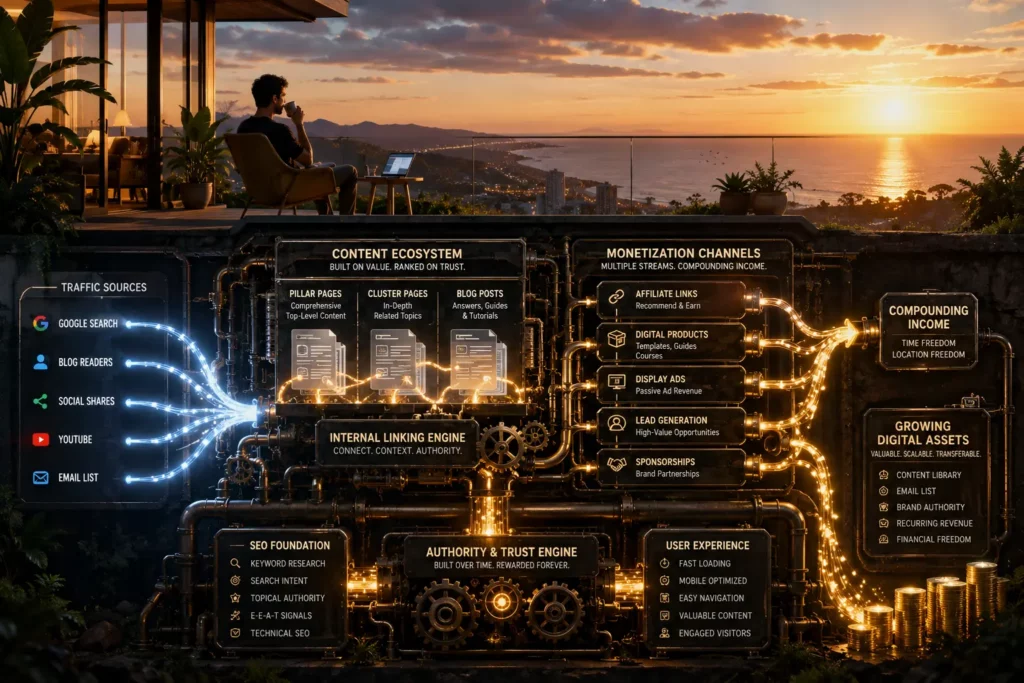
The alignment was almost effortless.
If an article explained how to solve a problem, and a tool genuinely helped solve that problem, recommending the tool felt helpful rather than promotional.
That’s an important distinction.
Readers don’t mind recommendations.
They mind manipulation.
How Affiliate Marketing Actually Works
The concept is surprisingly simple.
A company provides a referral link.
A visitor clicks.
They purchase a product or service.
You receive a commission.
The visitor pays nothing extra.
The company gains a customer.
The website earns revenue.
Everyone benefits.
When implemented correctly, affiliate marketing becomes one of the cleanest monetization models available.
The Hidden Advantage of Commercial Intent
Earlier in the process, I spent significant time evaluating niche selection.
At the time, commercial intent seemed important.
Later, I realized it was absolutely essential.
Because traffic becomes dramatically more valuable when visitors are already researching solutions.
Consider the difference.
Someone searching:
“What is passive income?”
Is learning.
Someone searching:
“Best blogging platform for beginners”
Is evaluating.
Someone searching:
“Start a blog today”
Is preparing to act.
The closer search intent moves toward action, the greater the monetization opportunity.
This is why understanding intent influences far more than rankings.
It influences revenue.
The First Affiliate Commission
The amount was small.
Smaller than I expected.
Almost laughably small.
But I remember it clearly.
Not because of the money.
Because of what it represented.
A stranger found content through Google.
Consumed the information.
Trusted the recommendation.
Took action.
And the website generated revenue without direct involvement from me.
That moment felt different from every previous online income experience.
Because I wasn’t selling my time.
The asset was working.
Exactly as intended.
Display Advertising: Letting Traffic Monetize Itself
As the content library expanded and traffic increased, another opportunity emerged.
Display advertising.
This model is straightforward.
Advertisers pay to place ads on your website.
You earn revenue based on impressions, clicks, or audience quality.
Unlike affiliate marketing, display advertising doesn’t require visitors to purchase anything.
Traffic alone creates value.
This makes it an attractive layer of passive income.
Particularly for informational content.
When Display Ads Start Making Sense
Many beginners install advertisements too early.
I nearly did the same thing.
The problem is that low traffic produces low returns.
A website with a small audience often sacrifices user experience without earning meaningful revenue.
Waiting until traffic reaches a stronger foundation typically creates a better outcome.
More visitors.
Higher earnings.
Less disruption.
Patience once again becomes an advantage.
The Revenue Model That Changed My Perspective Completely
Affiliate marketing worked.
Advertising worked.
But neither shifted my thinking as dramatically as digital products.
Because digital products introduce something unique.
Ownership.
Instead of promoting someone else’s solution, you create your own.
And once I understood that possibility, the economics of a passive income website changed dramatically.
Why Digital Products Are So Powerful
Every article on the website solved problems.
Some solved small problems.
Others solved larger ones.
Over time, patterns emerged.
Certain questions appeared repeatedly.
Certain challenges surfaced constantly.
Certain readers wanted more than an article could provide.
That demand created opportunities.
Examples include:
- Templates
- Checklists
- Guides
- Workbooks
- Mini-courses
- Premium resources
The content attracted attention.
The products delivered transformation.
Together they formed a complete ecosystem.
The Surprising Relationship Between Content and Products
Most people think products come first.
For me, it was the opposite.
Content revealed what products should exist.
The audience effectively performed the research.
Every comment.
Every email.
Every recurring question.
Each one pointed toward unmet needs.
By the time a product was created, demand already existed.
This dramatically reduced uncertainty.
Because the product wasn’t based on assumptions.
It was based on evidence.
Lead Generation: The Quiet Revenue Engine
Another monetization strategy became increasingly visible as traffic grew.
Lead generation.
Many businesses are willing to pay for qualified prospects.
If your website helps connect users with relevant services, that connection can create significant value.
Examples include:
- Financial services
- Marketing agencies
- Consulting businesses
- Insurance providers
- Home service companies
In some industries, a single lead can be worth more than thousands of ad impressions.
That’s why lead generation remains one of the most underrated passive income models online.
Building Multiple Revenue Streams
One lesson became obvious fairly quickly.
Relying on a single source of income creates unnecessary risk.
Algorithms change.
Affiliate programs close.
Advertising rates fluctuate.
Markets evolve.
Diversification provides stability.
Over time, the website developed multiple layers of monetization:
Layer One
Affiliate marketing.
Layer Two
Display advertising.
Layer Three
Digital products.
Layer Four
Lead generation opportunities.
Each layer strengthened the others.
Together they created a far more resilient business model.
The Moment the Website Started Feeling Like an Asset
There wasn’t a dramatic breakthrough.
No viral post.
No overnight success story.
No life-changing payment notification.
Instead, something quieter happened.
Revenue became predictable.
Traffic became consistent.
New content amplified existing content.
Older articles continued generating value.
The website developed momentum.
Not explosive momentum.
Sustainable momentum.
The kind that compounds.
The kind that grows while you’re focused elsewhere.
The kind that transforms a collection of articles into a genuine digital asset.
And that’s when I realized something surprising.
The most important lessons weren’t about SEO.
Or affiliate marketing.
Or monetization.
They were about patience.
Systems.
Consistency.
Because every meaningful result came from those principles.
Which became incredibly clear when I looked back at the journey from the beginning and examined the mistakes, lessons, and decisions I would handle differently if I had to start again from scratch.
Part 7: What I’d Do Differently, What Actually Matters, and the Resources That Made the Biggest Difference
If I could go back to the day I published that first article, I wouldn’t change the goal.
I’d still build a passive income website.
I’d still focus on search traffic.
I’d still use free tools.
But I would absolutely change the way I approached the process.
Because hindsight reveals something interesting.
Most breakthroughs don’t come from discovering hidden tactics.
They come from eliminating unnecessary mistakes.
And when I look back across the entire journey—from the first niche decision to the first affiliate commission—the biggest lessons are surprisingly simple.
They’re just difficult to appreciate when you’re standing at the beginning.
I Would Stop Chasing Perfect and Start Publishing Faster
One of the most expensive habits I carried into this project was perfectionism.
At the time, it felt responsible.
Professional.
Strategic.
In reality, it was often disguised procrastination.
I’d spend hours tweaking headlines.
Adjusting formatting.
Rewriting introductions.
Researching one more source.
Optimizing one more section.
Meanwhile, nothing was being published.
And unpublished content generates exactly zero traffic.
Looking back, I’d trade perfection for consistency every single time.
Because websites grow through accumulated value.
Not isolated masterpieces.
The article you publish today teaches you more than the article you endlessly refine for three weeks.
I Would Focus on Topical Authority Earlier
This is probably the biggest strategic change I’d make.
In the beginning, I thought about individual articles.
Successful websites think about ecosystems.
Google increasingly rewards topic depth.
Not because it wants more content.
Because comprehensive coverage creates stronger trust signals.
If I were starting over today, I’d build content clusters immediately.
I’d choose one topic.
Create a pillar page.
Publish supporting articles.
Connect everything through internal linking.
Then repeat.
That approach accelerates authority dramatically.
I Would Spend Less Time Looking at Competitors
This one surprised me.
Studying competitors is useful.
Obsessing over competitors is not.
There was a period where I constantly compared my website to larger publishers.
Bigger traffic numbers.
More backlinks.
Larger teams.
More resources.
Every comparison created pressure.
Very little created progress.
Eventually I realized something important.
Search engines don’t rank websites based on who has the biggest company.
They rank pages based on relevance, usefulness, expertise, and satisfaction.
Your job isn’t beating every competitor.
Your job is serving your audience better than the alternatives available for a specific query.
That shift changes everything.
Why Most Passive Income Websites Quietly Fail
People often assume failure comes from competition.
Or algorithm updates.
Or lack of technical expertise.
Sometimes those factors matter.
Most of the time, failure is much simpler.
The website disappears before momentum arrives.
That’s it.
The owner quits.
The publishing stops.
The content ecosystem freezes.
Growth stalls.
Compounding never gets a chance to occur.
Because the uncomfortable truth about SEO is that many rewards arrive long after the effort that created them.
The article ranking today might have been published nine months ago.
The affiliate commission earned this week may have originated from content written last year.
Passive income websites reward patience in a world obsessed with immediacy.
That’s why so many people abandon them prematurely.
The Hidden Skill Behind Every Successful Website
For a long time, I thought the most important skill was SEO.
Then I thought it was content marketing.
Then keyword research.
Then monetization.
Eventually I realized all of those skills sit underneath something larger.
The ability to consistently solve problems.
That’s the real game.
Every search query represents friction.
Confusion.
Curiosity.
A challenge.
A desire.
People aren’t searching for keywords.
They’re searching for progress.
The websites that win are usually the websites that help users move forward.
Search engines simply reward that behavior.
Questions I Wish Someone Had Answered Earlier
“Do I need to be an expert before starting?”
No.
But you do need to become increasingly knowledgeable over time.
Many successful websites begin with curiosity.
Expertise develops through research, experience, publishing, and learning.
The important thing is honesty.
Document what you know.
Research what you don’t.
Improve continuously.
“Can I really build a passive income website with free tools?”
Absolutely.
Free website platforms, Google Search Console, Google Trends, Google Docs, and AI-assisted research tools provide enough functionality to launch and grow a website.
Paid software can accelerate certain tasks.
It cannot replace strategy.
“How long before I see results?”
Longer than you want.
Shorter than you fear.
Most people underestimate the time required for search traffic to develop.
At the same time, they underestimate how powerful compounding becomes once it does.
Focus on creating assets.
Not timelines.
“How many articles should I publish?”
This question appears constantly.
The better question is:
How completely are you covering the topic?
Ten exceptional articles connected through a thoughtful content cluster often outperform fifty disconnected articles.
Depth creates authority.
Authority creates visibility.
“Is AI replacing websites?”
No.
But it’s changing them.
Search engines, AI-generated summaries, and generative search experiences increasingly favor content that demonstrates expertise, clarity, originality, and topical depth.
The future belongs to websites that provide real value.
Not websites that simply generate more words.
That’s why Generative Engine Optimization (GEO), topical authority, entity relationships, and first-hand experience matter more than ever.
Products / Tools / Resources
The following tools played a meaningful role in helping me build, grow, optimize, and monetize a passive income website. You don’t need all of them on day one, but each serves a specific purpose as your site evolves.
Website Publishing
WordPress
Still one of the most flexible publishing platforms available.
Ideal for building long-term authority sites, content hubs, and niche websites.
Blogger
Simple, free, and beginner-friendly.
A practical option for testing ideas before committing to a larger build.
GitHub Pages
Excellent for lightweight projects, documentation sites, and static websites.
Fast, reliable, and completely free.
Keyword Research and SEO
Google Search Console
The single most valuable free SEO tool available.
Use it to track impressions, clicks, indexing status, ranking opportunities, and content performance.
Google Trends
Helpful for identifying growing topics, seasonal patterns, and long-term demand shifts.
Google Keyword Planner
Useful for understanding keyword variations, search demand, and commercial intent.
People Also Ask
One of the best free content research resources on the internet.
Great for uncovering real-world questions and expanding topical coverage.
Content Creation
Google Docs
Simple, reliable, and distraction-free.
Perfect for drafting, organizing, and managing content workflows.
ChatGPT
Useful for brainstorming, outlining, research support, content planning, entity mapping, and idea expansion.
Best used as an assistant rather than a replacement for expertise.
Grammarly
Helpful for improving readability, clarity, grammar, and overall content quality.
Analytics and Optimization
Google Analytics
Provides deeper visibility into audience behavior, traffic sources, engagement, and conversions.
Search Console + Analytics Combination
Together, these tools create a powerful feedback loop that helps identify what users search for, how they behave, and where growth opportunities exist.
Monetization
Affiliate Programs
Ideal for recommending products, software, services, and resources that genuinely help your audience.
Display Advertising Networks
Useful once traffic reaches meaningful levels and consistent page views are being generated.
Digital Products
Templates, guides, checklists, courses, workbooks, and educational resources often provide the highest long-term leverage.
Lead Generation
Particularly effective in industries where qualified inquiries have substantial value.
Recommended Topics to Explore Next
- Topical Authority SEO
- Content Cluster Strategy
- Search Intent Optimization
- Internal Linking Best Practices
- Affiliate Marketing for Beginners
- GEO (Generative Engine Optimization)
- E-E-A-T and Trust Signals
- Knowledge Graph SEO
- Semantic SEO
- AI Overview Optimization
- Evergreen Content Strategy
- Digital Product Creation
- How to Make Money with a Tools Website
The deeper you explore these subjects, the easier it becomes to see the same pattern emerge: successful passive income websites are rarely built on tricks. They’re built on useful information, structured intelligently, delivered consistently, and designed to solve problems better than the alternatives.