
Snippet
Traffic alone doesn’t pay affiliate commissions—buyer intent does. In this guide, you’ll learn how to uncover the search terms used by people who are genuinely preparing to buy, validate their commercial value, and create content that answers the exact questions standing between curiosity and a purchase. Whether you’re just starting an affiliate blog or refining an established one, this framework will help you attract visitors who are far more likely to convert.
Table of Contents
- Why Buyer Intent Matters
- Understanding Search Intent
- The Buyer’s Journey
- The Psychology of Buyer Intent
- Step 1: Choose the Right Products
- Step 2: Find Buyer Intent Keywords
- Step 3: Validate Commercial Intent
- Step 4: Create High-Converting Content
- Step 5: Build Long-Term Growth
- Common Affiliate Mistakes
- Frequently Asked Questions
- Bonus: 30-Minute Keyword Research Routine
- Products / Tools / Resources
Introduction
Most affiliate marketers spend their time looking for more traffic.
It’s an understandable goal. More visitors should mean more clicks, more commissions, and more growth.
At least, that’s the theory.
In reality, many websites attract thousands of monthly visitors while generating surprisingly little income. Others receive only a fraction of that traffic yet produce steady affiliate commissions month after month.
The difference isn’t luck.
It isn’t even the quality of the writing.
More often than not, it comes down to targeting people at the exact moment they’re ready to make a decision.
Think about your own search habits for a moment.
When you’re simply curious about a topic, you search differently than when you’re about to spend money. The questions become more specific. You compare options. You look for reassurance. You read reviews. You want proof that you’re making the right choice.
Those searches reveal something incredibly valuable: intent.
Learning to recognize that intent changes the way you approach keyword research forever.
Instead of trying to attract everyone, you begin attracting the people who are already moving toward a purchase. Your content stops competing for attention and starts becoming part of the decision-making process.
That’s where affiliate marketing becomes far more effective.
Throughout this guide, you’ll learn how to identify buyer intent keywords, evaluate whether they’re worth targeting, and create content that naturally earns trust before asking for a click. These are practical methods you can apply across almost any niche, whether you’re promoting software, online courses, physical products, or subscription services.
When your keyword strategy aligns with genuine buying behavior, every article has a stronger chance of becoming a long-term asset instead of just another page on your website.
Why Buyer Intent Is More Valuable Than High Traffic
There’s a common trap that catches almost every new affiliate marketer.
It starts with search volume.
A keyword showing 50,000 monthly searches looks exciting. Naturally, it feels like the obvious choice.
But numbers rarely tell the full story.
Imagine two different articles.
The first attracts 40,000 visitors every month. Most readers arrive looking for general information, skim the page for a minute or two, and leave without taking any meaningful action.
The second receives only 2,000 visitors.
Almost every visitor is comparing products, checking prices, reading reviews, or deciding between competing solutions.
Which article would you rather own?
For affiliate marketers, the answer is almost always the second one.
A smaller audience with stronger buying intent is often worth far more than massive amounts of casual traffic.
The goal isn’t to win a popularity contest.
It’s to meet people precisely when they’re looking for guidance before making a purchase.
Traffic Doesn’t Equal Revenue
One of the biggest mindset shifts successful affiliate marketers make is separating traffic from income.
Visitors don’t generate commissions.
Decisions do.
Someone searching for “what is cloud storage?” is still learning.
Someone searching for “best cloud storage for photographers” has already moved much further along.
Their problem is defined.
They’re weighing their options.
They’re much closer to opening their wallet.
That difference is enormous.
When your content appears during that stage, you’re no longer introducing the idea of a solution. You’re helping someone choose the right one.
Better Visitors Create Better Results
Not every visitor brings the same value.
People arriving through buyer-focused searches usually spend more time reading because they’re actively looking for information that will influence a real purchase.
They compare details.
They look for advantages and drawbacks.
They pay attention to recommendations.
Most importantly, they engage with your content because they need answers—not because they happened to click an interesting headline.
That naturally leads to:
- Higher engagement
- Better click-through rates
- More qualified affiliate clicks
- Increased conversion potential
- Greater long-term trust
Over time, attracting the right audience becomes far more profitable than simply attracting a larger one.
Google Rewards Content That Matches Intent
Search engines have become remarkably good at understanding why people search—not just what they type.
If someone searches for a product review, Google usually doesn’t respond with a beginner’s tutorial.
Likewise, someone looking for basic definitions probably isn’t shown pages full of affiliate recommendations.
Google studies user behavior constantly.
It observes which pages satisfy visitors, which answers keep people engaged, and which results encourage users to stop searching because they’ve found what they need.
That’s why matching intent has become one of the strongest signals of high-quality content.
When your article aligns with the reader’s expectations, everyone benefits.
The visitor finds useful guidance.
Google sees positive engagement.
You gain the opportunity to earn trust—and eventually, commissions.
Understanding Search Intent Before You Research Keywords
Before you open a keyword tool or begin brainstorming article ideas, it’s worth understanding one simple truth.
Every search represents a goal.
Sometimes that goal is learning.
Sometimes it’s solving a problem.
Sometimes it’s making a purchase.
Recognizing the difference is what separates strategic keyword research from random keyword collection.
Most searches fall into four broad categories.
Informational Searches
These searches happen at the beginning of the journey.
People are exploring unfamiliar topics, learning new concepts, or trying to understand a problem.
Examples include:
- What is affiliate marketing?
- How does web hosting work?
- What is search intent?
- How do backlinks help SEO?
These searches can bring valuable traffic and establish authority, but they’re rarely where purchasing decisions happen.
Navigational Searches
Here, the destination is already known.
The search simply helps people get there.
Examples include:
- Canva login
- Ahrefs website
- Shopify dashboard
- Amazon customer service
These searches usually have limited affiliate potential because the user already knows exactly where they’re headed.
Commercial Investigation
This is where affiliate marketers begin to pay close attention.
The reader understands the problem.
Now they’re evaluating possible solutions.
Typical searches include:
- Best project management software
- ConvertKit review
- Semrush vs Ahrefs
- Best budget laptop for students
- Top email marketing platforms
The purchase hasn’t happened yet.
But it’s getting close.
Readers are gathering information that will influence their final decision.
High-quality comparison articles, reviews, and buying guides perform exceptionally well at this stage because they answer the questions buyers are already asking.
Transactional Searches
These are the strongest buying signals.
The person has finished researching and is looking for the final piece of information before completing a purchase.
Examples include:
- Buy Grammarly Premium
- Web hosting discounts
- Semrush pricing
- Best VPN deal today
Searches like these often produce fewer impressions than broad informational keywords, but the visitors arriving through them are significantly more likely to convert.
Understanding these four intent categories gives every keyword greater context.
Instead of seeing isolated search phrases, you begin seeing real people moving through a decision-making process.
And that’s where truly effective affiliate content begins.
Following the Buyer’s Journey from Curiosity to Commitment
Every purchase starts long before someone reaches a checkout page.
It begins with a question.
Then another.
And another.
As those questions become more specific, the searcher’s mindset changes. Curiosity gradually gives way to evaluation, and evaluation eventually becomes confidence.
Understanding that progression allows you to create content that feels helpful at every stage instead of promotional.
Imagine someone starting an online business for the first time.
At first, they’re simply exploring ideas.
A few days later, they’re comparing website platforms.
Soon after, they’re reading reviews and pricing pages before making a decision.
Each stage produces different searches—and each search reveals a different level of intent.
Recognizing those subtle shifts is one of the most valuable skills an affiliate marketer can develop.
Learn more: Simple Money-Making Website Setup for Starting an Online Business: The 24-Hour Beginner Blueprint
The Psychology Behind Buyer Intent Searches
If you look only at keywords, you’ll miss the most important part of the equation.
Every search begins with a thought.
Behind that thought is a feeling.
And behind that feeling is usually a problem someone wants to solve.
That’s why keyword research isn’t really about words at all. It’s about understanding people.
When someone searches for “best budgeting app for families,” they’re not looking for another app to install. They may be worried about mounting bills, trying to save for a home, or searching for a way to reduce financial stress.
The keyword is only the surface.
The motivation underneath is what matters.
The most successful affiliate marketers learn to recognize these emotional patterns. They don’t simply answer questions—they respond to concerns, remove uncertainty, and help readers feel confident enough to make a decision.
That shift changes everything.
Instead of writing for search engines, you begin writing for people who happen to use search engines.
Ironically, that’s exactly what modern search engines reward.
People Buy Confidence Before They Buy Products
Every purchase carries some level of risk.
Will this actually work?
Am I wasting my money?
Is there a better option?
What if I choose the wrong one?
These questions quietly run through almost every buyer’s mind.
That’s why searches containing words like:
- Best
- Honest review
- Worth it
- Pros and cons
- Comparison
- Alternative
appear so frequently.
They’re not just keyword modifiers.
They’re signs that someone is looking for reassurance.
Your role isn’t to pressure readers into making a purchase.
It’s to reduce uncertainty until the next step feels obvious.
Fear Often Drives More Searches Than Excitement
People naturally focus on avoiding mistakes.
Psychologists sometimes refer to this as loss aversion—the tendency to fear losing something more than we enjoy gaining something of equal value.
You can see this behavior reflected throughout Google.
Searches such as:
- Is Product X worth it?
- Should I switch to…
- Product A vs Product B
- Problems with…
- Is this a scam?
all reveal the same underlying emotion.
People don’t simply want the best product.
They want to avoid making a decision they’ll regret.
When your content openly discusses advantages, disadvantages, and who a product may not be suitable for, readers become far more likely to trust your recommendations.
Trust grows from honesty—not perfection.
Simplicity Wins
The internet is overflowing with information.
What people struggle to find is clarity.
Someone comparing five similar products doesn’t necessarily want more information.
They want someone to simplify the decision.
That’s why phrases like:
- Beginner’s guide
- Step-by-step
- Easy comparison
- Quick review
- Complete guide
continue attracting strong engagement.
Readers appreciate content that saves them time while helping them feel informed.
The easier you make a complicated decision, the more valuable your article becomes.
People Want Proof, Not Promises
Today’s readers have become remarkably good at recognizing exaggerated marketing.
Bold claims rarely persuade experienced buyers anymore.
Evidence does.
That’s why searches increasingly include phrases such as:
- Real experience
- User reviews
- Honest opinion
- Customer feedback
- Long-term review
People want to know how a product performs in everyday situations—not just how it’s described on a sales page.
Articles that balance enthusiasm with objectivity almost always create stronger long-term credibility.
Step 1: Choose Products People Already Want
Many affiliate marketers reverse the process.
They begin by searching for keywords.
A stronger strategy begins by identifying products that solve meaningful problems.
When people genuinely need a solution, buyer intent naturally follows.
Think about the products you use regularly.
Chances are they help you save time, reduce frustration, increase productivity, or achieve a goal more efficiently.
Those are exactly the kinds of products worth researching.
Rather than asking, “What keywords can I rank for?”
Ask yourself:
“What problems are people actively trying to solve?”
The answers often lead you toward far more profitable opportunities.
Focus on Evergreen Needs
Some markets rise and fall with trends.
Others remain relevant year after year because the underlying need never disappears.
Evergreen product categories include:
- Web hosting
- Email marketing platforms
- SEO software
- Graphic design tools
- Accounting software
- Password managers
- Project management platforms
- Online learning platforms
People continue searching for these solutions because businesses, freelancers, creators, and entrepreneurs continue facing the same challenges.
Evergreen demand creates evergreen opportunities.
Learn more: The Evergreen Goldmine Framework: How to Find Niches That Print Money Year After Year (Even If Trends Die)
Look for Expensive Problems
People become highly motivated when a problem costs them time, money, or peace of mind.
For example:
A business owner struggling to manage customer relationships is far more likely to invest in CRM software.
Someone losing website traffic has a strong reason to explore SEO tools.
A freelancer overwhelmed by administrative work may gladly pay for software that simplifies daily tasks.
The greater the problem, the stronger the buying intent tends to become.
Evaluate the Product Before the Commission
A generous commission rate can be tempting.
But commission percentages alone don’t build successful affiliate businesses.
Before promoting anything, ask questions like:
- Does the product genuinely solve a problem?
- Does the company have a strong reputation?
- Are customers satisfied?
- Is support responsive?
- Does the product receive regular updates?
- Would you feel comfortable recommending it to a friend?
Affiliate marketing works best when recommendations come from genuine confidence rather than financial incentive.
Readers notice the difference.
Think Long-Term
One sale is rewarding.
A loyal audience is far more valuable.
Choosing reliable products helps establish credibility that compounds over time.
People remember who helped them make a smart decision.
When they trust your recommendations once, they’re much more likely to return the next time they need advice.
That trust becomes one of the most valuable assets an affiliate marketer can build.
Step 2: Build a List of Buyer Intent Keywords
Once you’ve chosen products worth recommending, the next challenge is discovering how potential buyers actually search for them.
This is where many marketers overcomplicate the process.
You don’t need thousands of keywords.
You need the right ones.
Imagine standing beside someone while they research a purchase online.
Listen carefully to the questions they ask.
Those questions become your keyword opportunities.
Start with Broad Product Topics
Begin with simple product categories.
Examples include:
- Email marketing software
- Website builder
- CRM software
- AI writing tool
- VPN service
- Web hosting
- Graphic design software
These broad topics act as the starting point for dozens—sometimes hundreds—of commercial keyword variations.
Add Buyer Intent Modifiers
Small changes in wording often reveal dramatically different levels of purchase intent.
Some of the most valuable modifiers include:
- Best
- Review
- Reviews
- Comparison
- Vs
- Alternative
- Pricing
- Cost
- Discount
- Coupon
- Features
- Worth it
- Pros and cons
- For beginners
- For small business
- For bloggers
- For freelancers
Each modifier represents a slightly different stage of the buying journey.
Together, they form the foundation of countless affiliate content opportunities.
Let Google Reveal Real Searches
One of the simplest research tools is also one of the most powerful.
Begin typing your keyword into Google’s search bar.
Autocomplete suggestions are based on real search behavior—not guesses.
They often uncover:
- Common buying questions
- Popular comparisons
- Product-specific concerns
- Frequently searched alternatives
- Emerging trends
Pay attention to recurring themes.
They often reveal what matters most to potential buyers.
Explore “People Also Ask”
Few sections of Google’s results provide as much insight into buyer psychology.
The questions found in “People Also Ask” frequently expose the final uncertainties preventing someone from making a purchase.
For example:
- Is this worth the price?
- Can beginners use it?
- What’s included?
- Is customer support reliable?
- Are there better alternatives?
Each question represents another opportunity to create genuinely helpful content.
When your article answers these concerns naturally, readers feel understood.
Study Related Searches
The bottom of Google’s search results often contains an overlooked source of inspiration.
Related searches reveal how people continue exploring a topic after their original search.
These suggestions can uncover:
- Additional keyword variations
- Closely related products
- New audience segments
- Alternative search phrasing
- Long-tail opportunities with strong commercial intent
Viewed together, these searches create a broader picture of the buyer’s journey instead of isolated keyword ideas.
Learn from Customer Language
Some of the best keyword research doesn’t happen inside SEO tools.
It happens where customers share real experiences.
Read reviews.
Browse discussion forums.
Explore comments on product videos.
Notice the words people repeat.
You might see phrases such as:
- Easy to set up
- Saved hours every week
- Excellent support
- Too expensive
- Worth every dollar
- Great for beginners
- Simple interface
- Powerful automation
This language matters because it’s authentic.
Using similar wording naturally throughout your articles helps your content feel more relatable while aligning closely with how real people think, speak, and search.
Step 3: Confirm Commercial Intent Before You Start Writing
Finding a promising keyword can feel like a breakthrough.
It’s exciting to discover a phrase with healthy search volume and manageable competition. But before you invest hours researching, writing, and polishing an article, pause for a moment.
One important question still needs an answer.
Is this keyword likely to attract buyers—or just curious readers?
That distinction is often the difference between content that generates steady affiliate commissions and content that quietly collects page views without producing meaningful results.
Commercial intent isn’t something you guess.
It’s something you verify.
Fortunately, Google leaves clues everywhere.
Let the Search Results Tell the Story
The first page of Google is more than a list of websites.
It’s a window into user expectations.
Search your keyword and study what consistently appears.
If Google fills the results with buying guides, comparison articles, expert reviews, and product roundups, it’s sending a clear message.
People searching this phrase are trying to make a decision.
If, instead, the results are dominated by encyclopedic definitions, beginner tutorials, and educational articles, the audience is probably still gathering information.
Neither type of keyword is inherently better.
They’re simply designed for different stages of the buyer’s journey.
The goal is to make sure your content matches the intent behind the search.
Recommended reading: Easy Content Websites for Affiliate Commissions: How Small Sites Can Turn Helpful Articles Into Long-Term Income
Watch for Buying Signals in the SERP
Google often displays visual clues that reveal commercial intent before you even open a single result.
Pay attention to features like:
- Star ratings
- Product reviews
- Shopping results
- Pricing information
- Comparison tables
- Popular products
- Frequently asked purchasing questions
When several of these appear together, they’re strong indicators that people searching this topic are preparing to spend money.
Google wouldn’t surface those features if they weren’t useful to searchers.
Specific Searches Usually Convert Better
Broad keywords attract broad audiences.
Specific keywords attract people with specific needs.
Compare these two searches:
Email marketing
versus
Best email marketing software for coaches
The second search tells an entirely different story.
The searcher already knows what they need.
Now they’re choosing which solution fits their business.
The more detail a search includes, the easier it becomes to understand what the reader is hoping to accomplish.
Specificity often signals commitment.
Use Cost Per Click as a Helpful Clue
Cost Per Click (CPC) isn’t a ranking factor, but it can provide valuable insight into commercial value.
When advertisers are willing to pay higher prices for a keyword, it usually means those searches have a history of generating revenue.
Think of CPC as one piece of evidence—not the final verdict.
A keyword with moderate search volume, strong commercial intent, and healthy advertiser interest is often a far better opportunity than a high-volume keyword with little purchasing motivation.
Always consider the bigger picture.
Look Beyond Today’s Trends
It’s easy to get caught up chasing whatever is popular this month.
Sometimes that’s worthwhile.
More often, it’s better to build around topics people will continue searching for years from now.
Evergreen commercial keywords provide lasting value because the problems they solve never really disappear.
Businesses will continue needing accounting software.
Creators will continue searching for email marketing platforms.
Entrepreneurs will continue comparing website builders.
Building around these ongoing needs creates a more stable foundation for affiliate growth.
Step 4: Create Content That Helps People Make Buying Decisions
A buyer intent keyword opens the door.
Your content determines whether someone walks through it.
This is where many affiliate articles fall short.
They describe products.
They list features.
They repeat information already available on the company’s website.
But readers aren’t looking for another product brochure.
They’re looking for clarity.
Your job isn’t simply to explain what a product does.
It’s to help someone decide whether it’s the right solution for their situation.
That’s a very different kind of writing.
Learn more: The Content Website Flywheel: Build an Authority Brand That Attracts Traffic, Trust, and Sales on Autopilot
Match the Article to the Search
Every keyword carries an expectation.
The fastest way to disappoint readers is by giving them something they weren’t looking for.
Someone searching for a comparison article expects exactly that—a comparison.
Someone reading a review wants honest evaluation.
Someone searching for “best” products expects carefully selected recommendations.
Meeting those expectations should always come before trying to persuade anyone.
When your content naturally satisfies the reason behind the search, trust develops almost effortlessly.
Write Reviews That Feel Authentic
Readers have become remarkably skilled at recognizing superficial reviews.
If every product sounds amazing, nothing feels believable.
A useful review acknowledges both strengths and weaknesses.
Discuss questions such as:
- Who is this product designed for?
- Who might be happier choosing something else?
- Where does it perform exceptionally well?
- Where could it improve?
- What surprised you?
- What limitations should buyers understand?
Balanced reviews don’t weaken recommendations.
They strengthen them.
People trust honesty.
Comparisons Should Reduce Confusion
Comparison articles aren’t about declaring a winner as quickly as possible.
They’re about helping readers understand the differences that actually matter.
Compare areas such as:
- Ease of use
- Features
- Pricing
- Customer support
- Scalability
- Learning curve
- Integrations
- Overall value
A reader should finish the article thinking,
“Now I know which option fits my needs.”
That feeling is far more valuable than simply announcing one product as “the best.”
Buying Guides Should Feel Personal
When someone searches for “best” products, they’re rarely looking for a universal winner.
They’re searching for the best choice for themselves.
A thoughtful buying guide recognizes that different readers have different priorities.
For example:
- Best for complete beginners
- Best value for money
- Best premium solution
- Best for small businesses
- Best for creators
- Best for growing teams
Instead of forcing every reader toward the same recommendation, you help each person identify the option that makes the most sense for their circumstances.
That approach feels far more genuine.
Answer the Questions Readers Haven’t Asked Yet
Great affiliate content anticipates uncertainty.
As readers move through your article, new questions naturally appear in their minds.
Address them before they become reasons to leave.
Consider topics like:
- Is setup difficult?
- How long does it take to learn?
- Are there hidden costs?
- Can beginners succeed with it?
- Is customer support responsive?
- What happens if it doesn’t work?
- Are there better alternatives?
Each answer quietly removes another obstacle standing between interest and action.
Build Trust Before Expecting Clicks
Affiliate commissions are earned long before someone clicks a link.
They begin the moment readers decide they trust your judgment.
Trust grows through consistency.
It grows when recommendations feel thoughtful instead of promotional.
It grows when weaknesses are acknowledged rather than hidden.
And it grows when readers leave feeling they understand their options better than they did before arriving.
People don’t remember every feature you describe.
They remember how confident they felt after reading your advice.
That confidence is what turns casual visitors into loyal readers—and eventually, into customers.
Step 5: Build a Long-Term Affiliate Strategy Around Buyer Intent
Finding profitable keywords isn’t a one-time task.
It’s an ongoing process that becomes more valuable with every article you publish.
Many affiliate marketers think in terms of individual posts. They celebrate a page that ranks well, then immediately move on to the next keyword.
The most successful websites take a different approach.
They build collections of content that answer the questions people ask throughout the buying journey.
Over time, those individual articles begin working together. A reader who arrives looking for one answer often stays because every new question is answered with the same level of care and clarity.
That’s how authority is built—not overnight, but article by article.
Prioritize Evergreen Opportunities
Some topics explode in popularity for a few weeks before disappearing.
Others continue attracting motivated buyers year after year.
Whenever possible, focus your attention on evergreen opportunities such as:
- Product reviews
- Buying guides
- Product comparisons
- Pricing guides
- Software recommendations
- Alternative product lists
- Beginner-focused recommendations
- Industry-specific solutions
These topics remain useful because the problems behind them remain constant.
People will continue searching for better tools, smarter software, and more efficient ways to solve everyday challenges.
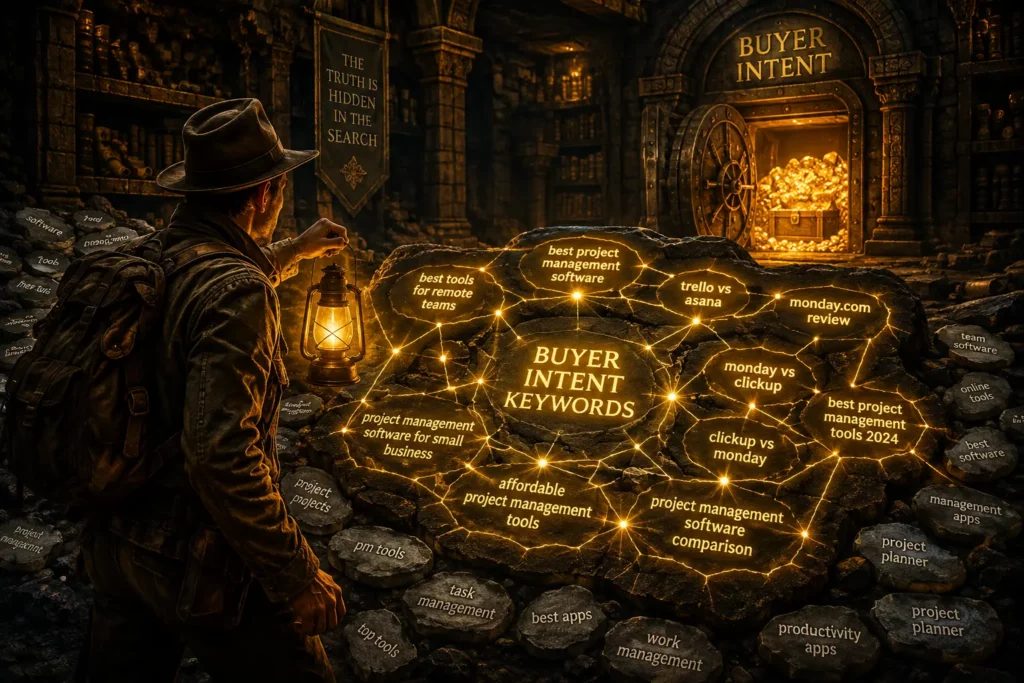
Creating content around lasting demand gives your website a stronger foundation than constantly chasing short-lived trends.
Keep Your Best Articles Alive
Publishing an article isn’t the finish line.
It’s the beginning.
Products evolve.
Features improve.
Companies change their pricing.
Competitors introduce new ideas.
If your article never changes, it slowly becomes less useful.
Readers notice outdated information, and so do search engines.
Set aside time to revisit your strongest content.
Look for opportunities to improve:
- Accuracy
- Product information
- Screenshots
- Pricing details
- New features
- Better comparisons
- Frequently asked questions
Small updates performed consistently often outperform publishing dozens of brand-new articles.
Think of every successful article as a valuable asset worth maintaining.
Let Your Audience Guide Your Next Decisions
One of the best sources of keyword inspiration is already visiting your website.
Your audience constantly tells you what they find valuable through their behavior.
Watch for patterns.
Which articles keep readers engaged the longest?
Which product categories generate the most affiliate clicks?
Which topics encourage repeat visits?
Which pages receive the strongest interaction?
These patterns reveal what your readers truly care about—not what you assume they care about.
When you create more content around proven interests, growth becomes far more predictable.
Expand Topics Instead of Constantly Starting Over
Imagine one of your articles begins performing exceptionally well.
Rather than moving to a completely unrelated topic, ask yourself what naturally comes next.
Readers interested in one product often have additional questions.
For example:
- Is there a better alternative?
- Which version should I choose?
- How does it compare with another product?
- Is it suitable for beginners?
- What happens after the free trial?
- Which accessories improve the experience?
Each question represents another opportunity to help readers while strengthening your expertise.
Over time, this approach creates depth instead of simply increasing page count.
Think Like a Trusted Advisor
People rarely remember the website that shouted the loudest.
They remember the one that helped them make a confident decision.
Approach every article with that mindset.
Instead of asking,
“How can I make this visitor click?”
Ask,
“What information would genuinely help someone choose wisely?”
That subtle change affects every part of your writing.
Your recommendations become more balanced.
Your explanations become clearer.
Your content feels more trustworthy.
Ironically, putting readers first often leads to more affiliate commissions because trust naturally encourages action.
Common Mistakes That Quietly Reduce Affiliate Commissions
Even experienced affiliate marketers make mistakes that limit the earning potential of otherwise excellent content.
Fortunately, most of these mistakes are easy to recognize once you know what to look for.
Mistaking Traffic for Success
It’s easy to celebrate increasing visitor numbers.
Traffic graphs look impressive.
But traffic alone doesn’t pay the bills.
If thousands of visitors leave without clicking an affiliate link—or without finding the information they were searching for—the article isn’t accomplishing its real purpose.
Always measure success by the value you provide and the quality of the audience you attract, not by page views alone.
Ignoring the Intent Behind the Search
This is one of the most common mistakes in affiliate marketing.
Suppose someone searches for:
Best accounting software for freelancers
Instead of comparing products, the article spends several thousand words explaining what accounting software is.
The reader arrived ready to evaluate solutions.
Instead, they’re forced to read information they already know.
That disconnect creates frustration.
The closer your content matches the reader’s expectations, the more useful—and effective—it becomes.
Recommending Too Many Products
More choices don’t always create a better experience.
In fact, too many recommendations often create uncertainty.
When readers are presented with endless options, making a decision becomes harder rather than easier.
Instead of overwhelming people with dozens of products, focus on carefully selected recommendations that serve different needs.
Explain why each option deserves consideration.
Help readers recognize which one fits their situation.
Clear guidance almost always outperforms endless lists.
Writing Reviews That Feel Generic
Readers have encountered enough copy-and-paste reviews to recognize them immediately.
Repeating product descriptions or feature lists adds very little value.
Instead, concentrate on practical questions.
What does daily use actually feel like?
Who benefits the most?
Where does the product excel?
What frustrations should buyers know about beforehand?
The more specific your observations become, the more authentic your recommendations feel.
Forgetting That Trust Comes First
Affiliate marketing isn’t about convincing everyone to buy.
It’s about helping the right people make informed decisions.
Sometimes the most valuable recommendation is explaining why a product may not suit a particular reader.
That honesty builds something far more valuable than a single commission.
It builds credibility.
Readers who trust your advice today are far more likely to return tomorrow when they’re ready for another recommendation.
Making Articles Difficult to Read
Excellent information loses much of its value if readers struggle to absorb it.
Long, uninterrupted blocks of text can feel exhausting, especially on mobile devices.
Good structure creates momentum.
Use:
- Clear headings
- Short paragraphs
- Numbered steps
- Bullet lists
- Helpful examples
- Comparison tables where appropriate
- Natural transitions between ideas
The easier your content is to navigate, the longer readers tend to stay.
And the longer they stay, the greater the opportunity to earn their confidence.
Frequently Asked Questions
How do I know if a keyword has genuine buyer intent?
A simple way to tell is by looking at the search results themselves. If Google primarily shows reviews, comparison articles, buying guides, pricing pages, and product recommendations, it’s usually a strong sign that people searching for that phrase are actively evaluating a purchase rather than simply learning about a topic.
Should I ignore informational keywords completely?
Not at all.
Informational content helps establish credibility, answers early-stage questions, and introduces new readers to your website.
The key is understanding that informational articles and buyer-focused articles serve different purposes. Together, they create a more complete content strategy.
Are long-tail keywords better for affiliate marketing?
In many cases, yes.
Long-tail keywords often reveal much clearer intent because they’re more specific.
Someone searching for “best project management software for freelance designers” usually has a much clearer goal than someone searching only for “project management.”
Specific searches frequently attract visitors who are much closer to making a purchase.
Is search volume the most important metric?
Search volume is useful, but it’s only one part of the picture.
A keyword with moderate traffic and strong commercial intent can easily outperform a much larger keyword that attracts visitors who have no immediate interest in buying anything.
Always evaluate keywords within the context of user intent.
How often should I update affiliate articles?
A good rule is to review your most important articles several times each year.
Update pricing, features, screenshots, product comparisons, and recommendations whenever meaningful changes occur.
Keeping your content current improves accuracy, maintains reader trust, and helps ensure your recommendations remain relevant over time.
Valuable Bonus: A 30-Minute Buyer Intent Keyword Research Routine You Can Use Every Week
One of the biggest misconceptions about keyword research is that it requires expensive software and hours of analysis.
In reality, consistency matters far more than complexity.
A focused half-hour each week can uncover enough high-quality keyword opportunities to fuel months of content creation.
Here’s a practical workflow you can repeat again and again.
Step 1: Pick One Product Worth Recommending
Start with a product or service you genuinely believe solves a real problem.
Ask yourself a few simple questions:
- Does it save people time?
- Does it reduce frustration?
- Is it well reviewed?
- Would you honestly recommend it to someone you know?
If the answer is yes, it’s worth exploring further.
Beginning with a quality product makes everything else easier.
Step 2: Write Down Your Main Keyword
Keep it simple.
Examples include:
- Email marketing software
- Password manager
- AI writing tool
- Website builder
- Web hosting
- Graphic design software
- Project management platform
This becomes the foundation for every variation you’ll uncover.
Step 3: Add Commercial Intent Modifiers
Now expand your keyword using the phrases real buyers naturally search for.
Examples include:
- Best
- Review
- Reviews
- Vs
- Alternative
- Pricing
- Cost
- Discount
- Features
- Worth it
- Pros and cons
- For beginners
- For small business
- For creators
A single product can quickly turn into dozens of valuable keyword ideas without forcing the process.
Step 4: Study Google’s Results Carefully
Don’t rush past the search results.
They’re one of the best research tools available.
Notice:
- Which articles consistently rank near the top
- What questions appear repeatedly
- Which products are mentioned most often
- How competitors structure their content
- What topics seem to receive the greatest attention
Instead of copying what others have written, look for opportunities to create something clearer, more balanced, and genuinely more useful.
Step 5: Listen to Real Customers
This step is often overlooked.
Visit places where people openly discuss products.
Read customer reviews.
Browse community forums.
Watch product demonstrations and read the comments underneath.
Pay close attention to recurring phrases.
You’ll often notice people describing:
- Problems they faced
- Features they appreciate
- Common frustrations
- Unexpected benefits
- Questions they still have before buying
These conversations provide language that’s natural, authentic, and closely aligned with the way potential buyers actually think.
Step 6: Organize Similar Keywords Together
Rather than treating every keyword as a separate project, group closely related searches.
For example:
Main Topic
- Best email marketing software
Supporting searches:
- Email marketing software review
- ConvertKit vs Mailchimp
- Best email platform for beginners
- Affordable email marketing tools
- Email marketing pricing comparison
Grouping keywords this way helps you see the bigger picture instead of isolated opportunities.
Step 7: Write the Article People Hope They’ll Find
Before you begin writing, ask yourself one question:
“If I searched this keyword today, what would I genuinely want someone to explain?”
That single question changes your perspective.
Instead of chasing rankings, you begin solving problems.
Readers notice the difference.
So do search engines.
Products / Tools / Resources
The right tools won’t replace thoughtful research, but they can make the process faster and more informed. Whether you’re just getting started or refining an established affiliate strategy, these resources are worth exploring.
Keyword Research Tools
- Google Autocomplete
- Google People Also Ask
- Google Related Searches
- Google Trends
- Ahrefs Keywords Explorer
- Semrush Keyword Magic Tool
- Moz Keyword Explorer
- Ubersuggest
- KeywordTool.io
- AnswerThePublic
Competitor Research Tools
- Ahrefs Site Explorer
- Semrush Organic Research
- Similarweb
- SpyFu
These platforms help you identify which buyer-intent topics competitors are already targeting and where opportunities may still exist.
Content Planning Tools
- Notion
- Trello
- Asana
- ClickUp
A structured content plan makes it much easier to organize keyword clusters, article ideas, publishing schedules, and future updates.
Writing and Editing Tools
- Grammarly
- Hemingway Editor
- Google Docs
- Microsoft Word
Clear writing builds trust. Simple editing tools help improve readability without changing your natural voice.
Analytics and Performance Tracking
- Google Search Console
- Google Analytics
These free tools reveal how people discover your content, which pages attract qualified visitors, and where future optimization opportunities may exist.
Affiliate Networks to Explore
Depending on your niche, reputable affiliate programs can often be found through:
- Amazon Associates
- ClickBank
- ShareASale
- CJ Affiliate
- Impact
- PartnerStack
Always choose products that align with your audience’s needs and that you would feel comfortable recommending based on their quality and reputation.
A Final Thought Before You Publish
Before clicking the publish button on your next affiliate article, pause for just a moment and reread it through the eyes of someone who has never heard of the product before.
Ask yourself:
- Would this article genuinely help me make a decision?
- Have I answered the questions that would make me hesitate?
- Does the recommendation feel balanced and honest?
- Have I explained who the product is—and isn’t—for?
- Would I still be proud of this article if there were no affiliate links on the page?
If the answer to those questions is yes, you’ve created something far more valuable than another SEO article.
You’ve created a resource that respects the reader’s time, earns their trust, and has every opportunity to generate affiliate commissions for years to come.