
There’s a particular hesitation that comes with sending a sales email to a small list. You know these subscribers didn’t all sign up for the same reason. A pitch that feels relevant to one person may feel like noise to another.
That’s why promoting affiliate products to a small email list starts with a better question than “How many people can I send this to?” Ask: Who might find this useful, and what would they need to know before deciding?
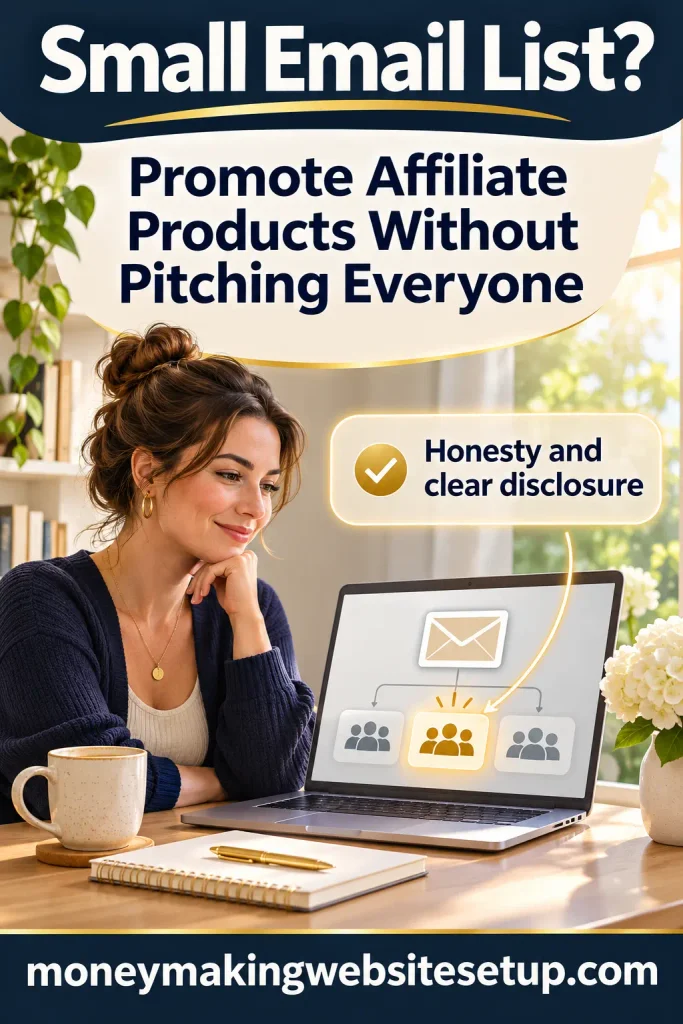
Choose one relevant offer, send it to the subscribers most likely to care, and explain the recommendation honestly. A useful campaign gives readers a reason to consider the product—and enough context to decide it isn’t for them.
Begin with the problem the product solves
Before writing a subject line, describe the problem the product is meant to solve. If you can’t explain it in a sentence, take another look at the offer—or at what you know about your subscribers.
A good affiliate product should make sense for the topic people signed up to hear about. Check:
- Audience fit: Does the product relate to subscribers’ interests or the reason they joined?
- Product quality: Can you explain what it does and who may find it useful?
- Evidence: Have you used it, tested it, or checked reliable product information?
- Limitations: What should a potential buyer understand before deciding?
- Program terms: Does the affiliate program allow email promotions? Does it restrict links, product claims, discounts, or brand wording?
- Email platform rules: Does your email service provider allow this kind of affiliate promotion?
A generous commission doesn’t turn an irrelevant product into a helpful recommendation. The better test is whether you could explain why the offer belongs in this conversation even if no commission were involved.
Get a Complete Money-Making Website Built For You - Free
If you’ve used the product, describe what you personally experienced. If you haven’t, don’t imply otherwise. Be clear about what you verified and what you haven’t tested.
Find the subscribers who are most likely to care
A small email list may still contain several different groups. Some joined for a particular guide. Others may have arrived through a newsletter signup or an article on a related topic. Treating them all as one audience can make a good offer feel out of place.
Look first at the information you already have:
- Signup source: Which page, form, or campaign brought each subscriber in?
- Topic interest: What did they ask to learn about or download?
- Relevant behavior: Have they clicked on related articles or recommendations?
- Purchase status: Do you know whether they’ve already bought the product?
For example, someone who signed up for advice about starting a website may be interested in website tools. That doesn’t mean every subscriber wants the same tool, or is ready to buy one. A relevant signup topic or click can help you decide who should receive more information.
Keep the process simple. If two segments would get the same email, there may be no need to separate them yet. A small, useful segment is better than an elaborate system that doesn’t change what you send.
Let the recommendation grow out of the email
A campaign feels abrupt when the product appears before readers understand why it matters. Give them useful context first. Then introduce the product where it naturally fits.
Here’s one sequence you can adapt:
| Purpose | What to include | |
|---|---|---|
| 1. Teach | Offer a useful idea related to the problem. | A practical tip, checklist, or lesson. |
| 2. Clarify | Help readers understand the challenge. | A common obstacle and a step they can try. |
| 3. Recommend | Introduce the product in context. | What it does, who it may suit, your evidence or experience, and a clear disclosure. |
| 4. Compare | Help readers decide if it fits. | Answers to likely questions, alternatives, and limitations. |
| 5. Follow up | Offer a clear next step. | A short recap and a reminder only when it’s genuinely useful. |
This is a starting point, not a five-day rule. You might use fewer emails, spread them across your normal newsletter schedule, or skip a message that adds nothing. The sequence should fit your usual communication and the offer’s actual timeline.
Email 1: Give readers something useful
Subject: A simple way to [solve a related problem]
Share one tip or process that helps readers make progress. It should still be worth reading if they never buy anything.
Email 2: Help them make the decision
Subject: Before you choose a tool for [task], check this
Explain what matters when choosing a solution. Depending on the topic, that might be ease of setup, cost, compatibility, or the type of user the product is designed for.
Email 3: Make the recommendation
Subject: The [product type] I’d consider for [specific need]
Say what you’re recommending, why it may fit, and who might benefit from it. Put a clear disclosure near the recommendation and link, such as: “I may earn a commission if you purchase through my link.” Make sure the wording accurately describes your relationship and the offer.
The Federal Trade Commission advises that affiliate relationships should be disclosed clearly and conspicuously, so readers can weigh the recommendation with that context.
Recommended guide: What Legal Pages Does an Affiliate Website Need? A Location, Audience, and Data Checklist
Email 4: Talk through the questions
Subject: Is [product] a good fit for you?
Cover the questions a reader might reasonably ask: What does the product do? What doesn’t it do? Who might prefer another option? If you know a drawback or limitation, include it plainly. Helping someone decide against a purchase can be just as useful as helping someone decide to buy.
Email 5: Close the loop
Subject: A quick recap on [problem or product]
Summarize the useful points and include the link again if it makes sense. If there’s no real deadline, don’t invent one. Give readers a next step whether they choose this product, another solution, or no purchase.
Make the email useful even if nobody buys
An affiliate link shouldn’t be the only reason for the campaign. You might also include a checklist for comparing solutions, a tutorial that helps readers take the next step, or an alternative approach for people who aren’t ready to buy.
That’s the difference between sending a pitch and making a recommendation. One asks for attention. The other earns it by helping readers understand their options.
Disclose the relationship and follow email rules
Make your affiliate relationship easy to understand near the recommendation. Don’t assume every reader knows what “affiliate link” means, and don’t leave the explanation where a reader is unlikely to notice it.
Email rules vary by location. In the United States, the FTC’s CAN-SPAM guidance covers commercial email requirements such as accurate sender and subject information, identifying commercial messages, providing a valid postal address, and offering a way to opt out. Other countries and regions have their own rules, so check the requirements that apply to you and your audience. www.ftc.gov
Also review the affiliate program’s terms and your email provider’s policies before sending. They may have additional requirements for promotional links, claims, or content.
Measure what happened—and use it to improve
A small campaign can produce a small amount of data. Try not to turn one email’s results into a verdict on the whole list. Look at how the offer, segment, and message worked together.
Useful measures include:
- Clicks: Did the intended subscribers want to learn more?
- Conversions: Did the affiliate program record purchases?
- Approved commissions: Were those purchases ultimately approved?
- Refunds or reversals: Did the recorded sales remain valid?
- Unsubscribes and complaints: Did the promotion feel irrelevant or too frequent?
Then ask a more specific question. Few clicks? Revisit the segment, subject line, or clarity of the recommendation. Clicks without sales? Check the offer, landing page, and tracking. More unsubscribes than usual? Consider whether the promotion matched what subscribers expected to receive.
There’s no universal list size, email count, or schedule that guarantees sales. Treat each campaign as a chance to learn what your audience finds relevant.
Recommended guide: Getting Website Visitors but No Income? Fix These 17 Traffic-to-Revenue Leaks
Mistakes that can make a good offer feel wrong
- Sending to everyone by default: Reach the subscribers most likely to find the offer relevant.
- Promoting unrelated products: A high commission doesn’t replace audience fit.
- Making claims you can’t support: Be specific about what you know and what you’ve personally experienced.
- Creating fake urgency: Mention a deadline only when it’s real.
- Repeating the same pitch: Each follow-up should teach, answer a question, or clarify the decision.
- Skipping the program and platform rules: Confirm that your promotion method is allowed before sending.
- Judging your whole list from one campaign: Use the results to identify what to investigate next.
Questions subscribers—and marketers—often ask
Should I send an affiliate promotion to my entire list?
Only if the offer is relevant to the whole list and fits what subscribers expected when they signed up. If people joined for different topics, send the promotion to the segment most likely to care.
How many emails should an affiliate campaign include?
There’s no required number. Send enough messages to explain the problem, present the offer honestly, and answer relevant questions. Keep the schedule consistent with your regular emails and the offer’s real timeline.
Learn more: 7 Welcome Emails for a New Affiliate Website Subscriber: What to Send, When to Send It, and What to Automate
Can I put affiliate links in my regular newsletter?
That depends on the affiliate program and your email provider’s rules. If they permit it, make sure the recommendation fits the newsletter topic and clearly disclose your relationship near the link.
What if people click but don’t buy?
Check whether the offer matches their needs, whether the landing page explains it clearly, and whether the link and tracking work. A click shows interest in learning more; it doesn’t guarantee a purchase.
What if I haven’t used the product myself?
Don’t suggest that you have. You can share reliable product information, explain what you verified, and say plainly that you haven’t tested it. If you don’t have enough evidence to recommend it responsibly, choose a different offer.
Products / Tools / Resources
You don’t need a complicated marketing stack to start. A few practical resources can help you send a more relevant campaign and understand what happened afterward.
- Email service provider: Use the segmentation, scheduling, and unsubscribe tools you already have. Check its policy on affiliate promotions before including links.
- Affiliate program dashboard: Review the program’s email rules and use its reporting to check clicks, recorded sales, approved commissions, and reversals.
- Campaign tracking sheet: Record the date, segment, offer, emails sent, clicks, conversions, approved commissions, refunds, and unsubscribes. A simple spreadsheet is enough to spot patterns.
- FTC resources for U.S. marketers: Review the CAN-SPAM compliance guide and affiliate disclosure guidance for the rules and disclosure principles discussed above.