
A product page can make every claim sound certain. The real work begins when you ask a quieter question:
What do I actually know about this product, and how do I know it?
That question is the heart of a trustworthy affiliate product review.
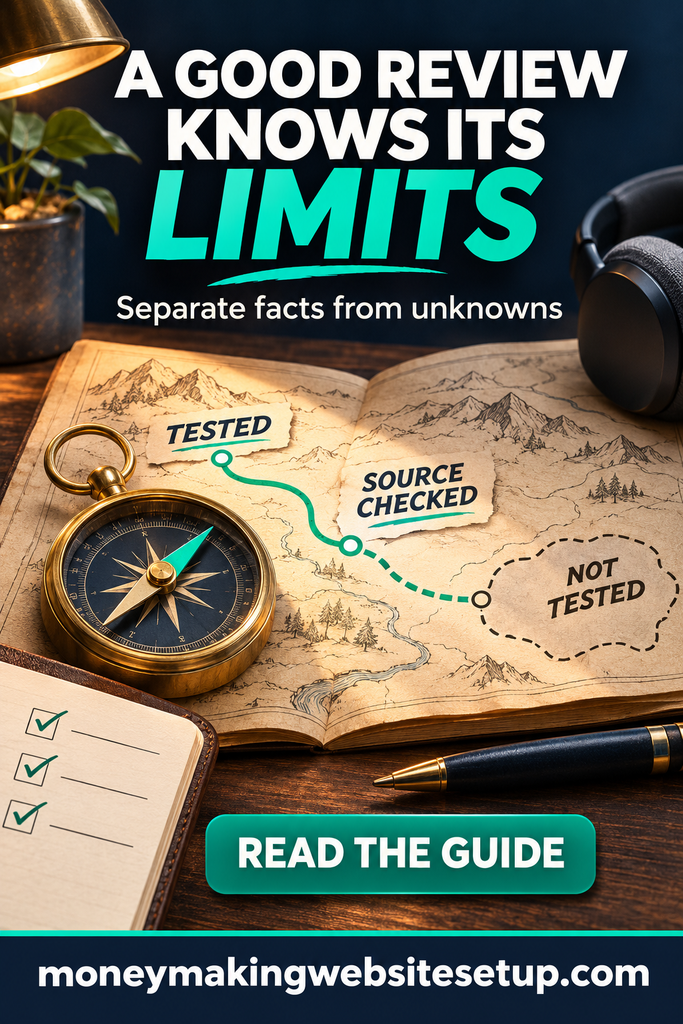
Readers should be able to distinguish what you tested, what a source says, what other reviewers have reported, and what remains unknown.
The short answer: List the claims that could affect a reader’s decision. For each one, record the evidence and label it clearly: tested firsthand, documented by a source, independently corroborated, unverified, or unknown. Attribute claims accurately, explain the limits of your testing, and make recommendations only as strong as the evidence behind them.
That may sound like a small discipline. On the page, it changes everything.
Get a Complete Money-Making Website Built For You - Free
What does “verified” mean in an affiliate product review?
A measurement you took yourself is different from a specification on a manufacturer’s website. Both can be useful, but they support different statements.
Use labels that show readers where each claim comes from:
| Evidence label | What it means | How to phrase it |
|---|---|---|
| Tested firsthand | You observed or measured it yourself under conditions you can describe. | “I tested the setup by…” |
| Documented by a source | A named source publishes the information, but you have not tested it independently. | “The manufacturer lists…” |
| Independently corroborated | One or more credible sources separate from the manufacturer support the claim. | “Independent tests reported…” |
| Unverified claim | A source makes the claim, but you have not confirmed it. | “The brand says…, which I haven’t independently verified.” |
| Unknown | The available evidence doesn’t answer the question. | “I couldn’t confirm whether…” |
The wording matters. A manufacturer’s page can confirm what the manufacturer says about a product. It doesn’t prove the product performs that way in everyday use.
Imagine a backpack described as “water-resistant.” You can report that the manufacturer uses that term.
But unless you tested it in relevant conditions or found credible independent testing, don’t turn the claim into “This backpack keeps your gear dry in heavy rain.”
A careful review lets readers see the difference.
Start with the decision your reader is trying to make
Before opening a dozen product pages, decide what the reader needs to know. Are they checking compatibility? Comparing costs? Choosing a tool for a specific task? Trying to understand whether a feature is worth paying for?
A review becomes more useful when every fact serves a real decision. A dense list of specifications may look thorough, yet leave readers unsure which details matter.
Write down:
- Who the product may suit
- What problem the reader wants to solve
- Which claims could change their choice
- What limitations or trade-offs they need to consider
For software, those questions might involve supported devices, recurring charges, export options, or setup time. For a physical tool, readers may care more about handling, maintenance, materials, and the jobs it can realistically do.
This focus also keeps you from treating every line on a product page as equally important.
Build a claim list before you draft
Gather the claims you plan to make, then check them one by one. Include statements from product pages, manuals, advertisements, customer accounts, independent reviews, and your own experience.
A simple evidence log can look like this:
| Claim | Source or evidence | Status | Why it matters |
|---|---|---|---|
| The product works with a certain device | Manufacturer compatibility page | Documented by a source | The reader may already own that device |
| Setup is straightforward | Your setup notes | Tested firsthand | Affects the learning curve |
| The battery lasts all day | Manufacturer marketing page | Unverified claim | Battery life may shape the buying decision |
| Replacement parts are available | No reliable source found | Unknown | Could affect long-term ownership |
This table is your working document. You don’t have to publish every row. Its purpose is to catch unsupported claims before they slip into the review as facts.
Check the claims with the biggest consequences
Spend the most time on claims about:
- Compatibility
- Performance or results
- Safety
- Durability
- Included features or accessories
- Price, availability, and recurring charges
- Warranty, returns, and customer support
If you can’t verify something that could materially affect a reader’s decision, say so beside the recommendation it informs.
Match each claim to the right kind of source
Different sources answer different questions. A manual may be the best place to check an official specification. Your own test can show how the product worked for you. Independent testing may help assess a performance claim.
Use each source for what it can actually establish:
- Manufacturer documentation can show published specifications, instructions, policies, and compatibility statements.
- Your own testing can support descriptions of what you did, observed, or measured.
- Independent testing can offer additional evidence, especially when its method and conditions are clear.
- Customer comments and forum posts can surface questions or recurring concerns, but individual accounts are reports, not conclusive proof.
If a source is promotional, attribute the claim. If you checked only the manufacturer’s page, write “The manufacturer says…” rather than presenting the statement as independently confirmed.
And if sources disagree, don’t smooth over the conflict. Explain what each source says, note when you checked it, and tell readers whether you found enough evidence to settle the question.
Tell readers what you tested—and what you didn’t
“I tested this product” sounds reassuring, but it leaves important details in the dark. How long did you use it? Under what conditions? For which task?
Describe the test well enough that readers can understand what your experience does and doesn’t show:
- Which version or model did you use?
- What task did you try?
- How long did you use it?
- What conditions affected the result?
- What did you leave untested?
For example:
I used the product for a week for basic home tasks. I didn’t test it outdoors or measure its performance under continuous heavy use.
That small amount of context helps prevent a limited test from becoming a sweeping verdict.
If you haven’t used the product, don’t imply that you have. A research-based review or comparison can still help readers, but make clear which parts come from documentation and which questions you couldn’t answer firsthand.
Say what’s uncertain in plain language
Uncertainty doesn’t have to make a review evasive. It becomes useful when you name the gap and explain why it matters.
Try sentences like these:
- “The manufacturer lists this as compatible with the model. I haven’t tested that combination.”
- “I found no independent test of this performance claim.”
- “I confirmed the stated warranty period, but couldn’t verify how quickly support handles claims.”
- “I didn’t test the product in wet conditions, so I can’t assess how it performs in rain.”
- “The price may change; check the seller’s page for the current amount.”
Avoid vague hedges such as “probably,” “seems great,” or “should work” when you can say what you checked. If you need to make an inference, call it an inference and explain your reasoning.
Shape the review around the evidence
A clear affiliate product review can follow this sequence:
- Who the product may suit: Name the intended use and the decision the reader is facing.
- What the review is based on: Say whether you tested the product, reviewed documentation, or used both.
- What you found: Describe firsthand observations and attribute sourced facts.
- What works well: Explain benefits with examples or evidence.
- Limitations and trade-offs: Include drawbacks that could change a reader’s choice.
- What remains unknown: Call out material questions you couldn’t answer.
- Alternatives: Compare relevant options using consistent criteria.
- Recommendation: Match your conclusion to your evidence and the reader’s needs.
A balanced recommendation can be direct without pretending to fit everyone:
This may suit someone who needs X and values Y. It may be a poor fit if you need Z, which I didn’t test.
That tells readers more than calling a product “the best” without explaining what “best” means.
Make the affiliate relationship clear
Readers should be able to tell when a link may earn you a commission. Use plain language, place the disclosure where it can be seen before or near the links, and explain the basis for your recommendation.
A commission doesn’t prove that a product is good or bad. Your evidence, testing method, limitations, and comparison criteria give readers a way to judge the recommendation for themselves.
Explain the product’s fit and trade-offs first. Then offer the link to readers who want to check current details. An affiliate link should not make an unknown claim sound certain.
Google cautions against affiliate pages that simply copy merchant descriptions without adding value. Its examples of added value include original reviews, rigorous testing, useful product information, and comparisons.
Keep details current when they can change
A price can move overnight. A product version can change quietly. Compatibility lists, subscription terms, stock, and warranty policies can all become outdated.
For changeable details:
- Record when you checked them.
- Link to the relevant source when it helps readers confirm the information.
- Recheck important claims when you update the article.
- Make meaningful updates clear.
- Remove or qualify details you can no longer confirm.
A checked-on date doesn’t make a claim accurate by itself. It tells readers when you last reviewed it.
Make the article easy to scan—and still worth reading
Some readers want a quick answer. Others need the evidence behind it. Serve both: give a direct response near the top, use headings that name real questions, and keep evidence close to the claims it supports.
A table can make claims and evidence easier to compare. Short answers under question-based headings can make a section easier to navigate. These are useful editorial choices, not guarantees of a featured snippet or AI search appearance. Google says its systems select featured snippets automatically, and its AI search guidance emphasizes foundational SEO rather than special AI schema.
If you use structured data, make sure it reflects information readers can see on the page. Don’t add ratings or review claims the article cannot support.
Original reporting, a clear testing method, useful evidence, and a satisfying answer to the reader’s question give an article substance. Google’s people-first guidance asks whether content offers original value, shows relevant experience, and leaves readers with enough information to reach their goal.
Before you publish, check the claims one last time
- Have I separated what I tested from what I learned from sources?
- Does each important product claim have evidence or clear attribution?
- Did I avoid presenting a manufacturer’s statement as an independent test result?
- Have I explained the limits of my testing?
- Did I identify important unknowns?
- Does the recommendation fit the evidence and the intended reader?
- Can readers see whether links may earn a commission?
- Are changeable details dated or qualified?
- Does the review add useful information beyond the product description?
Questions writers often ask about affiliate product reviews
“Can I review something I haven’t personally used?”
Yes, but be clear that it’s a research-based review or comparison. Attribute product claims to their sources, don’t imply firsthand experience, and identify what you couldn’t verify. If hands-on testing is central to the reader’s question, say so.
“Does the product page count as proof?”
It proves what the manufacturer publishes. It doesn’t necessarily prove how the product performs in everyday use. Attribute the specification to the manufacturer unless you checked it independently.
“What if I can’t confirm a claim?”
Say who made the claim, explain that you haven’t independently verified it, and consider whether the uncertainty affects the reader’s choice. If the claim is central and unsupported, leave it out of your recommendation.
“Do I really need to mention negative points?”
If a drawback is relevant and supported by evidence, include it. Limitations help readers decide whether a product fits their needs. Describe the conditions behind the drawback rather than presenting a personal preference as a universal flaw.
“How often should I update a product review?”
Recheck details that can change, especially price, availability, versions, compatibility, and terms. The right schedule depends on the product and how quickly its information changes. Update the article when you have meaningful new evidence or a correction.
“Can I add schema to get a featured snippet?”
No markup can designate a page as a featured snippet. Google’s systems select snippets automatically. Clear answers and useful structure can make the page easier to understand, but they don’t guarantee a particular search feature.
Products / Tools / Resources
- Claim-and-evidence worksheet: A simple spreadsheet or notebook table for recording each claim, its source, verification status, and relevance to the reader.
- Product test log: A running record of the model or version tested, dates, setup, tasks, observations, and anything left untested.
- Source folder: A place to save manuals, compatibility pages, warranty terms, and independent test reports, with the date you checked each one.
- Comparison matrix: A consistent set of criteria for comparing alternatives without letting a feature list do all the persuading.
- Pre-publication disclosure checklist: A reminder to make the affiliate relationship clear and check that each product link still leads to the intended page.