There is a particular kind of frustration that comes with starting an online business.
You open a blank browser tab. Then another. A domain registrar is waiting in one window, a website builder in the next, and somewhere behind them is a comparison article explaining why every platform is supposedly the best choice. Before you have written a single useful sentence, you are already surrounded by decisions.
The temptation is to build a bigger website to feel safer. More pages. More categories. More tools. A logo that looks established. A menu with enough options to suggest a full company is hiding behind it.
But income rarely begins with more.
It begins with a clear path.
A simple money-making website setup connects one audience to one meaningful problem, gives that audience useful help, and offers one sensible next step.
That next step might be an email opt-in, a service inquiry, an affiliate recommendation, or a digital product. The site does not have to be enormous. It has to be understandable.
The working model is simple:
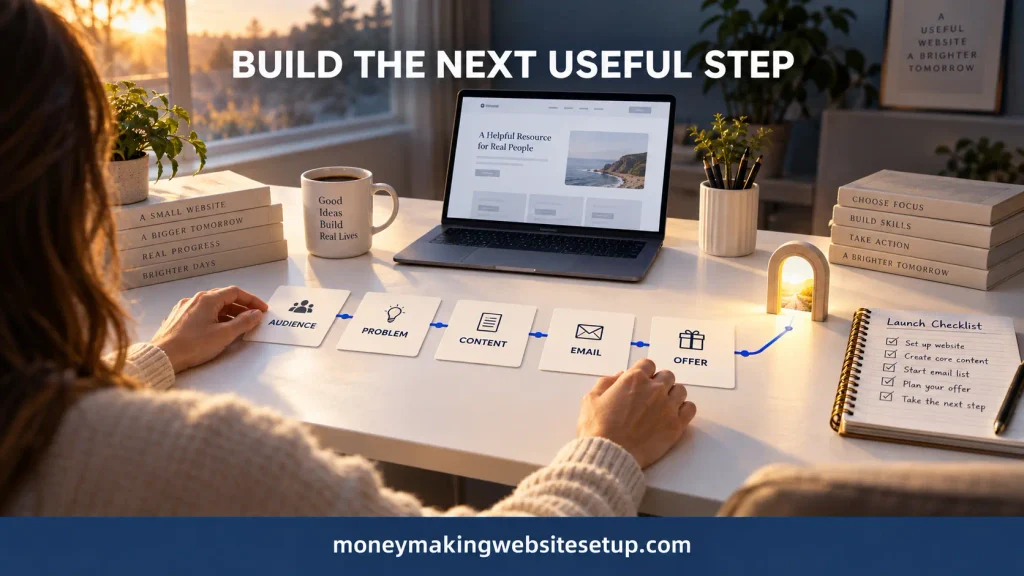
A focused audience → a real problem → helpful content → a relevant solution → respectful follow-up.
This guide walks through that model from the first decision to the first measurable signals. It is written for beginners who want an online business they can actually maintain—not a complicated collection of software they will abandon when the novelty wears off.
Quick answer: What is the simplest money-making website setup?
The simplest money-making website setup is a focused site built for one audience and one problem. It needs a domain, reliable hosting or a website platform, a clear homepage, useful content, contact and legal pages, one conversion path, and a relevant way to earn revenue. The most accessible beginner models are affiliate marketing, service lead generation, and an email list connected to a product or service.
The process looks like this:
- Choose a narrow audience and a problem they genuinely want to solve.
- Select one realistic online business model.
- Register a suitable domain and launch the technical foundation.
- Publish the essential pages before adding decorative extras.
- Create a useful free resource or a clear inquiry path.
- Publish content that matches informational, commercial, and transactional searches.
- Connect the right visitors with an honest offer.
- Watch the data and improve the point where the journey breaks.
You can launch the structure quickly. Meaningful organic traffic and reliable income usually take longer. A simple setup creates a credible route to earning; it cannot promise instant results.
What makes a website an online business?
A website becomes an online business when it does more than sit on the internet with a nice design. It attracts a defined group of people, helps them make progress, and gives them a way to take a valuable next step.
That step may lead to a commission, a client, a sale, a referral, or an email relationship that continues beyond the first visit. The technology delivers the experience. The business model determines why the experience exists.
Here is the relationship in plain terms:
| Business element | What the visitor sees | What it can lead to |
|---|---|---|
| Audience | Homepage language, navigation, and categories | The right people recognize themselves |
| Problem | Guides, tutorials, comparisons, and FAQs | Search visibility and trust |
| Solution | Offer page, recommendation, service, or product | Commercial action |
| Relationship | Email opt-in, inquiry form, or account | Permission to continue the conversation |
| Measurement | Analytics and conversion tracking | Better decisions over time |
Every important page should have a job. A beginner’s guide may answer a question and lead to a deeper tutorial. A comparison page may help someone choose between two tools. A landing page may collect an email address. A service page may turn interest into a conversation.
Without that relationship between pages, visitors are left wandering through a library with no librarian. With it, the next step feels like a natural continuation of the question that brought them there.
Start with the business model, not the website design
Design is seductive because it gives you something visible immediately. You can spend an evening adjusting colors and wake up with a site that looks more finished than it did the night before.
The business model is quieter. It asks harder questions. Who is this for? What problem is valuable enough to solve? Where does the money come from?
Answer those first. A beautiful homepage cannot rescue an unclear offer.
Affiliate marketing websites
An affiliate website helps people understand a topic and choose products or services that may solve a related problem. If a visitor purchases through a tracked referral, the website owner may receive a commission.
The model appeals to beginners because there is no inventory to store, package, or ship. You do not have to manufacture the product or build customer support from scratch. Your responsibility is different: the content must be useful, the recommendation must be relevant, and the limitations must be stated honestly.
Affiliate links are most natural on comparison, evaluation, and transactional pages—places where a reader is already deciding what to use. They do not need to be forced into every informational guide. On a purely educational article, a clean explanation and a relevant internal link may serve the reader better than a row of promotional buttons.
Service and lead-generation websites
A service website turns expertise into a clear deliverable. It explains who you help, what you do, what problem you solve, and how someone can contact you.
A lead-generation site takes a slightly different route. It attracts people with a specific need and passes qualified inquiries to a service provider, sometimes in exchange for a fee or referral payment.
This model can produce meaningful revenue from fewer visitors because one good client may be worth more than many low-intent clicks. The price of that advantage is responsibility: the service must be real, the promise must be specific, and inquiries need a prompt response.
Learn more: Free Lead Generation Website Setup: The Exact System That Turns a New Website Into a Lead-Capturing Machine
Digital products and email-based businesses
Here, the website begins the relationship and the email list carries it forward. Visitors discover useful content, receive a free resource, and later encounter a paid guide, template, course, membership, or other solution.
The attraction is ownership. You are not relying entirely on one search result or one platform. You are building a permission-based channel through which you can continue helping people.
The work is also more personal. The product has to be good. Delivery has to function. Questions need answers. A digital product is not passive simply because it is downloadable.
How to choose the right model
| If your priority is… | A sensible starting point is… | What it asks of you |
|---|---|---|
| Building a long-term content asset | Affiliate content | Patience, useful publishing, and trust |
| Earning from fewer, higher-value visitors | Services or lead generation | A clear deliverable and reliable follow-up |
| Owning more of the customer relationship | Email and digital products | Useful expertise and fulfillment |
| Avoiding inventory and shipping | Affiliate or digital products | Audience fit and credibility |
| Starting with skills you already have | A service website | A narrow, understandable offer |
You do not need to choose every path at once. One working route is more valuable than three unfinished ones.
Step one: Choose a narrow audience and a valuable problem
“Make money online” sounds large, but it is not yet a business direction. It is a cloud of possibilities. To turn it into something useful, give it a person, a situation, and an outcome.
Try this sentence:
I help [specific type of person] achieve [specific outcome] when they are struggling with [specific problem].
For example:
I help beginners set up a simple website and understand how content, email, and relevant offers can work together to create an online income pathway.
That sentence may look modest. That is its strength. It gives you a boundary. It tells you which subjects belong on the site and which ones do not.
Use the three-test topic filter
Before committing months of work to a topic, place it through three practical tests.
Test one: Do people actively look for help?
Look for the questions people ask when they are stuck, curious, comparing options, or close to taking action. In this subject, that language may include:
- how to set up a website
- simple website for beginners
- how to make money with a website
- best website model for a beginner
- how to build an email list
- affiliate website setup
- how to start an affiliate marketing website with little money
The goal is not to stuff a spreadsheet with synonyms. It is to hear the audience’s vocabulary. “How do I start?” carries a different emotional temperature from “Which platform is best?” and both deserve different content.
Test two: Does the problem have emotional weight?
People rarely want a website for its own sake. They may want more independence, a flexible side income, control over their schedule, or the quiet satisfaction of proving that they can build something without waiting for permission.
Good content respects both layers. It answers the practical question while recognizing the feeling underneath it: confusion, urgency, hope, embarrassment, or the fear of wasting another month on the wrong idea.
Test three: Is there a credible solution?
Attention alone is not a business. Before building a large content library, identify the solutions that could honestly help the audience. They might be a product, a service, a referral, a training program, or a resource you create yourself.
This is not an invitation to force a sales pitch into an unrelated topic. It is a way to make sure the site’s helpfulness and its revenue path are pointed in the same direction.
Step two: Choose a domain, platform, and hosting foundation
The technical foundation should be boring in the best possible way. It should let you publish, update, back up, and measure the site without turning every small change into a research project.
The best platform is rarely the one with the longest feature list. It is the one you can use consistently.
Choose a domain that supports the topic
A useful domain is easy to remember, easy to spell, and broad enough for the direction you actually intend to pursue. Avoid names that are packed with awkward keywords, difficult punctuation, or promises the site cannot keep.
You do not need a domain that explains the entire business in one breath. It needs to create a stable identity visitors can recognize when they see it again.
Recommended reading: The Silent Asset: How Strategic Domain Names Compound Passive Income for Years (While Others Start From Zero)
Choose a content management system or website builder
A content management system such as WordPress offers control over publishing, design, plugins, content categories, and landing pages. A hosted website builder may feel lighter if you prefer fewer technical decisions.
Compare platforms by asking:
- Can I publish and update content without friction?
- Does the platform support both articles and landing pages?
- Can I connect an email service?
- Can I add analytics and Search Console verification?
- Does the site work well on a phone?
- Can I back up or export what I build?
Do not migrate simply because another platform looks exciting. A migration consumes the same scarce resource that content creation needs: your attention.
Confirm the foundation before publishing
Before sending visitors to the site, check the small things that can quietly undermine trust:
- HTTPS is enabled.
- The mobile layout is readable.
- The navigation menu works.
- The contact form actually sends messages.
- Search-engine indexability is configured intentionally.
- Backups exist.
- Privacy and disclosure information is accessible.
- Visits and conversions can be measured.
None of this is glamorous. That is precisely why it is easy to postpone. Do it once, then return to the work visitors can see.
Step three: Build the essential pages—not every possible page
A new website can become a construction site with no opening day. Pages keep multiplying: a resources page, a team page, a press page, six category pages, and a collection of empty menus.
Build the smallest credible foundation first.
The homepage
The homepage has a few seconds to answer three questions:
- Who is this for?
- What problem does it help with?
- What should I do next?
“Welcome to our website” answers none of them. A clearer promise might be:
Practical website setup and online business guidance for beginners who want a simpler path to earning online.
The rest of the homepage can introduce the major topic clusters, point visitors toward the most useful guides, and offer one primary call to action. It does not need to tell the entire history of the business.
The content hub or blog
The content hub is the living center of a search-focused website. This is where tutorials, definitions, comparisons, case-based explanations, and FAQs gather around the main subject.
Organize it so the relationships are visible. Possible clusters include:
- website setup
- online business models
- affiliate marketing
- email marketing
- SEO and organic traffic
- lead generation
- website monetization
The categories should help a real person choose what to read next. If a category exists only because it contains a keyword, it probably does not deserve a place in the menu.
About and contact pages
The About page explains why the site exists, who it serves, and what kind of guidance visitors can expect. The Contact page gives people a way to ask a question, flag an error, or request clarification.
You do not have to invent a public personality that does not fit your business. A no-face brand can still be transparent. Explain the site’s purpose, make its standards visible, and provide a genuine way to get in touch.
Privacy, terms, and disclosure pages
Your exact responsibilities depend on your location, audience, tools, and business model. Use accurate legal information suited to those circumstances, and keep it easy to find.
If the site uses affiliate relationships, disclose them clearly. If it collects email addresses, explain what happens to that information and provide a legitimate unsubscribe option.
The landing page
A landing page has one main job. It might collect an email address, present a service, or explain a particular offer.
The page should not make visitors choose between six unrelated actions. Remove distractions, state the benefit plainly, and make the next step feel proportionate to the promise.
One clear landing page is enough to begin testing. You can build more after you understand what people respond to.
Step four: Create a simple visitor-to-income path
It is easy to say, “I need more traffic.” A more useful question is:
When the right person arrives, what should happen next?
For a content-led business, the path often looks like this:
Search result → helpful page → relevant next step → email or inquiry → follow-up → offer.
That sequence gives the website a purpose without making every page feel like an advertisement.
Give every important page a next step
The next step should match the reader’s intent.
Someone reading a definition may simply need a deeper beginner guide. Someone comparing solutions may be ready for an evaluation page. Someone who has downloaded a checklist may welcome a short email sequence that helps them use it.
One primary call to action is often enough. When every button competes for attention, the visitor has to perform the sorting that the website should have done.
Offer a useful free resource
A lead magnet gives a visitor a reason to exchange an email address. It should solve a small, immediate problem and point naturally toward the larger solution your business provides.
Useful examples include:
- a website launch checklist
- a 24-hour setup blueprint
- a beginner’s tool comparison
- a content planning worksheet
- a first-commission action plan
- a simple email sequence template
“Free information” is too vague to carry much weight. “The 12-Step Beginner Website Launch Checklist” lets the reader picture what they are receiving and why it may help.
Build a short welcome sequence
The first email should feel like the resource arriving—not like a trapdoor opening beneath it.
- Email one: Deliver the resource and show the reader how to use it.
- Email two: Name the common mistake that makes the first step harder.
- Email three: Walk through a simple process or example.
- Email four: Answer an objection about time, technology, or cost.
- Email five: Introduce the most relevant next step.
Education comes before promotion. A subscriber should feel that the relationship has already produced something useful before being asked to consider an offer.
Recommended guide: How to Make Money With an Email List Without Spamming Your Subscribers: 9 Ethical Monetization Strategies
Step five: Publish content that matches the full search journey
A website becomes discoverable when it answers real questions. It becomes commercially useful when it helps visitors move from uncertainty toward an appropriate decision.
That journey has more than one kind of search.
Informational intent: help people understand
Informational searches are the questions asked before a person feels ready to choose anything:
- What is an online business website?
- How does affiliate marketing work?
- What pages does a new website need?
- Can I make money with a website without selling products?
These articles create understanding. They introduce the site’s vocabulary, perspective, and standards.
Commercial investigation: help people compare
Commercial searches appear when the reader has moved closer to a decision:
- WordPress versus a website builder
- affiliate website versus service website
- best email tools for beginners
- website ideas that cost little to start
Comparison content earns trust by showing tradeoffs. “Best” is rarely a universal verdict. It usually means best for a particular budget, skill level, time horizon, or business model.
Transactional intent: help people act
Transactional searches are closer to a choice, purchase, signup, or inquiry:
- website hosting for a beginner business
- launch an affiliate website
- website setup service
- email funnel template
These pages need a clear offer, credible proof, relevant limitations, and an uncomplicated way to continue. They are also the most natural places for selective affiliate links when the recommendation genuinely matches the decision being made.
Build topic clusters instead of isolated articles
A topic cluster starts with a broad pillar and grows through closely related supporting pages. For this subject, the structure might look like this:
- Pillar: Simple money-making website setup
- Support: How to choose a website business model
- Support: How to create a website that makes money
- Support: How to make money with a website without blogging
- Support: How to make money with a website without selling products
- Support: How to build an email list for an online business
- Support: How long it takes for a new website to make money
The supporting pages should link back to the pillar when the connection helps the reader. The pillar should send readers deeper when a question deserves more room.
This is not a contest to place links everywhere. It is a way to make the site feel like one coherent body of knowledge instead of a pile of unrelated articles.
Remember that one guide can rank for many phrases
People rarely express the same need in exactly the same words. One person searches for “simple money-making website setup.” Another asks how to create a website that makes money without a product. A third wants to know whether an email list is necessary.
A strong guide can serve all three when it covers the underlying concepts naturally: domain, hosting, content management system, landing page, lead magnet, email marketing, affiliate offer, search intent, organic traffic, conversion rate, trust, and online business model.
That is the difference between covering a topic and repeating a phrase.
Use a repeatable article structure
For most search-focused guides, a dependable shape is:
- Answer the main question near the beginning.
- Explain why the question matters.
- Walk through the process.
- Add examples and decision criteria.
- Show mistakes, limitations, and tradeoffs.
- Give the reader a checklist or action plan.
- Answer the questions they are likely to ask next.
- Offer one relevant continuation.
The structure serves the impatient reader who wants a quick answer and the careful reader who wants to understand the reasoning behind it.
Step six: Choose a monetization path that fits the content
Money should appear where the reader’s problem naturally leads to a solution. If an article explains how to choose a website platform, a relevant platform recommendation may make sense. If it helps a local business attract customers, an inquiry path may be appropriate. If it teaches a repeatable process, a template or course may save the reader time.
The question is not, “Where can I insert a link?” It is, “What would genuinely help this person now?”
Affiliate commissions
Affiliate marketing can be a practical starting point because the site can recommend an existing solution. The recommendation becomes stronger when the page explains who the solution suits, who may want an alternative, what it requires, and where its limitations are.
Keep affiliate links selective. They belong most naturally on product comparisons, “best for” pages, buying guides, and other content where visitors are evaluating an option. Informational guides should not be turned into a wall of links merely because links are available.
The disclosure should be clear enough that the reader does not have to hunt for it.
Service revenue
Services can produce meaningful revenue from modest traffic because the value of one qualified client may be substantial. The offer needs edges:
- what you deliver
- who it is for
- how long it takes
- what the client must provide
- what happens after the inquiry
“Online marketing help” feels foggy. “A 60-minute website conversion review with a written action plan” gives the reader something they can understand.
Digital products
Digital products might include checklists, templates, calculators, guides, courses, or memberships. Start with the smallest product that solves a real problem.
A concise worksheet that helps someone complete a task can be more valuable than a huge library of loosely connected lessons. Size is not the same as usefulness.
Email-driven monetization
An email list creates a repeat communication channel, but it does not create permission to send endless promotions. The asset is the relationship: relevant explanations, honest recommendations, useful reminders, and respect for the subscriber’s limited attention.
For many beginners, the website’s job is simply to attract the right person and invite that person to opt in. The deeper monetization can happen in the follow-up sequence, where there is enough room to explain context, answer objections, and introduce a relevant offer without crowding the article itself.
Learn more: Email List Monetization for Beginners: A 30-Day Plan to Turn New Subscribers Into Income
Step seven: Get visitors without making the setup complicated
Traffic is the bridge between the website and the business. It is also where beginners are most likely to scatter their effort across too many channels.
Choose one primary channel first.
Use one primary traffic channel
For a content-driven site, organic search can be the primary channel. That means publishing useful pages, connecting related content with internal links, keeping the technical foundation accessible, and giving search systems time to discover and evaluate the work.
Email and one supporting distribution channel can complement search. The best choice depends on the audience and the way the topic is naturally discussed.
Paid advertising is not required for this model. If it is ever considered, it should be treated as a separate investment decision—not a substitute for a clear page, a relevant offer, or a working conversion path.
Do not confuse publishing with promotion
Publishing creates an inventory of useful answers. Promotion gives those answers a chance to be seen.
A simple rhythm might be:
- publish a genuinely helpful guide
- connect it to related pages
- share one clear insight or visual where the audience is present
- participate in relevant conversations without dropping links indiscriminately
- invite interested readers to continue through the site or email list
The work is quieter than a launch-day burst, but it gives the website more than one chance to be found.
Measure the bottleneck instead of guessing
You do not need a wall of dashboards. You need a few signals that tell you where the journey is losing people.
| Signal | What it may suggest | First improvement to test |
|---|---|---|
| No impressions | Discovery, indexing, relevance, or competition may be limiting visibility | Check accessibility, coverage, topic focus, and internal links |
| Impressions but few clicks | The result may not match the searcher’s need or earn attention | Improve the title, description, and opening promise |
| Clicks but weak engagement | The page may delay or miss the answer implied by the result | Put the direct answer and useful structure earlier |
| Engagement but few opt-ins | The next step may be unclear or poorly matched | Improve the resource and call to action |
| Opt-ins but no sales | The follow-up or offer may not resolve the real objection | Improve relevance, sequencing, and offer fit |
The temptation is to change everything at once: the domain, design, topic, publishing schedule, email sequence, and offer. Resist it. If every variable moves together, the business cannot learn from the result.
A practical 30-day launch plan
Days 1–3: Decide and define
Choose the audience, problem, business model, domain, and primary conversion goal. Write the site’s purpose in one sentence.
If the sentence keeps expanding with “and,” the topic probably needs another round of narrowing.
Days 4–7: Launch the foundation
Set up the platform, hosting, HTTPS, mobile layout, homepage, content hub, About page, Contact page, privacy information, and disclosure information where needed. Create the first landing page or inquiry path.
The point is not visual perfection. It is to make the site real enough that a visitor can understand it and take the next step.
Days 8–14: Publish the first authority cluster
Publish the main guide and several supporting pages around closely related questions. Link them together with descriptive anchor text. Give each page a useful next step.
Do not write five versions of the same article to create the illusion of volume. Build coverage around the reader’s actual journey.
Days 15–21: Add the conversion system
Create the free resource, opt-in form, thank-you page, and welcome sequence. Test everything on a phone as well as a desktop. Submit your own form and confirm that the promised resource arrives.
There is a special kind of disappointment in discovering that a funnel has been collecting nothing because the form was quietly broken. Test it before visitors do.
Days 22–30: Improve and begin distribution
Review the pages for accuracy, clarity, readability, and trust. Connect analytics and Search Console. Share the strongest ideas through one supporting channel. Pay attention to the questions people ask; those questions often contain your next article.
At the end of the month, judge the system by whether it is clear, usable, measurable, and capable of expanding. Revenue matters, but it is not the only early signal worth watching.
How much does a simple money-making website cost?
The exact amount depends on your country, platform, hosting provider, email service, and optional tools. The usual cost categories are:
- domain registration
- hosting or a website-builder subscription
- email delivery if you collect subscribers
- optional design, research, analytics, or productivity tools
The lean version can use one platform, one email system, one primary offer, and free or built-in measurement tools. You do not need to purchase an entire shelf of software before the site has shown you what it needs.
The largest investment is often not software. It is the time required to choose a clear subject, produce useful content, improve weak pages, answer real questions, and remain consistent long enough to gather evidence.
How long does it take for a new website to make money?
There is no honest universal deadline. A website might receive an early inquiry, subscriber, or commission. Consistent organic traffic generally takes longer because visibility depends on discovery, relevance, competition, content quality, site trust, and continued refinement.
The progression often feels less like a switch turning on and more like a room slowly becoming visible:
- Foundation: The site becomes accessible, understandable, and measurable.
- Discovery: Search systems begin finding and evaluating pages.
- Early visibility: Some pages receive impressions and occasional clicks.
- Validation: Certain topics, titles, or offers produce stronger responses.
- Compounding: More relevant pages and internal links create additional entry points.
- Optimization: The business improves click-through rate, opt-ins, conversions, and revenue per visitor.
“No income yet” and “nothing is happening” are not always the same statement. Impressions, indexed pages, relevant visits, subscribers, and thoughtful questions can all be early evidence. They are not revenue, and they should not be presented as revenue, but they help show where the system is moving.
Recommended guide: How Long Does It Take to Make Money From a Website? The Fastest Realistic Path to Your First $100
Mistakes that make a simple website unnecessarily difficult
Choosing a broad topic with no recognizable audience
A site aimed at everyone usually gives no one a strong reason to stay. Narrow the audience or the problem until the homepage, content plan, and offer become easier to describe.
Spending more time on appearance than usefulness
A clean design reduces friction. It does not replace a helpful article, a clear offer, or a working form. Once the site is readable and trustworthy, return to the questions visitors need answered.
Publishing without a business connection
Traffic is not automatically business progress. Each content cluster should support the audience, the problem, and the solution that may eventually help them.
Promoting too aggressively
When every paragraph points toward a product, readers can feel the sales machinery underneath the words. Lead with useful help. Make the recommendation relevant. Keep purely informational guides focused on the reader’s question.
Changing direction before the evidence arrives
New websites often need time to collect search and conversion data. Improve weak pages, but do not abandon a coherent strategy after a few quiet days.
Making income claims that cannot be supported
Avoid guaranteed results, fake urgency, exaggerated screenshots, and vague promises. Clear expectations may produce fewer impulsive clicks, but they attract better-fit readers and protect the site’s credibility.
Trust signals that strengthen the entire website
Trust is not a decorative layer added after the business is finished. It is the feeling that lets a visitor continue when they could easily return to the search results.
Strengthen it by:
- explaining the site’s purpose and audience
- showing how recommendations are evaluated
- disclosing affiliate relationships
- correcting or updating outdated information
- using original examples, screenshots, tests, or calculations when available
- linking to authoritative sources for changing or technical claims
- providing a genuine contact method
- avoiding fake testimonials and artificial authority signals
- making privacy and email expectations understandable
You do not need to become a public-facing personality to build a credible site. A no-face business can still be clear, accountable, useful, and honest about how it earns money.
Frequently asked questions
What is the easiest website to make money with?
That depends on what you already know and how you want to work. Affiliate content is often simple to launch because you can recommend existing solutions. A service website may reach revenue faster with fewer visitors. A digital-product site offers more control but asks you to create and support something useful.
Can I build a money-making website without coding?
Yes. Website builders and content management systems allow beginners to launch without writing code. You still need to understand the basics of pages, menus, forms, email delivery, analytics, search visibility, and privacy.
Do I need my own product?
No. You can begin with affiliate recommendations, services, referrals, or lead generation. Creating your own product later may give you more control and margin, but it is not required to start an online business website.
Can a website make money without paid advertising?
Yes. Organic search, email, social distribution, relevant communities, partnerships, and direct referrals can all bring visitors. Organic methods usually ask for consistent work and patience instead of an advertising budget.
Learn more: Simple Money-Making Website Setup for Earning Commissions Online Without Paid Ads: The Trust-First System
How many pages does a new website need?
There is no magic number. Begin with the essential foundation and a focused cluster of genuinely useful content. Ten relevant pages can do more for a new site than one hundred thin or unrelated pages.
Should I start one website or several?
For most beginners, one focused website is easier to understand, maintain, improve, and turn into a recognizable authority. Several sites can divide attention before the first system has produced useful evidence.
What should I do if my website has no traffic yet?
First check accessibility and indexability. Then review the topic focus, search intent, content quality, internal links, titles, and distribution. Keep publishing useful pages while watching impressions and clicks. A quiet beginning is a signal to investigate, not automatic proof that the model cannot work.
Products / Tools / Resources
Your stack does not need to look impressive. It needs to remove friction between an idea and the next useful action.
- A domain and reliable hosting: Choose a provider that makes publishing, backups, HTTPS, and basic maintenance straightforward. Avoid paying for advanced features before you need them.
- WordPress or a beginner-friendly website builder: Use the platform that lets you publish consistently, create landing pages, connect email, and maintain a mobile-friendly site.
- An email marketing service: Look for forms, automated sequences, delivery of free resources, consent management, and a clear unsubscribe process. The important feature is not the longest feature list; it is dependable follow-up.
- Google Search Console and analytics: Use them to understand discovery, impressions, clicks, landing pages, and conversions. They are more useful than guessing what visitors may be doing.
- A simple planning system: A spreadsheet, calendar, or content board is enough to map topic clusters, search intent, internal links, publication dates, and page updates.
- A website launch checklist or 24-hour blueprint: A concise checklist can keep the setup moving when technical details begin to blur together. Use it to finish the foundation, not to postpone publishing.
- A source and disclosure file: Keep notes on product evaluations, prices, tests, citations, affiliate relationships, and update dates. This makes future revisions faster and recommendations easier to trust.
Start with the few resources that help you publish, collect permission to follow up, and learn what the audience needs next. Add everything else only when the work itself gives you a reason.