
The internet has a habit of making temporary things look permanent.
A new platform catches fire. A software category explodes. An affiliate offer starts paying unusually high commissions. Suddenly everyone seems to be talking about the same opportunity, and for a while it feels as if you’ve stumbled onto the thing that could keep paying forever.
Then the market shifts.
The platform cools down. The product disappears. The commission structure changes. Search behavior moves somewhere else. What looked like a sturdy business turns out to have been standing on rented ground.
That’s why the smartest question in affiliate marketing isn’t:
“Which niche pays the highest commission right now?”
It’s:
“Which market will people still care about years from now?”
That question changes everything.
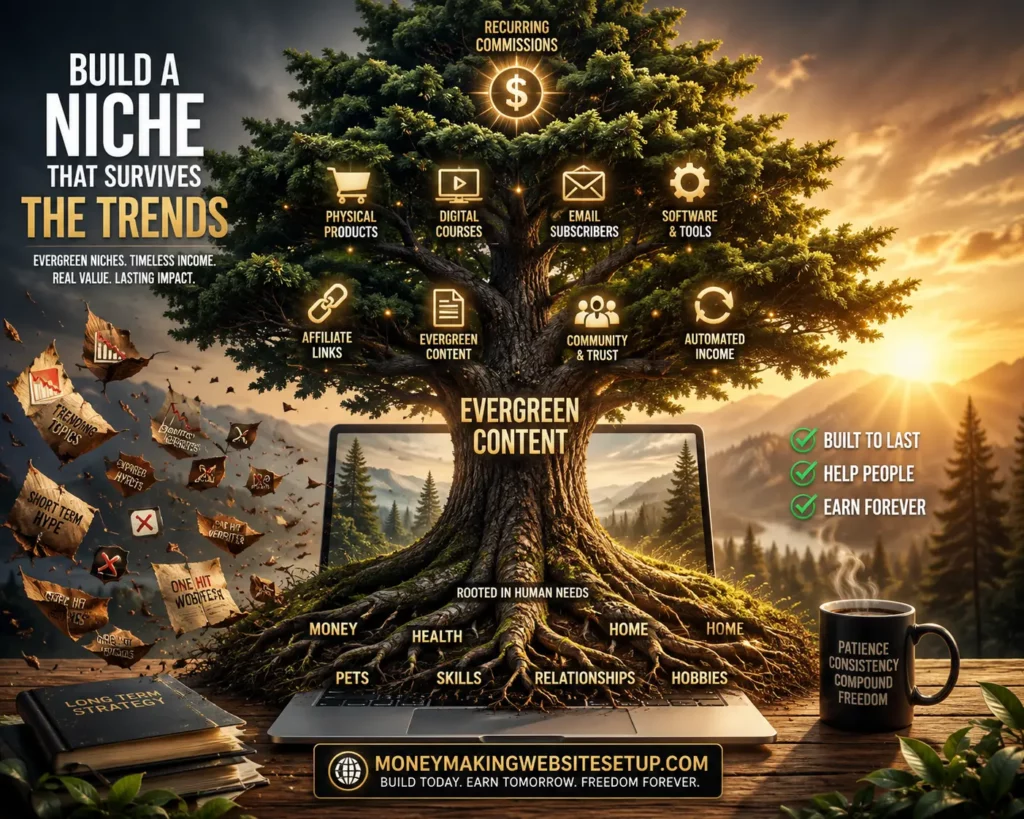
Because if you’re building a website for the long haul, you don’t want to anchor it to a product. You want to anchor it to a human need.
People will still want to save money.
They’ll still want to get healthier.
They’ll still improve their homes, care for their pets, learn new skills, raise families, build businesses, pursue hobbies, and solve problems that refuse to go out of fashion.
Products change fast.
Human motivations don’t.
And that is the real advantage behind the best evergreen affiliate marketing niches.
What Are the Best Evergreen Affiliate Marketing Niches?
The best evergreen affiliate marketing niches are markets built around needs, desires, problems, and interests that remain relevant year after year.
Strong examples include:
- Personal finance
- Health and fitness
- Home improvement and DIY
- Woodworking
- Pets and pet care
- Relationships and dating
- Parenting and family
- Education and online learning
- Career development
- Beauty and personal care
- Hobbies and crafts
- Food and cooking
- Gardening
- Software and technology
- Website building and online business
What makes these niches durable isn’t that every product inside them lasts forever.
Most won’t.
A software tool may disappear.
A piece of fitness equipment may be replaced by a newer model.
A hosting company may change its pricing.
A woodworking tool brand may lose popularity.
But the underlying reason people enter the market is still there.
Someone will still want to build a website.
Someone will still want to lose weight.
Someone will still want to make a table.
Someone will still need help training a dog.
Someone will still want to organize their finances.
The products rotate.
The need survives.
That distinction is what separates a website built around a temporary opportunity from one that can keep finding new readers years after it was launched.
What Makes an Affiliate Marketing Niche Truly Evergreen?
An evergreen affiliate marketing niche is a market where demand doesn’t depend on a short-lived trend.
That doesn’t mean search volume remains perfectly flat. It doesn’t mean every topic stays current forever. It doesn’t even mean the same products will still exist ten years from now.
It means the core problem or desire keeps coming back.
Gardening is a simple example.
The tools change. New products appear. Certain techniques become more popular. Some recommendations need updating.
But people keep asking:
- How do I grow tomatoes?
- Why are my plants turning yellow?
- What’s the best soil for vegetables?
- How do I start a garden?
- Which tools do I actually need?
- How do I keep weeds under control?
Those questions aren’t attached to one year.
They’re attached to gardening itself.
That’s evergreen demand.
Recommended reading: The Evergreen Authority Engine: How One Content Website Can Generate Traffic, Leads, and Passive Income for the Next Decade
Evergreen Does Not Mean You Can Forget About the Content
This is where people sometimes get the wrong idea.
They hear “evergreen” and imagine publishing an article once, walking away, and collecting commissions indefinitely.
That’s not how durable websites work.
Some topics need very little maintenance.
A woodworking guide about basic joinery might remain useful for 25+ years.
A guide comparing website hosting services probably won’t.
The market can be evergreen while the content still needs updates.
The key question is not:
“Will this article look exactly the same ten years from now?”
It’s:
“Will people still care about the problem this article solves?”
That is the more useful test.
The 10-Year Test: Would This Niche Still Matter a Decade From Now?
Before you choose a niche, mentally remove the excitement surrounding today’s products.
Forget the current affiliate payouts.
Forget the trendy software.
Forget the “hot niche” lists.
Imagine the calendar has jumped forward ten years.
Then ask these five questions.
Will People Still Have This Problem or Desire?
Start here.
If the niche depends on something people will probably stop caring about, the foundation is shaky.
If it revolves around a permanent human concern, the picture changes.
People are unlikely to stop caring about:
- money,
- health,
- relationships,
- careers,
- family,
- pets,
- their homes,
- learning,
- hobbies,
- convenience,
- security,
- confidence,
- or personal improvement.
The details change.
The emotional core doesn’t.
That’s exactly what you want.
Will New People Keep Entering the Market?
This is one of the most powerful characteristics of an evergreen niche.
Take beginner woodworking.
A person may start as a complete novice, learn the basics, build a few projects, gain confidence, and eventually stop reading beginner articles.
That doesn’t mean the beginner market disappeared.
Someone else is buying their first saw tomorrow.
Someone else is setting up a garage workshop next month.
Someone else is wondering whether a jigsaw or circular saw should be their first power tool.
New audiences replace old ones.
The same thing happens in parenting, pet ownership, investing, gardening, cooking, website building, fitness, and dozens of other markets.
Evergreen niches renew themselves because life keeps creating beginners.
Are People Already Spending Money?
Traffic by itself isn’t enough.
You can find topics with enormous interest but weak commercial intent.
Affiliate marketing works best when people don’t just read about the subject—they spend money inside it.
Strong evergreen markets usually have several kinds of products or services:
- physical products,
- digital products,
- courses,
- subscriptions,
- software,
- memberships,
- accessories,
- upgrades,
- services,
- and replacements.
That matters because the deeper the commercial ecosystem is, the less fragile your business becomes.
You aren’t relying on one product.
You’re building around an audience that buys many different things.
Could You Write About This for Years Without Forcing It?
This is where some niche ideas quietly fall apart.
At first, everything looks promising.
You find 15 or 20 good keywords.
You publish them.
Then the site starts feeling thin.
A durable niche should unfold naturally into layers.
Take woodworking.
You don’t just have “woodworking.”
You have:
Tools → hand tools → power tools → saws → drills → routers → measuring tools.
Then:
Projects → furniture → storage → outdoor builds → beginner projects → gifts → workshop projects.
Then:
Skills → joinery → cutting → sanding → finishing → measuring → safety.
Then:
Workshops → benches → lighting → dust collection → tool storage → small-space setups.
Now you’re not searching desperately for article ideas.
You’re navigating an entire topic ecosystem.
That’s the kind of depth that can support a serious content site.
Would the Website Still Make Sense If One Affiliate Program Vanished?
This question can save you years of frustration.
Affiliate programs are not permanent.
Companies change commissions.
They close programs.
They alter tracking windows.
They stop selling certain products.
They get acquired.
They disappear.
If your entire website exists because one merchant currently pays well, you’re not really building around a niche.
You’re building around an offer.
That’s fragile.
A stronger model works the other way around:
Audience first. Problems second. Content third. Monetization after that.
If one offer disappears, you still have the audience.
And the audience is the real asset.
1. Personal Finance and Money Management
Money worries don’t go away because the year changes.
People will always want to understand where their money is going, how to save more of it, and how to create a little breathing room between income and expenses.
That creates enormous evergreen demand.
Someone may begin with a simple question:
“How do I create a monthly budget?”
Months later they might search:
“Best budgeting app for couples.”
Later:
“How do I start investing?”
Then:
“Best investment platforms for beginners.”
The person changes.
The search intent changes.
The commercial opportunity changes.
But it’s still the same market.
Evergreen Content Opportunities in Personal Finance
A finance-focused website can potentially cover:
- budgeting,
- saving,
- debt,
- banking,
- investing,
- retirement,
- credit,
- insurance,
- taxes,
- family finances,
- financial software,
- and side income.
That gives you informational content, commercial comparisons, and product-oriented searches in the same ecosystem.
Why Personal Finance Can Remain Relevant for Decades
The tools will change.
Regulations will change.
Banks will change.
Financial products will change.
But the desire for financial security is unlikely to disappear.
That makes the market exceptionally durable.
It also makes it demanding.
Personal finance falls into Your Money or Your Life (YMYL) territory, where sloppy advice can cause real harm.
Accuracy matters.
Transparency matters.
Sources matter.
Trust isn’t optional.
And in a niche this competitive, pretending to know more than you do is rarely a sustainable strategy anyway.
2. Health and Fitness
Health works for the same reason money does.
The surface details change.
The underlying desire remains.
Ten years from now, people may use completely different fitness apps and wearable devices. But they’ll still be asking things like:
- How do I get stronger?
- How do I lose weight?
- How do I start exercising?
- What’s the best workout for beginners?
- What equipment do I need at home?
The niche stays alive because it connects to powerful motivations:
- confidence,
- appearance,
- energy,
- mobility,
- longevity,
- independence,
- and self-improvement.
Affiliate Opportunities in Health and Fitness
Depending on the audience, a site could naturally cover:
- exercise equipment,
- training programs,
- fitness apps,
- clothing,
- accessories,
- books,
- educational products,
- and subscription services.
The niche also narrows cleanly.
Fitness → home fitness → beginner home fitness → strength training at home.
Or:
Fitness → running → beginner running → equipment → training → recovery.
That kind of narrowing makes a site easier for both readers and search engines to understand.
The Hard Part Is Trust
Health content comes with responsibility.
Topics involving injuries, medical conditions, treatments, supplements, and diagnoses need extra care.
A commission is never worth damaging trust.
And trust is what keeps an evergreen website useful long after the first rankings arrive.
3. Home Improvement and DIY
Homes generate problems almost automatically.
Something breaks.
A room needs repainting.
Storage runs out.
Furniture gets worn.
A new homeowner realizes that every wall, floor, cabinet, faucet, shelf, and hinge can eventually demand attention.
That’s what makes home improvement such a strong evergreen affiliate marketing niche.
The demand is built into ordinary life.
A Huge Web of Content Opportunities
A home improvement site can branch into:
- repairs,
- renovation,
- painting,
- flooring,
- storage,
- organization,
- tools,
- furniture,
- outdoor spaces,
- workshops,
- maintenance,
- materials,
- and DIY projects.
And those topics connect naturally.
A person reading about shelving may also need:
- a drill,
- drill bits,
- anchors,
- screws,
- a level,
- a stud finder,
- measuring tools,
- or storage ideas.
The informational content and the commercial intent often sit inches apart.
That’s useful because the products don’t have to be forced into the article.
They belong there.
4. Woodworking
Woodworking has a quality that makes it unusually sticky.
People don’t always arrive because they’re solving a problem.
Often they arrive because they want to make something.
A table.
A bench.
A cabinet.
A toy box.
A bookshelf.
Maybe just something solid enough to stand back from afterward and think:
I built that.
That feeling matters.
It’s the psychology of mastery.
Why Woodworking Is So Evergreen
Woodworking overlaps with:
- DIY,
- home improvement,
- furniture,
- tools,
- craftsmanship,
- creative hobbies,
- self-reliance,
- and practical education.
The commercial ecosystem is just as broad.
A woodworking site can naturally connect readers with:
- hand tools,
- power tools,
- workshop equipment,
- plans,
- safety gear,
- finishing supplies,
- measuring tools,
- storage systems,
- books,
- courses,
- and accessories.
Beginners Keep Entering the Niche
This is one of woodworking’s biggest strengths.
There will always be someone asking:
- Which tools should I buy first?
- What’s the easiest project to build?
- Which wood is best for beginners?
- How do I cut wood straight?
- Do I need a table saw?
- How do I set up a small workshop?
Those searches don’t disappear when one person becomes experienced.
Another beginner takes their place.
5. Pets and Pet Care
Pet owners don’t just buy products.
They worry.
They compare.
They second-guess themselves.
They want to know whether their dog is eating the right food, whether the new behavior is normal, whether that toy is safe, whether the crate is too small, whether the scratching means something.
That emotional involvement makes the pet niche unusually durable.
Evergreen Pet Content
A pet site might cover:
- feeding,
- training,
- grooming,
- toys,
- exercise,
- beds,
- crates,
- travel,
- accessories,
- behavior,
- breed traits,
- puppies,
- kittens,
- senior pets,
- and household routines.
There is also recurring purchase behavior.
Food runs out.
Toys break.
Animals grow.
Needs change.
Owners discover new problems.
So the same audience can return to the market over and over.
Why Micro-Niches Work Well Here
“Pets” is too broad for many new publishers.
But narrowing creates useful identity.
For example:
Dogs → large dogs → training and equipment.
Or:
Cats → indoor cats → enrichment and care.
Now the site feels specific.
The reader can recognize themselves immediately.
And that matters more than many people realize.
6. Relationships and Dating
Technology changes the way people meet.
It doesn’t remove the desire to be loved.
That’s why relationship niches remain evergreen at a level deeper than apps, websites, or platforms.
People will continue to search for help with:
- dating,
- confidence,
- communication,
- marriage,
- conflict,
- breakups,
- intimacy,
- and emotional connection.
The underlying triggers are powerful:
belonging, acceptance, companionship, desire, and fear of rejection.
Those aren’t passing trends.
They’re part of being human.
Monetization Possibilities
Depending on how the site is positioned, affiliate opportunities may include:
- dating platforms,
- relationship books,
- online courses,
- communication tools,
- memberships,
- apps,
- and educational resources.
The difficulty is tone.
Relationship content often reaches people when they’re vulnerable.
Overly aggressive selling can destroy trust instantly.
In this niche, subtlety isn’t just nicer writing.
It’s better business.
7. Parenting and Family
Parenting is one of the clearest examples of a self-renewing market.
Every year, new people encounter problems that millions of parents before them have already faced.
The problem isn’t new.
They are.
A new parent may spend weeks learning about newborn sleep, bottle feeding, strollers, car seats, baby monitors, or nursery furniture.
A few years later, those topics may no longer matter to them.
But another family has just entered the same stage.
Life Stages Create Endless Content Paths
The journey looks something like:
Pregnancy → newborn → baby → toddler → preschool → school years → teenage years.
Around each stage are clusters involving:
- sleep,
- feeding,
- clothing,
- toys,
- furniture,
- education,
- safety,
- activities,
- travel,
- organization,
- and family finances.
The commercial ecosystem evolves as the child grows.
That gives the niche unusual longevity.
And because many topics affect children’s health and safety, accuracy and responsible sourcing matter enormously.
8. Education and Online Learning
Human beings have always paid to learn.
The classroom changed.
The tools changed.
The delivery changed.
The motivation didn’t.
People learn because they want something on the other side of the skill.
A better job.
More money.
Confidence.
Creative freedom.
Independence.
Recognition.
Sometimes simply the satisfaction of knowing how to do something they couldn’t do yesterday.
Affiliate Opportunities in Education
Depending on the subject, the niche can connect naturally with:
- online courses,
- books,
- software,
- learning platforms,
- tutoring,
- certifications,
- subscriptions,
- educational equipment,
- and productivity tools.
Career Learning and Hobby Learning Behave Differently
Someone learning Excel for work may be motivated by promotion.
Someone learning guitar may want expression.
Someone learning woodworking may want mastery.
Someone learning a new language may want connection.
Different motivations.
Same underlying mechanism:
transformation through skill.
That’s what gives education its evergreen quality.
9. Career Development
Nobody knows exactly what work will look like ten years from now.
But people will still want better opportunities.
They’ll want:
- higher salaries,
- promotions,
- better jobs,
- career changes,
- remote work,
- new skills,
- more productivity,
- and greater control over how they earn a living.
Career content naturally overlaps with:
- education,
- software,
- productivity,
- personal finance,
- and entrepreneurship.
Commercial Opportunities
Depending on the audience, relevant products and services may include:
- courses,
- certifications,
- resume tools,
- books,
- productivity software,
- job platforms,
- business tools,
- and educational subscriptions.
The strongest career sites often don’t solve one isolated problem.
They help readers move.
A person arrives wanting a better resume.
Then they need interview advice.
Then salary negotiation.
Then skills training.
Then productivity tools.
That’s how one search becomes a relationship.
10. Beauty and Personal Care
Beauty trends change constantly.
The human motivations beneath them do not.
People continue to care about:
- grooming,
- skincare,
- haircare,
- appearance,
- confidence,
- identity,
- and personal routines.
That creates two attractive characteristics for affiliate marketers.
First, people search for advice.
Second, many products need to be bought again.
Repeat Purchases Change the Economics
Compare two buyers.
One purchases a durable power tool and keeps it for ten years.
Another buys skincare products every few months.
The first purchase may be larger.
The second market may create far more repeat transactions.
That’s why evaluating an affiliate niche only by commission size can be misleading.
Customer behavior matters just as much.
Sometimes more.
11. Hobbies With Expensive Equipment
Enthusiasts are interesting customers because they rarely stay at the beginner level forever.
A casual photographer may begin with a phone.
Then comes a camera.
Then another lens.
Then a tripod.
Then lighting.
Then editing software.
Then bags.
Then storage.
Then courses.
The same pattern appears across many hobbies.
Evergreen Hobby Niches Worth Exploring
- Woodworking
- Photography
- Music
- Sewing
- Crafts
- Camping
- Hiking
- Fishing
- Gardening
- Painting
- Collecting
- Cooking
Many of these markets contain a natural progression:
beginner → intermediate → advanced.
And purchasing often grows as skill grows.
That’s attractive because the audience becomes more valuable as they become more engaged.
Hobby niches also tend to generate strong dwell time.
People don’t just visit because they have to.
They genuinely enjoy the subject.
That makes them more likely to read deeply, explore related guides, return later, and join an email list.
12. Food and Cooking
People have to eat.
It doesn’t get much more evergreen than that.
Still, the niche has an interesting challenge.
Not every food search has strong commercial intent.
Someone looking for a pasta recipe may not be ready to buy anything.
Someone comparing stand mixers probably is.
Understanding that distinction changes how you structure the site.
Informational Food Content
Examples include:
- recipes,
- cooking techniques,
- substitutions,
- meal planning,
- storage,
- preparation,
- and beginner guides.
Commercial Food Content
Examples include:
- cookware,
- kitchen knives,
- mixers,
- air fryers,
- specialty appliances,
- utensils,
- meal services,
- books,
- and cooking courses.
The opportunity sits in the bridge between the two.
A reader learning to bake bread eventually needs equipment.
A reader learning espresso may eventually want a machine.
Someone struggling with knife technique may begin comparing better knives.
The useful content comes first.
The purchase often arrives later.
13. Gardening and Sustainable Living
Gardening is evergreen without being perfectly consistent.
Spring brings one wave of searches.
Summer brings another.
Autumn changes the questions.
Winter shifts the focus again.
But the topic doesn’t disappear.
It circles back.
Year after year.
Evergreen Gardening Content
A gardening website can cover:
- vegetable gardens,
- flowers,
- soil,
- composting,
- raised beds,
- greenhouses,
- irrigation,
- pest management,
- indoor gardening,
- landscaping,
- tools,
- seed starting,
- and container gardening.
The emotional motivations are varied too.
Some people garden for beauty.
Some for food.
Some for self-reliance.
Some for relaxation.
Some simply love watching something grow because they put it there.
That emotional depth gives the niche more staying power than a product-based analysis would suggest.
14. Technology and Software
Technology sounds like the least evergreen niche imaginable.
And in one sense, it is.
Devices become obsolete.
Software interfaces change.
Products vanish.
Entire platforms disappear.
Yet the problems technology solves are remarkably stable.
People will continue to need ways to:
- communicate,
- organize information,
- protect data,
- build websites,
- manage businesses,
- create content,
- store files,
- automate work,
- analyze information,
- and collaborate.
That’s where the evergreen opportunity sits.
The SaaS Advantage
Software-as-a-Service products can be especially attractive because some affiliate programs offer recurring commissions.
A customer pays monthly or annually.
Depending on the affiliate terms, the commission may continue while the customer remains subscribed.
That creates a different business model from a one-time retail sale.
The Price of That Opportunity Is Maintenance
Technology content ages quickly.
A woodworking guide can sometimes survive for years untouched.
A software tutorial may become outdated after an interface update.
Screenshots change.
Menus move.
Features disappear.
Pricing changes.
So technology may offer strong commercial potential, but it usually demands more upkeep.
Evergreen demand does not mean evergreen documentation.
15. Website Building, Online Business, and Affiliate Marketing
People have always looked for ways to create more independence.
The internet simply gave that desire a new form.
Someone today may want:
- a side income,
- a content business,
- an affiliate website,
- an online store,
- a service business,
- or a simple website that earns something on the side.
Ten years from now, the tools may be completely different.
The questions probably won’t be.
- How do I build a website?
- What should I build it around?
- How does a website make money?
- How do I get traffic?
- How does affiliate marketing work?
- Which tools do I need?
- Can a beginner do this?
- How much will it cost?
- How long does it take?
The Commercial Ecosystem Is Deep
This niche can include:
- domains,
- hosting,
- website builders,
- WordPress tools,
- email marketing,
- SEO software,
- analytics,
- productivity platforms,
- courses,
- advertising services,
- business software,
- and affiliate programs.
Many are subscription products.
That opens the door to recurring commissions.
Trust Is the Competitive Advantage
Income-related niches are crowded with exaggerated claims.
That creates a strange opportunity.
You can stand out by being restrained.
Explain tradeoffs.
Talk about uncertainty.
Avoid guaranteed outcomes.
Make the guide useful even if the reader never buys anything.
That doesn’t sound as exciting as a promise of overnight income.
It is far more believable.
And over a ten-year horizon, credibility compounds.
The Real Opportunity Is Often an Evergreen Sub-Niche
Broad markets are attractive because they seem limitless.
They can also be vague.
A site called “Fitness Everything” doesn’t tell the reader much.
A site for beginners trying to build strength at home does.
That’s the power of narrowing.
A simple niche formula is:
Evergreen market + specific audience + persistent problem = focused evergreen niche.
For example:
Gardening + apartment dwellers + limited space
becomes:
Small-space gardening.
Or:
Woodworking + beginners + limited workshop space
becomes:
Beginner woodworking for small workshops.
Or:
Website building + beginners + technical anxiety
becomes:
Simple website setup for non-technical beginners.
The market is still large.
But the positioning becomes sharper.
A visitor can recognize themselves immediately.
And that quiet feeling of “this is for someone like me” is one of the strongest forces in content marketing.
How to Know Whether an Evergreen Niche Can Actually Make Money
A niche can be evergreen and still be a poor affiliate business.
So after you’ve confirmed long-term demand, look at the economics.
Follow the Search Journey From Question to Purchase
Don’t evaluate a niche by looking at one keyword.
Look at the whole path.
Informational Intent
These searches are about learning:
- how to start woodworking
- how to create a budget
- how to grow tomatoes
- how affiliate marketing works
Commercial Investigation
Now the reader is comparing options:
- best saw for beginners
- best budgeting apps
- best fertilizer for tomatoes
- best email marketing software
Transactional Intent
The person is closer to acting:
- buy woodworking plans
- budgeting app free trial
- website hosting discount
- online course signup
A strong evergreen affiliate niche usually contains all three layers.
That matters because not every reader arrives ready to buy.
Some need education first.
Why Commission Percentage Can Fool You
Imagine one offer pays $200 per sale.
Another pays $20 recurring.
Which is better?
You can’t know from those numbers alone.
You would also need to understand:
- conversion rate,
- customer retention,
- refund rate,
- cookie duration,
- traffic intent,
- payout terms,
- recurring conditions,
- average customer value,
- and whether the product fits naturally with the content.
A big commission attached to an awkward offer can be worse than a smaller commission attached to something readers genuinely need.
The affiliate payout isn’t the business.
The audience-product fit is.
Look for More Than One Way to Monetize
One of the easiest ways to make an affiliate website fragile is to depend on a single offer.
Strong niches give you alternatives.
For example:
Woodworking
→ tools
→ plans
→ courses
→ accessories
→ workshop equipment
Online business
→ hosting
→ email software
→ website tools
→ education
→ subscriptions
Pets
→ food
→ toys
→ training
→ grooming
→ subscriptions
If one merchant disappears, you still have the reader.
That’s the part that matters.
The Content Moat: Why a Library Beats a Lone “Money Page”
Affiliate marketers love the idea of the perfect keyword.
Find it.
Rank for it.
Drop in an affiliate link.
Collect commissions.
Sometimes that works.
But a durable website becomes more powerful when each guide strengthens something larger.
Think:
audience → problems → topic clusters → useful content → internal links → trust → opt-in → relevant solutions.
Now every article has context.
A guide about choosing a woodworking workbench doesn’t have to stand alone.
It can lead naturally to:
- workbench plans,
- bench vises,
- workshop layouts,
- lumber selection,
- beginner tools,
- measuring techniques,
- storage,
- and safety.
One search becomes the doorway to several more useful pages.
Internal Links Should Feel Like the Next Thought
The simplest internal linking rule is also the best one:
What will this reader probably need next?
Link there.
If someone is reading about beginner woodworking tools, point them toward a simple first project.
If they’re learning how to start a website, point them toward choosing a niche.
If they’re reading about raised garden beds, connect them to soil, irrigation, and planting guides.
That helps search engines understand relationships between topics.
More importantly, it helps humans keep moving.
Informational Content Can Make Money Without Selling Immediately
Not every article has to close the sale.
In fact, forcing every page to behave like a sales page can make the site feel thin and transactional.
Suppose someone searches:
“How do I start woodworking?”
They may not buy anything today.
But they’ve told you something valuable.
They’re interested in woodworking.
If your guide helps them, they may read another.
Then another.
Perhaps they join your email list for a free resource.
A month later they need tools.
Later they want plans.
Then workshop equipment.
The first article wasn’t a failure because it didn’t produce an immediate commission.
It started the relationship.
That matters when you’re thinking in years instead of clicks.
Email Makes Evergreen Traffic More Valuable
Search traffic is powerful.
It is also borrowed.
Google can change rankings.
AI summaries can answer more queries without a click.
Another site can outrank you.
A new search interface can alter traffic patterns completely.
An email subscriber is different.
They made a deliberate decision to hear from you again.
That gives a content site another layer of durability.
A simple evergreen funnel might look like:
Search query → useful guide → relevant opt-in → email relationship → helpful follow-up → appropriate affiliate recommendation.
The article doesn’t have to sell everything.
Sometimes its job is simply to help enough that the reader wants the next thing from you.
That can be far more valuable than squeezing another affiliate link into the page.
Evergreen Does Not Mean Passive
This is worth saying plainly.
Evergreen affiliate websites still need work.
Search results change.
Competitors improve.
Links break.
Products disappear.
Affiliate programs shut down.
Statistics age.
Software updates.
Reader expectations rise.
Some pages need occasional tweaks.
Others need complete rewrites.
Maintenance Varies by Niche
A guide to a traditional woodworking joint might remain useful for years.
A “best laptops” article can become outdated in months.
Read this guide: What’s the Best Way to Earn Money From Home With a Laptop? Compare 25 Online Income Methods Before You Start
A budgeting principle may remain relevant for decades.
A tax guide may need annual revisions.
A dog-training concept may remain stable.
A comparison of pet subscription services may change constantly.
So when you’re evaluating a niche, don’t only ask:
“How much could this earn?”
Also ask:
“How much maintenance will this require?”
Time is part of the business model too.
Evergreen Niches Are Often Competitive for a Reason
There’s no great mystery here.
Markets with long-term buyer demand attract competition.
Finance is competitive because people spend money there.
Health is competitive because people care deeply about it.
Home improvement is competitive because homeowners buy things.
Software is competitive because subscriptions can be valuable.
Competition isn’t proof that you should stay away.
It is evidence that something is happening.
The real question is whether you can find your entry point.
Don’t ask:
“Can I rank for woodworking?”
That’s too broad.
Ask:
“Which woodworking questions are still answered poorly?”
Don’t ask:
“Can I compete in website building?”
Ask:
“Which beginner problems are so specific that larger sites barely bother with them?”
Huge niches contain tiny questions.
Tiny questions add up.
That’s how long-tail traffic becomes a strategy instead of a consolation prize.
What Most “Best Affiliate Niche” Lists Miss
The internet loves high numbers.
Highest commission.
Biggest market.
Most profitable niche.
Lowest competition.
The problem is that these labels rarely tell you whether a niche is actually suitable for building a durable website.
A strong niche needs more than an impressive payout.
You need to think about:
- demand,
- audience renewal,
- buyer intent,
- content depth,
- product diversity,
- recurring revenue,
- repeat purchases,
- competition,
- maintenance,
- trust requirements,
- and whether you can genuinely help the audience for years.
A $500 commission is meaningless if you can’t attract the right visitor.
A smaller commission can be valuable if it sits inside a deep, recurring market where people keep arriving and keep buying.
The question isn’t:
“Which niche pays the most?”
It’s:
“Which niche gives me enough demand, depth, and staying power to keep building without running out of useful things to say?”
That’s a much harder question.
It’s also the one that matters.
The 7-Question Evergreen Niche Test
Before committing to a niche, run it through these seven questions.
1. Does the Audience Have a Permanent Need, Problem, Hobby, or Desire?
If the answer is yes, keep going.
If the niche depends on a short-lived craze, be cautious.
2. Are People Already Spending Money?
Existing buying behavior is stronger evidence than enthusiasm alone.
A market where people already purchase products, software, services, subscriptions, or education is easier to monetize than one built mostly around curiosity.
3. Are There Several Relevant Affiliate Programs?
One is not enough.
You want options.
If one merchant disappears, the site should still have commercial possibilities.
4. Could You Create 100 or More Truly Useful Pieces of Content?
You don’t have to publish them tomorrow.
But the ideas should exist.
If the niche starts feeling exhausted after 20 topics, you’ve learned something important.
5. Are There Long-Tail Ways Into the Market?
You don’t have to rank for the largest keyword first.
You need specific questions, subtopics, comparisons, problems, and audience segments where useful content can compete.
6. Can You Build a Relationship Beyond the First Visit?
Email opt-ins, free resources, newsletters, communities, and other repeat-touch mechanisms can make each visitor more valuable.
7. Would the Site Still Make Sense If Your Favorite Offer Disappeared?
This is the final stress test.
If the answer is yes, you’ve probably built around an audience.
If the answer is no, you’ve probably built around an affiliate link.
That difference is enormous.
Broad Niche or Micro-Niche?
There is no universal winner.
A broad niche gives you room to expand.
It also gives you more competition and weaker initial positioning.
A micro-niche can be wonderfully clear.
It can also box you in.
A practical middle ground is:
start specific, plan broad.
Think of the site like a tree.
The core niche is the trunk.
Your topic clusters are the major branches.
Individual guides are smaller branches.
Questions, products, projects, comparisons, and tutorials become the leaves.
You don’t need to publish the whole tree on day one.
You just need to know there’s enough room for it to grow.
How Many Articles Does an Evergreen Affiliate Website Need?
There is no magic number.
Ten excellent guides can beat 100 shallow ones.
Five hundred articles can still fail if they repeat the same ideas, target weak search intent, or exist primarily to fill space.
The goal isn’t volume for its own sake.
The goal is useful topical coverage.
Still, genuinely evergreen markets often contain hundreds or thousands of real questions.
That gives serious publishers room to build for years.
So instead of asking:
“How many posts do I need?”
Ask:
“How completely can I help this audience?”
That’s the question that naturally leads to deeper content.
And often, more of it.
Could an Affiliate Website Really Still Earn 10 Years From Now?
Yes, potentially.
But not because you published it once and forgot about it.
A site can remain valuable for years if the market remains relevant and the publisher keeps adapting.
That means:
- updating stale information,
- replacing dead links,
- refreshing commercial recommendations,
- improving older content,
- adding new guides,
- strengthening internal links,
- building an email audience,
- and adjusting as search behavior changes.
The niche gives you longevity.
Maintenance gives you survival.
What Will Affiliate Marketing Look Like in 10 Years?
No one knows.
Search could look radically different.
AI systems may answer more questions directly.
Affiliate tracking may change.
Privacy rules may change.
Browsers may change.
Entire platforms could disappear.
New platforms could become dominant.
Trying to predict all of that is impossible.
But there is one thing you can predict with more confidence:
People will still have problems.
Someone will still ask how to build a workbench.
Someone will still wonder how to save money.
Someone will still want to train a dog.
Someone will still want to start a website.
Someone will still want to grow tomatoes.
Someone will still want to learn something difficult.
The interface may change.
The need remains.
That is why evergreen affiliate marketing niches are less about forecasting technology and more about understanding human behavior.
Frequently Asked Questions About Evergreen Affiliate Marketing Niches
“So what is the best evergreen affiliate marketing niche?”
There isn’t one universal winner.
The strongest evergreen affiliate marketing niches combine persistent demand, commercial intent, deep content opportunities, multiple affiliate products, and an audience that keeps renewing itself.
Personal finance, health, home improvement, woodworking, pets, education, hobbies, software, and online business can all qualify.
The better choice is the one where those characteristics overlap with your ability to create genuinely useful content.
“Which evergreen niches are easiest for beginners?”
Beginner-friendly niches often have clear problems, understandable products, and fewer regulatory concerns.
Hobbies, DIY, home improvement, pets, gardening, and skills-based education can sometimes be easier entry points than sensitive YMYL markets such as health or finance.
Competition still matters, but clarity matters too.
You should understand what the audience needs well enough to explain it simply.
“Which evergreen niches can pay recurring commissions?”
Recurring commissions are often found in software, hosting, email marketing, memberships, educational platforms, subscription services, and other SaaS businesses.
The exact terms vary.
Some programs pay recurring commissions only for a set period.
Others may continue longer.
Always verify the current affiliate agreement rather than assuming that “recurring” means lifetime.
Learn more: 51 Recurring Revenue Website Ideas: Build a Money-Making Website That Pays You Every Month
“Aren’t evergreen niches already too competitive?”
The broad categories often are.
The smaller problems inside them may not be.
“Fitness” is competitive.
A specific home-training problem for a defined audience may be much more approachable.
“Woodworking” is competitive.
A detailed guide for someone building their first workbench in a tiny garage can be far more specific.
Competition tends to shrink as intent becomes more precise.
“Should I choose a broad niche or go very narrow?”
Start narrow enough that the audience instantly understands who the site is for, but leave enough room for future growth.
A site that begins around a specific problem can eventually expand into related topic clusters.
That is usually more flexible than starting with a niche so narrow that you run out of useful content after a few dozen posts.
“Can informational articles really make affiliate sales?”
Yes, but not always immediately.
Informational content can introduce the reader to your site, build trust, lead them to related commercial content, encourage an email opt-in, and influence a purchase later.
The person searching for a beginner guide today may become the product buyer next month.
The journey matters more than the first click.
“Do I need affiliate links in every article?”
No.
Some content can exist almost entirely to attract and help the right audience.
From there, readers can move toward related guides, opt-in pages, comparison content, email sequences, or more commercial resources.
Not every page needs to behave like a sales page.
In many cases, the site’s job is to earn attention first.
“How do I find low-competition evergreen keywords?”
Look for specificity.
Explore:
- beginner questions,
- troubleshooting,
- mistakes,
- audience-specific problems,
- use cases,
- alternatives,
- comparisons,
- costs,
- projects,
- and long conversational queries.
Don’t rely only on keyword difficulty scores.
Look at the actual search results.
Ask whether the existing pages truly solve the query well.
Sometimes the opportunity is hiding in plain sight.
Learn more: High-Traffic, Low-Competition Website Ideas: 87 Untapped Niches You Can Still Rank for Before Everyone Else
“How long does an evergreen affiliate website take to make money?”
There is no reliable universal timeline.
Results depend on factors such as:
- competition,
- indexing,
- content quality,
- topical coverage,
- site authority,
- traffic sources,
- search visibility,
- conversion rates,
- affiliate offers,
- and email capture.
A serious content website is usually better treated as a long-term asset than as a quick-income experiment.
“Can an evergreen affiliate website really keep earning for 10 years?”
Potentially, yes.
The website needs a durable niche, useful content, ongoing maintenance, and the willingness to adapt.
The site may look different in ten years.
The monetization may change.
Some affiliate programs may disappear.
But if the audience still exists and the website continues helping them, the underlying business can still have value.
Products / Tools / Resources
If you’re evaluating an evergreen affiliate marketing niche, you don’t need dozens of expensive tools. A small stack is usually enough to help you understand the market, publish consistently, and build an audience you can continue reaching beyond search.
Google Search remains one of the simplest research tools available. Type real beginner questions into the search bar, study autocomplete suggestions, review related searches, and pay attention to the language people use. You can learn a surprising amount about search intent without paying for anything.
Google Trends can help you compare whether interest in a topic appears persistent, seasonal, rising, or fading. It shouldn’t make the niche decision for you, but it’s useful when you’re trying to distinguish a durable market from a temporary spike.
Google Search Console becomes valuable once your site is live. It shows which queries are generating impressions, where pages are appearing in search, and which topics Google is beginning to associate with your website.
WordPress remains a flexible option for publishers who want to build large content libraries without being locked into a proprietary platform. Its plugin ecosystem also makes it easier to add forms, SEO features, analytics, and other tools as the website grows.
Email marketing software is worth considering early rather than after traffic arrives. Search visitors can disappear forever after one pageview. An opt-in gives interested readers a reason to come back and lets you build a relationship that isn’t entirely dependent on search rankings.
Affiliate networks and direct affiliate programs are useful for validating the commercial side of a niche. Rather than choosing a market because one program looks attractive, look for several reputable merchants, different product categories, and multiple ways the audience already spends money.
A simple spreadsheet or content map can be surprisingly powerful. List the major topic clusters in your niche, then break them into beginner questions, problems, tutorials, comparisons, tools, costs, mistakes, and advanced topics. If the spreadsheet keeps expanding naturally, that’s often a good sign that you’ve found a niche with genuine content depth.
Your own website analytics will eventually tell you more than any niche list can. Watch which guides attract traffic, which internal links readers follow, where people subscribe, and which topics produce engagement. The strongest long-term content strategy is usually shaped by what real readers actually do—not by what a generic “most profitable niches” list says they should do.