
Somewhere Along the Way, the Internet Grew Up
There was a time when publishing online felt almost mechanical.
Find a keyword. Write an article. Add a few affiliate links. Wait for traffic.
For a while, that worked.
But the web feels different now. Heavier. Smarter. More suspicious.
Search engines no longer reward noise simply because it exists. Readers don’t either. People have become painfully good at sensing thin expertise, recycled advice, and content written to satisfy algorithms instead of humans.
And yet, something fascinating happened in the middle of all that skepticism:
Real expertise became more valuable than ever.
Not polished branding. Not growth hacks. Not keyword stuffing.
Trust.
The websites quietly dominating modern search are not just “blogs.” They are ecosystems of credibility. Digital environments where authority accumulates page by page, insight by insight, until the brand itself becomes the answer people are searching for.
That’s the shift most creators still haven’t fully understood.
An authority website isn’t built to chase traffic.
It’s built to become unavoidable.
What an Authority Website Actually Is
Most people hear the phrase “authority website” and imagine a large blog with decent SEO.
That’s not it.
A true authority website feels more like entering the mind of someone who deeply understands a subject. Everything connects. Every article expands the map. Every page reinforces trust.
At its core, an authority website is a trust-centered digital asset designed to transform expertise into recurring online income through:
- semantic SEO,
- audience loyalty,
- search visibility,
- and strategic monetization systems.
It doesn’t rely on one viral post.
It compounds.
Over time, search engines begin associating the brand with an entire category of knowledge. Readers return because the site doesn’t just answer questions — it reduces uncertainty.
And uncertainty is expensive.
Why Authority Websites Are Winning Modern Search
Google Is No Longer Ranking Pages. It’s Evaluating Ecosystems.
This is where many websites quietly collapse.
They treat content like isolated assets instead of connected knowledge structures.
Modern search systems interpret relationships:
- between topics,
- between entities,
- between search intent layers,
- and between user behaviors over time.
A site about “online income streams” becomes dramatically stronger when it also demonstrates expertise in:
- email marketing,
- conversion psychology,
- technical SEO,
- audience retention,
- monetization strategy,
- and digital product systems.
That interconnected depth matters because search engines increasingly evaluate contextual understanding rather than surface-level keyword matching.
In other words:
topical authority has become a form of algorithmic trust.
And trust compounds faster than traffic ever will.
The Hidden Psychology Behind High-Earning Authority Websites
People Rarely Buy Information
They buy relief.
Relief from confusion. From uncertainty. From feeling behind.
That’s why the highest-performing authority websites don’t simply publish content. They create emotional movement.
You can feel it when you land on one.
There’s clarity in the structure. Confidence in the tone. A subtle sense that someone has already walked the road you’re trying to navigate.
That emotional experience matters more than most SEO discussions acknowledge.
Because underneath every search query is a psychological state.
Someone searching:
“how to build recurring online income”
isn’t looking for words.
They’re looking for:
- stability,
- leverage,
- freedom,
- identity transformation,
- or proof that escape is possible.
The best authority websites understand this instinctively.
They answer the technical question while quietly speaking to the emotional one underneath it.
The Five Layers of a Powerful Authority Website
1. Positioning: Becoming Known for Something Specific
Weak websites try to appeal to everyone.
Authority websites narrow the lens.
Specificity creates trust because it signals clarity.
Compare these two examples:
Generic Positioning
“SEO tips for beginners”
Authority Positioning
“SEO systems for creators building recurring digital income.”
The second instantly creates:
- audience identity,
- emotional direction,
- and perceived expertise.
People trust specialists.
Not because specialists know everything —
but because they know exactly what matters.
2. Semantic Content Architecture: Building a Knowledge Graph Humans Can Feel
Authority websites aren’t built article by article.
They’re built system by system.
That distinction changes everything.
Instead of publishing random posts around loosely related keywords, authority websites organize content into semantic ecosystems.
Example Topical Cluster
Pillar Topic
Website Setup Strategies for Online Income
Supporting Entity Pages
- Technical SEO setup
- EEAT optimization
- Internal linking systems
- Affiliate marketing funnels
- Audience psychology
- Conversion rate optimization
- GEO strategies
- Email monetization
- Content clustering frameworks
Every supporting article reinforces the pillar.
Every pillar strengthens the site.
Over time, search engines begin recognizing the brand not as a participant in the niche — but as an authority within it.
And readers feel that depth immediately, even if they can’t articulate why.
Why Most Websites Never Build Trust
They Chase Visibility Before Credibility
This is one of the most common mistakes online.
Creators obsess over:
- impressions,
- clicks,
- rankings,
- and publishing velocity.
Meanwhile, users are subconsciously asking:
“Why should I believe you?”
Authority websites answer that question constantly, often without saying a word.
Trust lives in:
- structure,
- consistency,
- tone,
- design,
- clarity,
- and lived experience.
It appears in subtle details:
- screenshots,
- case studies,
- nuanced explanations,
- personal observations,
- and frictionless navigation.
Modern EEAT signals aren’t just technical guidelines.
They’re psychological reassurance mechanisms.
EEAT Isn’t a Ranking Trick — It’s Behavioral Design
Search engines increasingly reward signals tied to:
- Experience,
- Expertise,
- Authoritativeness,
- and Trustworthiness.
But readers evaluate those same things emotionally.
Experience
People can feel when advice comes from repetition instead of reality.
Expertise
Depth creates calm. Vagueness creates doubt.
Authoritativeness
Authority grows through consistency over time, not self-proclaimed status.
Trustworthiness
Simple things matter:
- clear navigation,
- transparent monetization,
- clean design,
- accurate information,
- and coherent structure.
Trust is cumulative.
And cumulative trust becomes recurring revenue.
The Monetization Layer Most Creators Build Too Late
Traffic alone is fragile.
One algorithm update can erase years of dependency overnight.
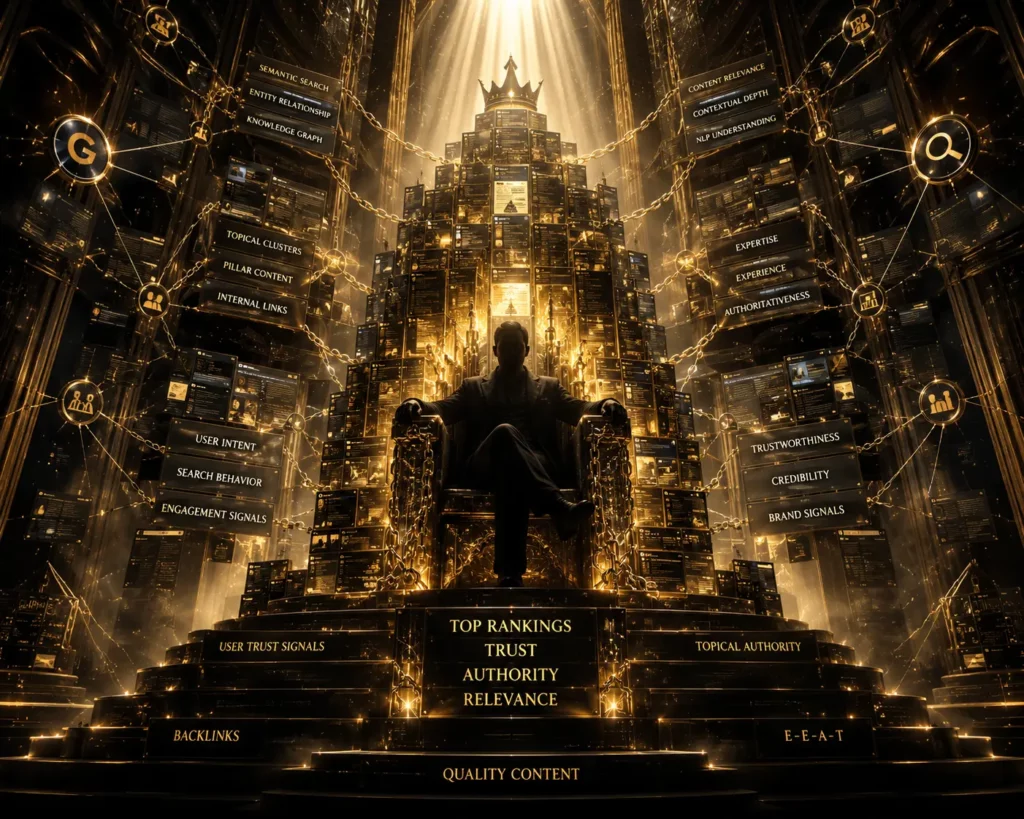
Authority websites survive because they diversify monetization from the beginning.
High-Trust Revenue Systems
Affiliate Marketing
Works best when recommendations emerge naturally from expertise.
People don’t mind affiliate links when trust already exists.
Digital Products
Templates. Playbooks. Systems. Frameworks.
Authority transforms information into intellectual property.
Membership Communities
Recurring income thrives when people feel connected to:
- progress,
- accountability,
- and shared identity.
Consulting & Coaching
High-trust audiences naturally seek proximity.
Sponsorships
Brands increasingly pay for trusted audience access, not just raw traffic numbers.
Internal Linking Is Quietly One of the Strongest SEO Signals
Most websites treat internal links like navigation.
Authority websites use them like semantic bridges.
Every internal link tells search engines:
- what matters,
- what connects,
- and which pages reinforce one another.
But there’s another layer people rarely discuss.
Internal linking also shapes human perception.
When readers naturally move from:
- SEO systems,
to: - audience psychology,
to: - monetization strategy,
the website begins feeling expansive and intelligent.
Depth creates authority.
Not through claims —
through structure.
The Future of SEO Belongs to Generative Engine Optimization (GEO)
Search is changing again.
AI-generated summaries are already reducing clicks for surface-level information.
Which means websites can no longer survive by offering shallow answers.
The new advantage belongs to content that:
- interprets,
- contextualizes,
- connects,
- and expands.
Generative Engine Optimization is fundamentally about making your expertise easy for both humans and machines to understand.
That means:
- direct definitions,
- semantic clarity,
- entity-rich structure,
- conversational phrasing,
- and retrieval-friendly formatting.
AI systems increasingly favor content that explains concepts cleanly without losing depth.
In many ways, the future of SEO looks surprisingly human.
Clear thinking wins.
Why Topical Authority Beats Publishing Volume
There’s a strange addiction online to producing more.
More posts.
More keywords.
More pages.
But the sites building lasting authority usually move differently.
They go deeper.
A smaller website with:
- stronger semantic structure,
- deeper expertise,
- higher engagement,
- and better trust signals
can outperform websites publishing ten times more content.
Because search engines increasingly evaluate cohesion.
Not chaos.
The goal is no longer:
“Publish everything.”
The goal is:
“Become unmistakably associated with something.”
Behavioral Writing Is the New SEO Advantage
Good SEO gets the click.
Behavioral writing earns the attention.
And attention has become one of the internet’s most valuable currencies.
The best authority websites understand pacing.
They understand tension.
They know when to shorten a sentence.
When to pause.
When to introduce a contradiction that quietly reopens curiosity.
Because people don’t read linearly online anymore. They scan emotionally.
They continue reading when they feel:
- momentum,
- recognition,
- surprise,
- clarity,
- or emotional relevance.
This is why structure matters so much.
Not just for algorithms.
For cognition.
The Websites Readers Remember Feel Like Worlds
Think about the websites you return to repeatedly.
Not because you need information —
but because being there changes the way you think.
That’s the real aspiration behind an authority website.
To create a digital environment so coherent, useful, and trusted that readers stop searching for alternatives.
At that point, rankings become a side effect of relevance.
Not the goal itself.
Questions People Quietly Ask Before Building an Authority Website
“How long does it actually take before this starts working?”
Usually longer than people hope.
But also faster than most people realize once compounding begins.
Authority websites often feel invisible for months. Then suddenly, traffic, trust, backlinks, audience growth, and revenue start reinforcing each other at the same time.
That’s the flywheel.
“Do I need to be an expert already?”
Not necessarily.
But you do need real curiosity and a willingness to develop depth publicly.
People trust evolving expertise far more than artificial perfection.
“What matters more — SEO or branding?”
Eventually, they become inseparable.
Strong SEO brings discovery.
Strong branding creates memory.
Authority websites need both.
“Can small creators still compete today?”
Yes.
In fact, smaller expert-driven websites often outperform larger generic publishers because they feel more human, more focused, and more trustworthy.
Search engines increasingly reward those qualities.
So do readers.
Products / Tools / Resources
Website Platforms
- WordPress — flexible, scalable, ideal for semantic SEO architecture
- Webflow — strong for premium brand positioning and modern UX
- Ghost — excellent for creator-led publishing and memberships
SEO & Content Intelligence Tools
- Ahrefs — keyword research, topical mapping, competitor analysis
- Semrush — semantic SEO and authority tracking
- Surfer SEO — content optimization and NLP alignment
- Screaming Frog — technical SEO auditing
- Clearscope — entity coverage and semantic depth optimization
Email Marketing Platforms
- ConvertKit — ideal for creators and authority brands
- Beehiiv — newsletter-first audience growth
- ActiveCampaign — advanced automation and behavioral segmentation
Conversion Optimization Tools
- Hotjar — heatmaps and behavioral analytics
- Thrive Architect — landing page and funnel creation
- OptinMonster — lead generation and pop-up optimization
Community & Recurring Revenue Platforms
- Circle — membership communities
- Skool — education-driven audience ecosystems
- Patreon — recurring creator monetization