
Snippet
If you’ve ever wondered why some affiliate websites seem to attract visitors every day without spending money on advertising, the answer almost always comes back to one thing: search engine optimization. This guide walks you through the entire SEO journey—from choosing the right niche and finding keywords to creating content that earns trust, ranks in search results, and converts readers into loyal customers. Whether you’re launching your very first affiliate website or trying to understand why your current site isn’t growing, this roadmap gives you a practical, beginner-friendly plan you can follow one step at a time.
Table of Contents
- Why SEO Is the Foundation of Long-Term Affiliate Marketing Success
- Why SEO outlasts paid advertising
- Building trust before making sales
- Thinking like a long-term business owner
- What to expect from this guide
- Understanding Search Intent Before You Write
- The four types of search intent
- Matching content to what readers actually want
- Using Google search results as your guide
- Writing content that satisfies user expectations
- Choosing a Profitable Affiliate Niche You Can Grow Into
- Solving real problems instead of chasing trends
- Evergreen niches vs. short-lived opportunities
- Finding the balance between passion and demand
- Building topical authority from the beginning
- Finding Keywords That New Websites Can Actually Rank For
- Why long-tail keywords matter
- Researching questions your audience is asking
- Building topic clusters instead of isolated articles
- Writing naturally without keyword stuffing
- Creating Content People and Search Engines Love
- Writing for readers first
- Structuring articles for readability
- Using examples to explain difficult ideas
- Creating evergreen content worth updating
- Building Topical Authority That Compounds Over Time
- Becoming a trusted resource
- Covering an entire subject comprehensively
- Why consistency beats publishing at random
- Creating a website that grows stronger with every article
- On-Page SEO That Makes Every Article Stronger
- Writing compelling titles and introductions
- Structuring content with clear headings
- Improving readability with short paragraphs and lists
- Using keywords naturally
- Adding valuable images and visual elements
- Improving internal flow and reader experience
- Optimizing for mobile readers
- Polishing every article before publishing
- Technical SEO Without the Overwhelm
- Understanding crawling and indexing
- Improving website speed and mobile usability
- Organizing your website for search engines
- XML sitemaps and robots.txt explained
- HTTPS and website security
- Canonical URLs and avoiding duplicate content
- Fixing broken links
- Image optimization and Core Web Vitals
- Simple technical maintenance that pays off
- Writing Affiliate Content That Builds Trust and Converts
- Teaching before selling
- Solving problems before recommending products
- Explaining benefits instead of features
- Writing honest product reviews
- Comparing products fairly
- Using storytelling to build credibility
- Addressing reader objections naturally
- Placing recommendations where they make sense
- Building long-term reader trust
- Measuring Progress and Improving Your Rankings
- Setting realistic SEO expectations
- Understanding impressions, rankings, and traffic
- Using Google Search Console effectively
- Learning from analytics
- Updating existing content
- Identifying high-potential pages
- Creating a monthly SEO review routine
- Why patience becomes a competitive advantage
- The Most Common SEO Mistakes Beginners Make
- Targeting overly competitive keywords
- Ignoring search intent
- Publishing thin or shallow content
- Writing for algorithms instead of people
- Covering unrelated topics
- Expecting overnight results
- Neglecting older content
- Overlooking technical SEO
- Measuring the wrong metrics
- Copying competitors instead of adding value
- Chasing every new SEO trend
- Giving up before momentum builds
- Building systems instead of relying on motivation
- Learning from mistakes and improving continuously
- Your 12-Month SEO Growth Plan
- Month 1: Build the right foundation
- Months 2–3: Build content momentum
- Months 4–6: Expand topical authority
- Months 7–9: Improve and update existing content
- Months 10–12: Double down on what works
- Thinking like a long-term builder
- Adapting to the future of search
- Building trust as your greatest asset
- Understanding how sustainable SEO success grows
- Bonus: The 30-Day SEO Action Plan
- Week 1: Build your foundation
- Week 2: Publish your first cornerstone content
- Week 3: Improve and optimize
- Week 4: Create a sustainable publishing system
- Frequently Asked Questions
- Do I need to be an SEO expert?
- How long does SEO take?
- Is quality more important than quantity?
- Should I update old articles?
- Can new websites compete?
- Is SEO still worth learning in the age of AI?
- Products / Tools / Resources
- Website platform
- Website hosting
- Keyword research tools
- Google Search Console
- Google Analytics
- Writing and editing tools
- Image creation tools
- Technical SEO tools
- Affiliate networks
- Productivity and content planning tools
Part 1: Why SEO Is the Foundation of Long-Term Affiliate Success
Imagine waking up, making your morning coffee, opening your laptop, and discovering that people have been visiting your website all night while you were asleep.
Some of them found answers to questions they had been searching for. Others subscribed to your email list. A few clicked an affiliate recommendation that genuinely solved a problem they were facing.
None of those visitors arrived because you paid for an advertisement that morning.
They came because months—or perhaps even years—earlier, you created something valuable enough for a search engine to recommend.
That’s the quiet power of SEO.
Unlike paid advertising, where traffic disappears the moment you stop spending money, search engine optimization has the potential to keep working long after you’ve pressed the publish button. A well-written article can continue attracting visitors day after day, slowly building authority and trust while becoming one of your most valuable business assets.
That doesn’t mean SEO is easy.
It isn’t.
But it is remarkably fair.
Search engines don’t care whether you’re running a business from a spare bedroom or managing a large company with dozens of employees. What they care about is whether your content genuinely helps the person performing the search.
That levels the playing field in a way few marketing channels can.
SEO Is About Helping Before Selling
One of the biggest misconceptions surrounding affiliate marketing is that success comes from finding the perfect product to promote.
In reality, successful affiliate marketers usually start somewhere entirely different.
They begin with the reader.
Every search begins with a need.
Someone wants to solve a problem, learn a new skill, compare products, or avoid making an expensive mistake. Behind every keyword is a real person hoping to find a trustworthy answer.
When your content delivers that answer better than competing pages, something important happens.
Trust begins to form.
And trust is the true currency of affiliate marketing.
People rarely purchase through recommendations from websites they don’t believe.
They buy from websites that consistently educate, guide, and simplify difficult decisions.
The affiliate commission is simply the by-product of that relationship.
Think Beyond Rankings
It’s easy to become obsessed with ranking number one on Google.
Many beginners check their rankings every day, hoping to see dramatic movement.
While rankings matter, they’re only one piece of a much larger picture.
The real objective is to become the website people are genuinely happy they found.
Imagine two articles answering the same question.
The first barely scratches the surface before pushing readers toward an affiliate link.
The second explains the topic clearly, answers follow-up questions, acknowledges common mistakes, and helps readers feel confident before recommending a relevant solution.
Which article would you bookmark?
Which one would you recommend to a friend?
Search engines increasingly ask those same questions in their own way.
They’re looking for pages that satisfy people, not simply pages that repeat keywords.
Organic Traffic Creates Momentum
One of the most rewarding aspects of SEO is that every useful article strengthens the next one.
As your website grows, search engines begin recognizing consistent expertise within your niche.
Readers notice it too.
Instead of seeing a handful of unrelated articles, they discover an expanding library of helpful resources.
That growing collection creates momentum.
Each new article reinforces the others.
Each helpful answer builds more trust.
Each satisfied visitor increases the likelihood of another recommendation, another return visit, or another share.
This is why experienced affiliate marketers often describe SEO as compound interest for content.
The early stages may feel slow, but steady effort has a way of producing results that become increasingly difficult to ignore.
Why Beginners Often Quit Too Soon
SEO demands patience, and patience isn’t always easy.
You might spend hours researching, writing, editing, and publishing a thoughtful article only to receive little immediate attention.
That can feel discouraging.
But what you don’t see is often just as important as what you do.
Search engines need time to discover new pages, understand their purpose, compare them with competing content, and evaluate how well they satisfy readers.
That process doesn’t happen overnight.
Many successful websites spent months building quietly before experiencing noticeable growth.
The creators who stayed committed during those quieter months were the ones positioned to benefit later.
If you expect instant success, SEO will probably disappoint you.
If you’re willing to think in months and years instead of days and weeks, it becomes one of the most dependable sources of traffic available.
The Difference Between Chasing Traffic and Building an Asset
Paid advertising can produce visitors almost immediately.
There’s nothing wrong with that.
But it’s similar to renting attention.
When the budget disappears, so do the visitors.
SEO works differently.
Every article becomes another permanent asset.
Some attract hundreds of visitors.
Others attract thousands.
Together, they form a growing foundation that continues serving readers long after publication.
Over time, your website evolves from a collection of blog posts into a trusted destination where people return because they know they’ll find thoughtful, practical answers.
That’s a far more durable strategy than constantly chasing the next source of paid traffic.
Why Modern SEO Is More Human Than Ever
Years ago, ranking often meant repeating keywords over and over again.
Those days are largely gone.
Today’s search engines have become much better at understanding natural language, context, and intent.
They reward content that feels useful rather than manufactured.
That should be encouraging.
You don’t need to write like a machine.
You need to write like someone who genuinely understands the reader’s challenges.
Explain ideas clearly.
Use examples.
Answer the questions people haven’t even thought to ask yet.
Write with empathy rather than algorithms in mind.
Ironically, that’s often what performs best in search.
Build a Reputation, Not Just a Website
Every article you publish tells readers something about you.
It tells them whether your advice is trustworthy.
Whether your explanations are clear.
Whether your recommendations feel sincere.
Over time, those impressions become your reputation.
That reputation influences far more than rankings.
It shapes whether readers return.
Whether they subscribe.
Whether they recommend your content to friends.
Whether they feel comfortable acting on your suggestions.
Great affiliate websites aren’t built on clever marketing tricks.
They’re built on consistency.
Every helpful article becomes another promise kept.
This Guide Is Your Roadmap
SEO can feel overwhelming when viewed all at once.
There are keywords, technical settings, content strategies, search intent, analytics, user experience, and countless opinions about what matters most.
The good news is that you don’t need to master everything today.
You simply need a clear path.
That’s exactly what this guide is designed to provide.
We’ll begin with the fundamentals, gradually build your understanding, and connect each piece so it makes sense in the context of a real affiliate website.
By the time you reach the end, SEO won’t feel like a collection of disconnected tactics.
It will feel like a practical system you can apply with confidence.
And once that system is in place, you’ll be building something much more valuable than traffic alone.
You’ll be building a money-making website setup that continues earning trust long after each article is published.
Continue to Part 2: Understanding Search Intent Before You Write.
Part 2: Understanding Search Intent Before You Write a Single Word
Have you ever searched for something online, clicked the first result, and almost immediately hit the back button?
Most of us have.
Not because the article was poorly written.
Not because the website looked unprofessional.
But because it answered a different question than the one we were actually asking.
That small moment reveals one of the biggest truths in SEO.
Ranking isn’t just about choosing the right keyword.
It’s about understanding the reason behind the search.
This is what marketers and search engines call search intent.
Once you understand it, your entire approach to content changes. Instead of guessing what people might want, you begin creating pages that meet them exactly where they are—whether they’re curious, confused, comparing options, or ready to make a decision.
That alignment is one of the strongest signals you can send to both readers and search engines.
Every Search Begins With a Purpose
People don’t type random words into Google.
They type hopes.
Questions.
Problems.
Goals.
A homeowner searching for “how to repair a leaking faucet” isn’t looking for the history of plumbing.
A new affiliate marketer searching for “SEO for beginners” isn’t trying to read an advanced technical manual.
They’re looking for guidance they can understand and use immediately.
When your content satisfies that expectation, readers stay longer, explore more, and leave feeling like they found exactly what they needed.
That’s the experience search engines want to deliver.
Your job is to make it easy for them to choose your page.
The Four Types of Search Intent
Although every search is unique, most fall into four broad categories.
Understanding these categories helps you create the right type of content for the right audience.
Informational Intent
The searcher wants to learn something.
Typical searches include:
- What is affiliate marketing?
- How does SEO work?
- Why are backlinks important?
- How long does SEO take?
These readers aren’t looking to buy immediately.
They’re trying to understand.
Your role is to educate, explain, and build confidence.
When you become the person who provides clear answers, readers naturally remember your website.
Navigational Intent
Sometimes people already know where they want to go.
They simply use Google as a shortcut.
Examples include:
- Google Search Console
- WordPress login
- Amazon Associates
- Canva
These searches are usually aimed at reaching a specific website or service.
Unless your brand is the destination, they aren’t typically the best opportunities for affiliate content.
Commercial Investigation
This is where curiosity starts becoming action.
The reader knows a solution exists but hasn’t decided which one is best.
Searches often look like this:
- Best email marketing software
- Best SEO tools for beginners
- Bluehost vs SiteGround
- Ahrefs review
People in this stage are researching carefully.
They’re comparing features, weighing pros and cons, and looking for trustworthy opinions.
Helpful comparisons, balanced reviews, and buying guides perform especially well here because they reduce uncertainty.
Transactional Intent
Now the reader is ready to act.
Their searches often include phrases like:
- Buy
- Discount
- Pricing
- Coupon
- Sign up
- Download
They’re no longer asking, “What is this?”
They’re asking, “Is this the right choice for me?”
Content aimed at transactional intent should remove doubts, answer final questions, and make the next step feel obvious rather than pressured.
The Same Keyword Can Mean Different Things
One of the easiest mistakes beginners make is assuming keywords always have one meaning.
They don’t.
Take the keyword:
Email marketing
One person may want to understand what it is.
Another may want software recommendations.
Someone else may be comparing two platforms.
Another visitor could be looking for pricing.
The words are identical.
The intent is completely different.
That’s why successful SEO begins with understanding the person behind the keyboard—not just the phrase they typed.
Let Google Show You What People Expect
One of the simplest forms of keyword research doesn’t require expensive software.
Search your target keyword yourself.
Look carefully at the first page.
Ask questions like:
- Are the top results beginner guides?
- Are they product reviews?
- Are they comparison articles?
- Are they tutorials?
- Are videos dominating the results?
- Are there featured snippets?
- What questions appear in the “People Also Ask” section?
Google has already analyzed what users seem to prefer for that search.
Treat the results as clues rather than competitors.
You’re learning what readers expect before you begin writing.
Write for the Reader’s Current Stage
Imagine someone learning to drive.
On the first day, they don’t need advanced racing techniques.
They need to understand where the brake pedal is.
The same principle applies to SEO.
A beginner searching for basic information doesn’t want to feel overwhelmed with advanced concepts.
Likewise, an experienced reader doesn’t want an article that spends two thousand words defining common terms.
Meet people where they are.
As you explain one concept clearly, you naturally earn permission to introduce the next.
That steady progression keeps readers engaged because the content grows alongside their understanding.
Anticipate the Next Question
Excellent articles don’t stop after answering the first question.
They predict the second.
Then the third.
Suppose someone searches:
How do keywords help SEO?
A complete article might naturally answer:
- What are keywords?
- Why do they matter?
- How do you find them?
- How many should you use?
- Should they appear in headings?
- Can you overuse them?
- What mistakes should beginners avoid?
Readers love this approach because it feels like the article understands what they’re thinking before they even ask.
Search engines appreciate it too because comprehensive content often satisfies multiple related searches.
Intent Creates Natural Structure
When you understand search intent, organizing an article becomes much easier.
Instead of forcing information into random sections, each heading becomes the next logical step in the reader’s journey.
For example:
Question.
Explanation.
Example.
Common mistake.
Solution.
Next step.
That flow feels natural because it mirrors how people actually learn.
Instead of jumping between disconnected ideas, readers move smoothly from curiosity to clarity.
Every Search Is a Conversation
Think about how people ask questions in real life.
They rarely begin with every detail.
Instead, they ask one question.
The answer leads to another.
And then another.
Search works the same way.
Your article shouldn’t feel like a list of isolated facts.
It should feel like a conversation with someone who understands exactly why the reader arrived and where they need to go next.
When readers finish your content feeling informed rather than overwhelmed, you’ve done far more than answer a keyword.
You’ve created a positive experience.
That’s what keeps people coming back.
Stop Chasing Keywords and Start Solving Problems
It’s tempting to build content around search volume alone.
After all, a keyword with thousands of monthly searches sounds exciting.
But traffic without relevance rarely produces meaningful results.
Instead of asking:
“What keyword should I target?”
Try asking:
“What problem can I solve better than anyone else?”
That subtle shift changes everything.
Keywords become the doorway.
The problem becomes the destination.
And the solution becomes the reason readers trust you.
Search Intent Is the Bridge Between Readers and Rankings
SEO often seems technical from the outside.
Algorithms.
Keywords.
Data.
Rankings.
Yet beneath all those moving parts lies one remarkably human principle.
People are searching because they need help.
The websites that consistently provide the clearest, most useful, and most complete answers are the ones most likely to earn visibility over time.
Master search intent, and you’ll stop creating content that merely exists.
You’ll begin creating content that matters.
And that’s where lasting organic growth begins.
Continue to Part 3: Choosing a Profitable Affiliate Niche You Can Grow Into.
Part 3: Choosing a Profitable Affiliate Niche You Can Grow Into
If someone asked you to build a house, you wouldn’t start with the roof.
You’d begin with the foundation.
Your affiliate niche is that foundation.
It influences every article you publish, every keyword you target, every product you recommend, and every visitor you attract.
Choose wisely, and your website becomes easier to grow with every passing month.
Choose poorly, and you’ll constantly feel like you’re swimming against the current.
That’s why niche selection isn’t just the first decision you make.
It’s one of the most important.
A Great Niche Solves Real Problems
Many beginners choose a niche based on excitement alone.
Others chase whatever seems popular this week.
Neither approach usually leads to long-term success.
The strongest affiliate niches have something much deeper in common.
They help people solve meaningful problems.
Think about the kinds of questions people ask every day.
How can I save money?
How do I lose weight?
What’s the best software for my business?
How do I build a deck?
Which camera should I buy?
How can I train my puppy?
These aren’t passing curiosities.
They’re ongoing challenges that millions of people actively want to solve.
Whenever a niche consistently helps people make better decisions or improve their lives, it has the potential to support a successful affiliate website.
Evergreen Beats Temporary Hype
New trends appear almost every week.
A social platform explodes in popularity.
A new gadget dominates the headlines.
A viral challenge spreads across the internet.
Some of these trends create short bursts of traffic.
Very few create lasting businesses.
Evergreen niches are different.
People searched for information about gardening ten years ago.
They’re searching today.
They’ll almost certainly keep searching ten years from now.
The same is true for topics like:
- Home improvement
- Personal finance
- Fitness
- Cooking
- Woodworking
- Pets
- Technology
- Parenting
- Outdoor living
- Hobbies
Evergreen content continues attracting readers long after it’s published because the problems never disappear.
When you’re building an affiliate website designed to grow for years, that’s exactly the kind of stability you want.
Passion Helps—But It Isn’t Everything
You’ve probably heard the advice:
“Follow your passion.”
There’s some truth in that.
If you genuinely enjoy a topic, creating content becomes much easier.
You’ll naturally stay curious.
Learning feels enjoyable instead of exhausting.
Publishing consistently becomes far more realistic.
But passion alone isn’t enough.
Ask yourself three questions:
- Do people actively search for information in this niche?
- Are there products or services that genuinely help them?
- Can I imagine writing about this topic a hundred times without running out of ideas?
If the answer to all three is yes, you’ve found something worth exploring.
Look for Questions That Never Stop Being Asked
The internet changes constantly.
Human curiosity doesn’t.
Some questions are asked millions of times every year.
Examples include:
- How do I get started?
- What’s the best option?
- Which product should I choose?
- How much does it cost?
- Is this worth it?
- How does it work?
- What mistakes should I avoid?
A healthy niche contains hundreds—often thousands—of these recurring questions.
Every question represents an opportunity to create genuinely helpful content.
Instead of chasing random keywords, begin collecting the questions your audience repeatedly asks.
Those questions become the blueprint for your content strategy.
Competition Isn’t the Enemy
Many beginners become discouraged when they discover successful websites already operating in their chosen niche.
They assume the opportunity has disappeared.
In reality, competition often proves the opposite.
If businesses are investing time, money, and effort into a market, there’s usually a reason.
People are spending money there.
The challenge isn’t avoiding competition altogether.
It’s finding your own angle.
Maybe you explain complex topics more clearly.
Perhaps you specialize in helping complete beginners.
Maybe your writing is more practical.
Or maybe you provide deeper comparisons than anyone else.
Readers rarely need another copy of an existing website.
They appreciate a fresh perspective delivered with genuine expertise and clarity.
Learn more: High-Traffic, Low-Competition Website Ideas: 87 Untapped Niches You Can Still Rank for Before Everyone Else
Go Narrow Before You Go Broad
One of the smartest strategies for new affiliate websites is to begin with a focused niche.
Imagine launching a website simply about health.
That’s an enormous subject.
Now compare it with:
- Home strength training for beginners
- Healthy meal planning for busy families
- Nutrition for adults over fifty
Each of those is much more specific.
Specific websites often build authority faster because every article reinforces a closely related topic.
As your reputation grows, expanding into neighboring subjects becomes much easier.
Think of it like planting one healthy tree before trying to grow an entire forest.
Choose a Niche With Plenty to Say
One simple exercise can save you from making an expensive mistake.
Open a blank document.
Set a timer for fifteen minutes.
Write down every article idea that comes to mind.
Don’t research.
Don’t edit.
Just write.
If you easily generate fifty or more ideas, that’s an encouraging sign.
If you struggle to think of ten, the niche may be too narrow to support long-term growth.
The best affiliate websites rarely succeed because of one extraordinary article.
They succeed because they consistently publish helpful content across hundreds of closely related topics.
Think About the Reader, Not Yourself
It’s easy to choose a niche based entirely on your own interests.
But remember why people visit websites in the first place.
They’re looking for help.
Ask yourself:
Who is this person?
What frustrates them?
What are they trying to accomplish?
What worries them?
What would success look like from their perspective?
When you understand your audience deeply, content ideas begin appearing everywhere.
Every obstacle becomes another article.
Every question becomes another opportunity to build trust.
Affiliate Products Should Feel Like Natural Solutions
A common beginner mistake is choosing a niche solely because it has expensive affiliate programs.
High commissions can be attractive.
But they’re meaningless if readers don’t trust your recommendations.
Instead, focus on whether affiliate products genuinely improve the reader’s experience.
For example:
Someone learning woodworking may appreciate recommendations for quality tools.
A beginner photographer may benefit from camera comparisons.
A new website owner may need reliable hosting or email marketing software.
Notice the pattern.
The products solve existing problems.
They don’t create new ones.
When recommendations appear naturally within genuinely helpful content, they feel like guidance rather than advertising.
Readers recognize the difference immediately.
Imagine Building This Website Five Years From Now
Here’s a question that many people never ask.
If your website became successful, would you still enjoy working on it five years from today?
That’s an important thought experiment.
SEO rewards consistency.
A niche that feels exciting for one month but exhausting after one year probably isn’t the best long-term choice.
Choose something with enough depth to keep teaching, learning, and discovering new ideas.
Curiosity has remarkable staying power.
And curiosity often produces better content than obligation ever could.
Don’t Wait for the “Perfect” Niche
Some beginners spend months trying to find the ideal topic.
They compare dozens of ideas.
Analyze endless statistics.
Watch countless videos.
Eventually, analysis replaces action.
Here’s the truth.
Your niche doesn’t have to be perfect.
It simply needs enough potential to begin.
As you publish more content, you’ll naturally discover:
- Which topics readers love.
- Which articles perform best.
- Which questions deserve more attention.
- Which affiliate recommendations feel most valuable.
Real-world experience almost always teaches more than endless planning.
Progress comes from publishing.
Not postponing.
Build Expertise One Article at a Time
Many new affiliate marketers worry that they aren’t experts.
They imagine every successful website is run by someone with decades of experience.
That’s rarely the full story.
Expertise is built gradually.
Each article requires research.
Each question deepens your understanding.
Each update improves your knowledge.
Over time, your growing collection of content becomes evidence of your expertise.
You don’t need to know everything before you begin.
You simply need to be committed to learning more than you knew yesterday.
Readers appreciate honesty, curiosity, and clear explanations far more than impossible perfection.
The Best Niche Is One You Can Serve for Years
A profitable niche isn’t defined only by search volume or affiliate commissions.
It’s defined by opportunity.
The opportunity to educate.
The opportunity to solve problems.
The opportunity to build trust with readers who return because they know your content consistently helps them make better decisions.
When you choose a niche with long-term potential, every article becomes another brick in something much bigger than a blog.
You’re building a resource people can rely on.
And over time, that’s exactly the kind of website both readers and search engines learn to trust.
Continue to Part 4: Finding Keywords That New Websites Can Actually Rank For.
Part 4: Finding Keywords That New Websites Can Actually Rank For
Imagine opening a brand-new shop in the middle of a city.
Would you try to compete immediately with the largest department store on the busiest street?
Probably not.
You’d look for an opportunity where people still need what you offer, but where the competition isn’t nearly as overwhelming.
Keyword research follows the same principle.
One of the biggest reasons new affiliate websites struggle isn’t because the content is poor.
It’s because the website is trying to compete for searches that are already dominated by established brands with years of authority behind them.
The good news is that Google processes billions of searches every day, and many of them are surprisingly specific.
Those specific searches are where new websites often find their first real opportunities.
A Keyword Is More Than Just a Search Phrase
It’s easy to think of keywords as nothing more than words typed into a search box.
In reality, every keyword tells a story.
Someone searching for:
best cordless drill for beginners
isn’t simply interested in cordless drills.
They’re probably worried about spending too much money.
They’re unsure which features matter.
They may never have used power tools before.
One search reveals uncertainty, curiosity, and the desire to make a good decision.
That’s why successful keyword research is really about understanding people.
The words are simply clues.
Long-Tail Keywords Are a Beginner’s Best Friend
When people first learn SEO, they often dream about ranking for enormous keywords like:
- SEO
- Fitness
- Gardening
- Woodworking
- Photography
Those searches receive huge amounts of traffic.
They also attract fierce competition.
Long-tail keywords are different.
Instead of broad topics, they describe highly specific needs.
For example:
- How to build a raised garden bed on uneven ground
- Best budget mirrorless camera for travel beginners
- How to stop a puppy from chewing furniture naturally
- DIY bookshelf plans for small apartments
- How to improve affiliate website SEO without backlinks
Each search may attract fewer visitors.
But those visitors usually know exactly what they’re looking for.
Specific searches often lead to higher engagement because your content closely matches the reader’s intent.
Smaller Audiences Can Produce Bigger Results
Many beginners become discouraged when they discover a keyword receives only a few hundred searches each month.
They assume it isn’t worth targeting.
That assumption can be expensive.
Imagine writing one article that attracts 300 highly interested visitors every month.
Now imagine publishing one hundred articles that each attract similar traffic.
Individually, they don’t seem impressive.
Together, they create substantial and reliable organic traffic.
Large websites are rarely built on one blockbuster article.
They’re built on hundreds of useful pages answering hundreds of specific questions.
Learn to Think in Topics Instead of Individual Keywords
Search engines have become much better at understanding relationships between ideas.
That’s why creating one article for every tiny keyword variation is no longer the best strategy.
Instead, focus on complete topics.
Suppose your main subject is:
Vegetable gardening for beginners
Within that topic, you might naturally cover:
- Choosing the right soil
- Watering schedules
- Raised beds
- Common pests
- Fertilizers
- Seasonal planting
- Harvest timing
One comprehensive article can rank for dozens—or even hundreds—of related searches because it addresses the subject thoroughly.
That’s exactly what modern search engines are designed to reward.
Start With Questions Real People Ask
Some of the best content ideas come directly from everyday questions.
Pay attention to:
- Google’s autocomplete suggestions.
- The “People Also Ask” section.
- Discussions in forums.
- Social media communities.
- Comments on popular blogs.
- Customer reviews.
- Questions friends and coworkers ask.
These aren’t manufactured keyword lists.
They’re genuine conversations.
When the same question appears repeatedly in different places, it’s usually a strong indication that people genuinely want the answer.
Search Intent Still Comes First
Finding a keyword is only the beginning.
You must also understand why someone searched for it.
Consider these examples:
How to sharpen chisels
The reader probably wants a practical tutorial.
Best woodworking chisels
They’re likely comparing products.
Wood chisel set review
They’re evaluating whether a specific product deserves their money.
Although these searches involve similar words, they require different kinds of content.
Matching intent always matters more than simply repeating keywords.
Look for Opportunities Hidden in Plain Sight
Many valuable keywords aren’t obvious at first glance.
Instead of searching only for broad topics, think about situations people experience.
Examples include:
Before buying
After buying
Common mistakes
Maintenance
Troubleshooting
Safety
Comparisons
Beginner questions
Advanced techniques
Seasonal advice
Each angle creates dozens of possible article ideas while helping you build deeper topical authority.
One Great Topic Can Inspire an Entire Content Series
Imagine writing an article about composting.
At first, it seems like one subject.
Look closer.
You could create additional articles about:
- Choosing a compost bin
- Composting in small gardens
- What foods should never be composted
- How long compost takes to mature
- Common composting mistakes
- Worm composting
- Winter composting
- Compost odor problems
- Compost for vegetable gardens
- Beginner compost recipes
Suddenly, one keyword has become an entire content cluster.
That’s how authoritative websites gradually grow.
Keyword Difficulty Isn’t a Rule—It’s a Guide
Many SEO tools assign a difficulty score to keywords.
These scores can be helpful.
But don’t treat them as absolute truth.
A keyword labeled “difficult” may still present opportunities if existing content is outdated, poorly organized, or fails to answer readers’ questions completely.
Likewise, an “easy” keyword isn’t guaranteed to rank.
Content quality, search intent, user experience, and topical authority all play important roles.
Think of keyword difficulty as one signal among many—not the final decision.
Avoid Keyword Obsession
Some beginners spend weeks researching keywords without publishing a single article.
Eventually, they know thousands of search phrases but have nothing for Google to rank.
Research matters.
Publishing matters more.
It’s perfectly acceptable to begin with the information you have, create the best article possible, and refine your strategy as you gain experience.
SEO rewards consistent action far more than endless preparation.
Build Keyword Clusters Instead of Random Lists
Successful affiliate websites rarely choose article ideas one at a time.
Instead, they organize related topics into clusters.
For example, if your niche is home fitness, one cluster might include:
- Beginner workout routines
- Choosing adjustable dumbbells
- Home gym equipment
- Workout benches
- Resistance bands
- Recovery techniques
- Exercise motivation
- Nutrition basics
Each article supports the others by expanding your expertise around a central subject.
This makes your website easier for readers to navigate and easier for search engines to understand.
Write Naturally—Not Repeatedly
Years ago, people believed repeating a keyword dozens of times improved rankings.
Today, that usually creates awkward, repetitive writing.
Modern search engines recognize context remarkably well.
Instead of forcing the same phrase into every paragraph, use natural language.
Discuss related ideas.
Answer connected questions.
Introduce examples.
Explain concepts from different angles.
If your article thoroughly covers the topic, relevant terminology will appear naturally without feeling forced.
Readers notice the difference.
So do search engines.
Great Keyword Research Creates Better Content
Keyword research isn’t about discovering magical phrases that unlock instant traffic.
It’s about understanding what people genuinely want to know.
Every keyword represents curiosity.
Every search represents a challenge.
Every question represents an opportunity to help someone move forward.
When you approach keyword research with that mindset, creating valuable content becomes much easier.
You’re no longer writing for an algorithm.
You’re writing for the person behind the search.
And when you consistently solve real problems better than competing pages, rankings become a natural consequence rather than the primary goal.
Continue to Part 5: Creating Content People and Search Engines Love.
Part 5: Creating Content People and Search Engines Love
There was a time when simply publishing an article gave you a reasonable chance of appearing near the top of the search results.
Those days are gone.
Today, readers have more choices than ever.
If your article doesn’t answer their question quickly, they’ll leave.
If another website explains the topic more clearly, they’ll click it instead.
Search engines notice those patterns.
Their goal has never been to reward the website with the most words.
Their goal is to recommend the page that leaves the searcher feeling satisfied.
That’s why great SEO content doesn’t begin with algorithms.
It begins with empathy.
Before you write a single sentence, ask yourself one simple question:
What does this person hope to understand by the time they finish reading?
When you answer that question exceptionally well, you’re already moving in the right direction.
Stop Writing Articles. Start Solving Problems.
Think back to the last time you searched for advice online.
Maybe you wanted to repair something around the house.
Maybe you were comparing two products.
Maybe you were trying to learn a completely new skill.
You probably weren’t hoping to read a beautifully optimized article.
You were hoping to solve your problem.
That’s the mindset every successful affiliate marketer should adopt.
Instead of thinking:
“I need to write about email marketing.”
Think:
“Someone is confused about email marketing. How can I make it simple?”
That small shift changes everything.
Your writing becomes more helpful.
Your examples become more practical.
Your explanations become easier to understand.
Readers feel like someone is guiding them instead of talking at them.
Begin With the Reader’s Biggest Question
The opening of your article matters more than many people realize.
When someone lands on your page, they make a decision within seconds.
They ask themselves:
“Am I in the right place?”
Your introduction should remove that uncertainty immediately.
Tell readers:
- What they’ll learn.
- Why it matters.
- What problem you’ll help them solve.
- What they’ll be able to do afterward.
There’s no need for long, dramatic introductions that delay the answer.
People appreciate clarity.
Give them confidence that they’re about to invest their time wisely.
Depth Beats Length Every Time
Many beginners become obsessed with word count.
They hear that long articles rank well and assume more words automatically mean better SEO.
Length alone has very little value.
A focused article with 2,500 useful words is far stronger than a 6,000-word article filled with repetition.
The goal isn’t to write more.
The goal is to leave fewer unanswered questions.
Ask yourself:
- Have I explained the core idea?
- Have I included practical examples?
- Have I answered the obvious follow-up questions?
- Have I addressed common misunderstandings?
- Have I made this topic genuinely easier to understand?
If the answer is yes, you’ve created depth.
That’s what readers remember.
Organize Information Like a Teacher
Think about your favorite teacher.
They probably didn’t overwhelm you with information all at once.
They introduced one concept.
Made sure you understood it.
Then built on it.
Your articles should follow the same rhythm.
Move naturally from:
Simple ideas…
to slightly more detailed explanations…
to practical application…
to common mistakes…
to advanced insights.
That progression keeps readers engaged because every section prepares them for the next.
Learning feels effortless when information arrives in the right order.
Write Like You’re Talking to One Person
One of the easiest ways to improve your writing is to imagine a single reader sitting across from you.
Not a crowd.
Not thousands of visitors.
Just one person asking for your help.
That mental shift creates a warmer, more conversational style.
Instead of sounding like a textbook, your writing begins to feel personal.
You naturally explain complicated ideas in simpler language.
You anticipate confusion.
You answer questions before they’re asked.
Readers don’t feel like they’re consuming content.
They feel like they’re receiving advice.
That feeling keeps them reading.
Make Every Heading Earn Its Place
Good headings do more than divide an article into sections.
They create momentum.
Each one should spark enough curiosity that readers want to continue.
Compare these examples:
Poor Heading
Benefits
Better Heading
Why These Benefits Matter More Than Most People Realize
The second heading promises value.
It creates a small curiosity gap.
Readers naturally want to know what’s coming next.
Throughout your article, headings should feel like stepping stones rather than road signs.
Each one should move the story forward.
Examples Make Complex Ideas Feel Simple
Abstract explanations are easy to forget.
Concrete examples stay with people.
Suppose you’re explaining topical authority.
Instead of defining it academically, paint a picture.
Imagine walking into two bookstores.
One sells books on every topic imaginable.
The other specializes entirely in gardening.
If you wanted advice about growing tomatoes, which store would you trust more?
That’s topical authority.
Suddenly, an abstract SEO concept becomes something readers can immediately understand.
Simple examples often create those moments of clarity that make an article memorable.
Answer Questions Before Readers Ask Them
Exceptional content always feels one step ahead.
The reader thinks:
“But what if…”
And the very next paragraph answers it.
That experience creates trust.
It tells readers:
“This person understands exactly what I’m trying to figure out.”
Before publishing any article, imagine every question a beginner might ask after reading each section.
Then answer those questions naturally within the article itself.
When readers never need to return to Google for clarification, you’ve done your job well.
Keep the Momentum Moving
Every paragraph should give readers a reason to continue.
Sometimes that’s curiosity.
Sometimes it’s a useful tip.
Sometimes it’s a relatable story.
Avoid sections that simply repeat information in different words.
Instead, make sure each paragraph introduces something new.
Think of your article as a journey.
Every step should bring the reader closer to understanding.
If they feel like they’re standing still, they’ll often stop reading.
Don’t Be Afraid of Simplicity
Many writers believe sounding intelligent requires complicated language.
The opposite is usually true.
The people who understand a topic deeply are often the ones who explain it most clearly.
Replace technical jargon whenever possible.
Use familiar words.
Short sentences.
Everyday examples.
Clear explanations.
Readers rarely complain that an article was too easy to understand.
They frequently leave articles that make simple ideas feel unnecessarily complicated.
Clarity isn’t a weakness.
It’s one of your greatest strengths.
Build Trust Through Honesty
No topic is perfect.
No strategy works for everyone.
The strongest affiliate content acknowledges that.
If something takes time, say so.
If a method has limitations, explain them.
If beginners often struggle with a certain step, prepare them for it.
Readers appreciate honesty because it feels authentic.
Ironically, admitting limitations often increases your credibility far more than pretending every solution is effortless.
Trust grows when people believe you’re helping them make informed decisions instead of trying to impress them.
Write for Today’s Reader—and Tomorrow’s
Great SEO content doesn’t become outdated the moment it’s published.
Whenever possible, focus on principles that remain valuable over time.
Instead of chasing every temporary trend, build articles around enduring concepts.
When information changes, update your content rather than abandoning it.
A well-maintained article can continue serving readers for years.
That’s one of the greatest advantages of creating evergreen resources.
Each update strengthens an asset you’ve already built instead of forcing you to start from scratch.
Learn more: How to Build an Evergreen Passive Income Website That Compounds Traffic for 10+ Years
Your Goal Is Confidence, Not Completion
Readers don’t expect you to answer every question in the universe.
They simply want enough clarity to take the next step.
By the end of your article, they should feel more capable than when they arrived.
Less confused.
More informed.
More confident.
That’s what great content accomplishes.
It transforms uncertainty into understanding.
And that’s exactly the kind of experience search engines aim to reward.
When your articles consistently leave readers feeling smarter, calmer, and ready to act, you’re doing far more than creating SEO content.
You’re building a website people genuinely trust—and trust has always been one of the strongest foundations for long-term affiliate success.
Continue to Part 6: Building Topical Authority That Compounds Over Time.
Part 6: Building Topical Authority That Compounds Over Time
Imagine walking into a library.
One shelf contains a single book about woodworking.
Another section contains hundreds of carefully organized books covering every aspect of the craft—hand tools, furniture building, joinery, finishing, safety, wood selection, workshop organization, and advanced techniques.
Which source would you instinctively trust?
Most people wouldn’t hesitate.
Depth creates confidence.
The same principle applies to your website.
Search engines are no longer evaluating individual articles in isolation. They’re increasingly trying to understand whether your entire website demonstrates meaningful expertise on a subject.
That’s what topical authority is all about.
It’s not built overnight.
It’s earned, article by article, until your website becomes known for answering questions better than almost anyone else in your niche.
Authority Is Built Through Consistency
Many beginners believe authority comes from publishing one extraordinary article.
While exceptional content certainly helps, that’s rarely enough.
Imagine meeting someone who claims to be an expert chef because they cooked one excellent meal.
You’d probably want more evidence.
Search engines think similarly.
One outstanding article is encouraging.
Twenty outstanding articles covering different aspects of the same subject tell a much stronger story.
Consistency sends a powerful message.
It shows that your expertise isn’t accidental.
It’s repeatable.
Become the Website People Keep Returning To
Think about the websites you visit most often.
You probably don’t return because of one article.
You return because you trust the entire website.
You know that if you have another question, there’s a good chance you’ll find the answer there.
That’s exactly the kind of relationship you want to build.
When readers begin thinking,
“I’ll check that website first,”
you’ve achieved something much more valuable than a single high-ranking page.
You’ve earned a place in their habits.
That kind of trust is incredibly difficult for competitors to copy.
Cover Topics From Every Angle
Suppose your niche is vegetable gardening.
One article explaining how to grow tomatoes is helpful.
But readers rarely stop there.
Soon they’re wondering:
- Which tomato varieties produce the best harvest?
- How often should tomatoes be watered?
- Why are the leaves turning yellow?
- Which fertilizer works best?
- How can pests be controlled naturally?
- Should tomatoes be grown in containers or raised beds?
- When is the best time to harvest?
Each question naturally leads to another.
As you answer them, your website grows from a collection of articles into a complete learning resource.
This is exactly how topical authority develops.
Instead of chasing unrelated keywords, you’re creating a network of knowledge that feels complete.
Think Like a Teacher, Not a Publisher
Teachers rarely introduce advanced concepts before covering the basics.
They understand that learning happens in stages.
Your content should follow the same pattern.
Start with foundational topics.
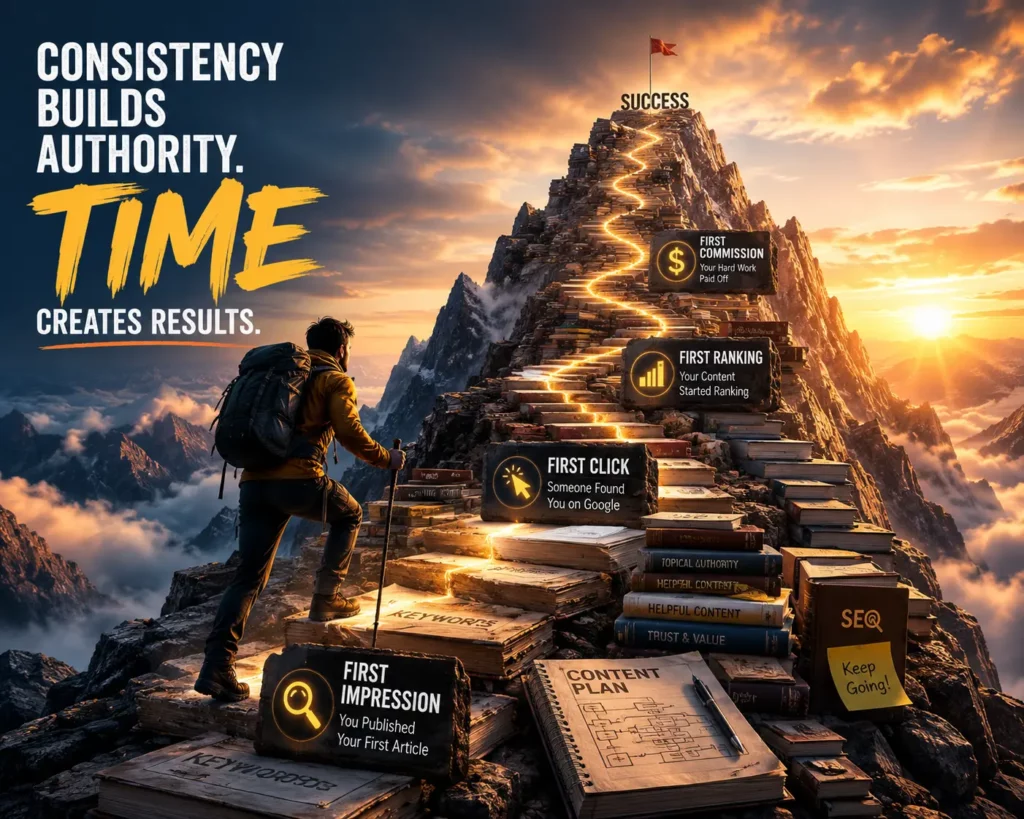
Then gradually introduce more detailed ideas.
For example:
A beginner learning SEO might first need to understand:
- What SEO is.
- Why keywords matter.
- How search engines work.
Later, they become interested in:
- Technical optimization.
- Content clusters.
- Schema markup.
- Search Console data.
- Conversion optimization.
Each article builds naturally on the previous ones.
Readers appreciate that progression because it feels logical instead of overwhelming.
Every Article Should Strengthen the Bigger Picture
It’s tempting to treat each article as an isolated project.
A better approach is to ask:
“How does this article strengthen my overall website?”
Imagine every article as another piece of a puzzle.
Individually, each one has value.
Together, they reveal a much larger picture.
This broader perspective changes how you choose topics.
Instead of asking,
“Will this keyword bring traffic?”
you begin asking,
“Will this topic make my website more complete?”
That’s often a far more valuable question.
Don’t Chase Every Trend
The internet moves quickly.
New tools appear.
Algorithms change.
Platforms rise and fall.
It can be tempting to chase every trending topic in hopes of capturing a burst of traffic.
Sometimes that works.
More often, it distracts you from building lasting authority.
Evergreen content continues helping readers long after headlines fade.
A thorough guide published today may still answer the same questions years from now.
That doesn’t mean you should ignore industry changes.
It simply means your foundation should be built on knowledge that remains valuable regardless of what’s trending this week.
Quality Creates Momentum
One remarkable thing happens when you consistently publish helpful content.
Creating new articles becomes easier.
Why?
Because you’ve already done much of the groundwork.
Suppose you’ve written detailed guides about:
- Keyword research
- Search intent
- Content creation
- On-page SEO
Writing an article about content optimization now becomes much easier because you’ve already explored the surrounding concepts.
Your knowledge compounds.
Your writing becomes more confident.
Your explanations become clearer.
Readers notice.
Search engines notice too.
Topical Authority Helps Readers Stay Longer
Imagine arriving on a website that answers your first question beautifully.
Then you notice another article that solves your next challenge.
And another.
Suddenly, thirty minutes have passed.
You never intended to spend that much time there.
You simply kept finding useful information.
That’s exactly what happens when your content covers a topic thoroughly.
Readers naturally continue learning because every article leads to another question they genuinely wanted answered.
The longer people stay engaged with your website, the stronger the relationship becomes.
Specialization Often Beats Generalization
Large websites often cover thousands of unrelated subjects.
As a new affiliate marketer, that’s not your advantage.
Your strength lies in focus.
Imagine comparing two doctors.
One practices general medicine.
The other specializes entirely in knee injuries.
If your knee hurts, which expert would you choose?
The specialist.
Websites benefit from the same perception.
When your content consistently revolves around one well-defined subject, readers begin associating your brand with expertise in that area.
That focused reputation is incredibly valuable.
Keep Expanding the Conversation
Every article should spark ideas for several more.
Ask yourself after publishing:
- What beginner questions remain unanswered?
- What mistakes deserve their own guide?
- Which tools need deeper explanations?
- Which comparisons would help readers decide?
- What advanced topics naturally follow this one?
Soon you’ll notice something interesting.
You’ll stop wondering what to write next.
Your existing content will continually suggest new opportunities.
That’s one of the biggest advantages of building topical authority.
Ideas begin generating more ideas.
Authority Grows Quietly
One of the challenges with SEO is that progress often happens behind the scenes.
You may not notice dramatic ranking improvements immediately.
Yet your website is gradually becoming more useful.
More complete.
More trustworthy.
Search engines observe those signals over time.
Readers experience them immediately.
Every thoughtful article strengthens your reputation.
Every useful explanation increases confidence.
Every honest recommendation builds credibility.
Those small improvements accumulate.
Eventually, they become difficult to ignore.
Build a Resource, Not Just a Blog
There’s an important difference between publishing blog posts and creating a resource.
A blog often feels like a timeline.
A resource feels timeless.
People don’t visit simply because something is new.
They visit because they know they’ll find dependable answers whenever they need them.
That’s the mindset worth embracing.
Instead of asking,
“What should I publish today?”
consider asking,
“What would make this website dramatically more helpful?”
The answers to that question will guide your content strategy far better than any list of trending keywords.
Trust Is the Real Goal
Topical authority isn’t about impressing algorithms.
It’s about earning confidence.
When readers repeatedly discover thoughtful, well-organized, genuinely useful content on your website, something subtle begins to happen.
They stop wondering whether your advice can be trusted.
They simply assume it can.
That’s an extraordinary position to reach.
Because once trust becomes part of your reputation, every new article benefits from everything you’ve already published.
Your website becomes more than a source of information.
It becomes a destination.
And that’s exactly what long-term SEO success looks like.
Continue to Part 7: On-Page SEO That Makes Every Article Stronger.
Part 7: On-Page SEO That Makes Every Article Stronger
Imagine two houses built from the same blueprint.
They have the same number of rooms.
The same square footage.
The same materials.
But one feels bright, organized, and welcoming the moment you step inside.
The other feels cluttered, confusing, and difficult to navigate.
The difference isn’t the foundation.
It’s the presentation.
On-page SEO works much the same way.
You may have researched the perfect keyword and written an outstanding article, but if that content is difficult to scan, poorly organized, or confusing to both readers and search engines, much of its potential is lost.
Fortunately, improving on-page SEO isn’t about complicated tricks.
It’s about making your content easier to understand.
For people.
And for search engines.
Your Title Is Your First Impression
Before anyone reads your article, they read your title.
That single line has an important job.
It needs to convince someone scrolling through search results that your page is worth clicking.
The strongest titles usually promise one of three things:
- A solution.
- A clear benefit.
- An answer to a specific question.
Good titles also set honest expectations.
If your headline promises a complete beginner’s guide, the article should genuinely deliver one.
If it promises practical advice, readers should find practical advice—not vague theory.
Trust begins with keeping the promise your title makes.
A Great Introduction Keeps Readers From Leaving
Getting someone to click is only the first step.
Now you have to convince them they’ve made the right decision.
Within the opening paragraphs, readers should immediately understand:
- What this article covers.
- Why it matters.
- Who it’s for.
- What they’ll gain by continuing.
Avoid long introductions that delay the real topic.
People rarely arrive because they want a dramatic opening.
They arrive because they want help.
Give them confidence that they’re exactly where they need to be.
Structure Makes Reading Effortless
Imagine opening a page that’s one enormous block of text.
No headings.
No spacing.
No visual breaks.
Even valuable information becomes exhausting when it’s difficult to read.
Now imagine that same information organized with:
- Clear headings.
- Short paragraphs.
- Logical progression.
- Bullet lists where appropriate.
- Plenty of white space.
Suddenly the content feels approachable.
Readers can quickly scan the page, locate the sections they need, and continue reading without feeling overwhelmed.
Structure doesn’t just improve readability.
It improves the overall experience.
Headings Should Guide the Journey
Think of your headings as signposts along a trail.
Each one reassures readers they’re moving in the right direction.
Instead of using generic labels, write headings that naturally encourage curiosity.
Compare these examples.
Generic
Keyword Research
More Engaging
How to Find Keywords That New Websites Can Actually Rank For
The second heading tells readers exactly what they’ll learn while creating enough interest to keep them scrolling.
Every heading should answer one simple question:
“Why should I read this section?”
Make Every Paragraph Easy to Follow
Large paragraphs can feel intimidating, especially on mobile devices.
Breaking ideas into smaller sections creates a smoother reading experience.
Whenever possible:
Focus on one main idea per paragraph.
Move naturally to the next thought.
Allow important ideas room to breathe.
Shorter paragraphs create rhythm.
That rhythm encourages readers to keep moving instead of stopping halfway through the article.
Remember, readability isn’t about making content shorter.
It’s about making it easier to absorb.
Use Keywords Naturally
Many beginners worry about using their target keyword enough.
That concern often leads to awkward writing.
Modern search engines understand context remarkably well.
Instead of repeating the same phrase over and over, concentrate on discussing the topic thoroughly.
Use:
- Related terminology.
- Natural language.
- Synonyms where appropriate.
- Supporting concepts.
- Practical examples.
If you’re genuinely covering the topic in depth, important phrases will usually appear naturally.
Readers should never notice your keyword strategy.
They should simply enjoy the article.
Images Should Add Value
Images aren’t there merely to make a page look attractive.
They should improve understanding.
A screenshot can simplify a technical explanation.
A diagram can clarify a complicated process.
A comparison table can make decisions easier.
Whenever you include visuals, ask yourself:
“Does this help someone understand the topic more quickly?”
If the answer is yes, the image belongs.
If not, it may simply distract from the content.
Thoughtful visuals enhance the learning experience instead of interrupting it.
Internal Flow Matters More Than Fancy Design
Beautiful websites don’t automatically create satisfied readers.
Clear communication does.
Every section should naturally lead into the next.
Avoid sudden jumps between unrelated ideas.
Imagine guiding someone through a conversation.
You wouldn’t randomly change subjects without explanation.
Your articles should feel the same way.
Each paragraph prepares readers for what comes next.
Each section builds on the previous one.
That smooth progression keeps attention focused because the journey feels intentional.
Answer Questions Before Readers Leave
One of the easiest ways to improve an article is to think beyond the primary topic.
Imagine you’re explaining keyword research.
What additional questions might appear?
Perhaps readers wonder:
- How many keywords should one article target?
- Are free keyword tools enough?
- What’s considered low competition?
- How long does ranking usually take?
When you naturally answer these questions within your article, readers have fewer reasons to leave and continue searching elsewhere.
Complete answers create satisfying experiences.
Satisfying experiences often produce stronger SEO performance.
Tables and Lists Improve Clarity
Not every idea belongs inside a paragraph.
Sometimes information becomes much easier to understand when organized visually.
Consider comparisons.
Instead of writing several paragraphs describing two products, a simple table allows readers to identify differences almost instantly.
Likewise, checklists, numbered steps, and bullet points help readers absorb important information more efficiently.
Use these formatting tools whenever they genuinely improve understanding.
The goal isn’t decoration.
It’s clarity.
Make Your Content Easy to Scan
Here’s an interesting reality.
Many people don’t read an article from beginning to end on their first visit.
They scan.
Their eyes jump between headings, lists, highlighted ideas, and short paragraphs.
They’re searching for reassurance that your article contains the answer they need.
Once they find it, they often slow down and begin reading carefully.
That’s why organization matters so much.
Good formatting welcomes scanners without sacrificing depth for dedicated readers.
You can serve both audiences at the same time.
Don’t Forget Mobile Readers
Today, a significant portion of visitors arrive using smartphones.
What looks perfect on a large desktop monitor may feel overwhelming on a small screen.
As you write, imagine someone reading while:
Waiting for a train.
Relaxing on the couch.
Taking a coffee break.
Standing in line at the grocery store.
Short paragraphs, clear headings, and generous spacing become even more valuable on mobile devices.
The easier your content is to consume anywhere, the more enjoyable the experience becomes.
Read Your Article Out Loud
Before publishing, try something surprisingly simple.
Read your article aloud.
You’ll quickly notice:
- Sentences that feel awkward.
- Repeated words.
- Abrupt transitions.
- Sections that sound unnatural.
- Paragraphs that feel too long.
Reading aloud forces you to experience the article the way another person will.
If something sounds clumsy when spoken, it often reads that way too.
Small edits based on this exercise can dramatically improve the overall flow.
Polish Before You Publish
Many writers treat publishing as the finish line.
Instead, think of it as the final inspection before opening your doors.
Ask yourself:
- Is every heading useful?
- Does every paragraph add something meaningful?
- Have I removed unnecessary repetition?
- Is the structure easy to follow?
- Would a complete beginner understand this?
- Have I answered the most important questions?
Taking just a few extra minutes to review your work often produces a noticeably stronger article.
Those small improvements accumulate over time.
Every Page Represents Your Brand
Visitors rarely judge your website based on one sentence.
They judge it based on the overall experience.
Was the article easy to understand?
Did it answer the question completely?
Did it feel trustworthy?
Would they return?
Every page contributes to those impressions.
When you consistently create well-structured, thoughtfully organized, reader-friendly content, you’re doing much more than improving on-page SEO.
You’re creating an experience that encourages people to stay longer, come back again, and confidently recommend your website to others.
That’s exactly the kind of reputation that grows stronger with every article you publish.
Learn more: How to Build an Affiliate SEO Silo That Google Actually Trusts: From Keyword Chaos to Topical Authority
Continue to Part 8: Technical SEO Without the Overwhelm.
Part 8: Technical SEO Without the Overwhelm
The phrase technical SEO has a way of making beginners nervous.
It sounds like something reserved for programmers, web developers, or people who speak in lines of code.
Fortunately, that’s not reality.
You don’t need to become a software engineer to build a website that search engines can understand.
Think of technical SEO this way.
Imagine owning a beautiful bookstore filled with helpful books.
The shelves are organized.
The staff is friendly.
The books are exactly what readers need.
Now imagine the front door is locked.
Or the lights don’t work.
Or the address is missing from every map.
No matter how valuable the books are, people will struggle to find them.
Technical SEO is simply the process of making sure nothing prevents search engines—or visitors—from reaching your content.
It isn’t about clever tricks.
It’s about removing obstacles.
Great Content Still Needs a Strong Foundation
Earlier in this guide, we focused on writing helpful content.
That remains the most important part of SEO.
But even exceptional articles benefit from a technically healthy website.
Search engines first need to:
- Discover your pages.
- Crawl your content.
- Understand your website.
- Store your pages in their index.
- Decide when to show them in search results.
If something interrupts that process, your content has fewer opportunities to appear where people can find it.
That’s why technical SEO supports great writing rather than replacing it.
Crawling: How Search Engines Discover Your Website
Search engines use automated programs, often called crawlers or spiders, to explore the web.
Their job is straightforward.
They move from page to page, following links and collecting information.
Every time you publish a new article, those crawlers eventually arrive to examine it.
They look at:
- The page title.
- Headings.
- Content.
- Images.
- Links.
- Overall structure.
If your website is easy to navigate, crawlers can understand it much more efficiently.
The easier your site is to explore, the easier it becomes for search engines to understand what each page is about.
Indexing: Getting Your Pages Into Search Results
Being crawled isn’t the same as being indexed.
Think of a library.
Receiving a new book doesn’t automatically place it on the shelves.
First, the librarian evaluates it, categorizes it, and adds it to the catalog.
Search engines work similarly.
After crawling your page, they decide whether it deserves a place in their searchable index.
Only indexed pages have the opportunity to appear in search results.
That’s why it’s helpful to monitor your indexing status from time to time.
If an important article isn’t indexed, it’s worth investigating why.
Website Speed Shapes First Impressions
People are remarkably impatient online.
If a page loads slowly, many visitors leave before reading the first sentence.
Search engines know this.
That’s why page speed has become an important part of the overall user experience.
Improving speed doesn’t always require technical expertise.
Often, the biggest improvements come from simple habits like:
- Compressing images before uploading them.
- Choosing reliable website hosting.
- Removing unnecessary plugins.
- Keeping your website software updated.
- Avoiding oversized media files.
A faster website creates a smoother experience for everyone.
Mobile Experience Is No Longer Optional
Years ago, websites were designed primarily for desktop computers.
Today, many visitors arrive on phones or tablets.
That changes everything.
Readers expect:
- Text that’s easy to read.
- Buttons that are easy to tap.
- Images that resize correctly.
- Pages that load quickly.
- Layouts that adapt naturally to smaller screens.
If your website feels frustrating on mobile devices, visitors rarely stay long.
Always review your content on multiple screen sizes before assuming everything looks perfect.
Clear Website Structure Helps Everyone
Imagine entering a grocery store where every product has been placed randomly.
Milk sits beside paint.
Bread is hidden in the electronics aisle.
Nothing follows a logical pattern.
Shopping would become frustrating very quickly.
Websites work the same way.
A logical structure helps both readers and search engines understand how everything fits together.
Organize content into clear categories.
Use descriptive page titles.
Maintain consistent navigation.
Help visitors move naturally through your website instead of forcing them to guess where information belongs.
Organization creates confidence.
XML Sitemaps Make Discovery Easier
An XML sitemap is simply a file that lists the important pages on your website.
Think of it as a directory rather than a shortcut.
It doesn’t guarantee rankings.
It simply helps search engines discover your content more efficiently.
Most modern content management systems generate sitemaps automatically, making this one of the easiest technical SEO improvements you can implement.
Once it’s in place, new content becomes easier for search engines to find.
Robots.txt Helps Guide Search Engines
Despite its intimidating name, the robots.txt file serves a straightforward purpose.
It tells search engine crawlers which parts of your website they should or shouldn’t explore.
For most beginners, there’s little reason to make frequent changes.
The important thing is ensuring you don’t accidentally block valuable content from being crawled.
One small mistake can hide entire sections of your website from search engines.
When in doubt, keep your robots.txt file simple.
HTTPS Builds Confidence
Have you ever noticed the small padlock icon beside a website address?
That’s HTTPS.
It encrypts the connection between your visitors and your website.
Beyond improving security, HTTPS also helps create trust.
People naturally feel more comfortable browsing secure websites.
Today, secure connections are considered standard practice rather than an optional upgrade.
If your website still isn’t using HTTPS, making the switch should be a priority.
Canonical URLs Prevent Confusion
Sometimes the same content can appear through multiple web addresses.
Without guidance, search engines may struggle to determine which version represents the original.
Canonical tags solve this problem.
They point search engines toward the preferred version of a page.
Many website platforms handle canonical tags automatically, so beginners often don’t need to manage them manually.
Still, it’s helpful to understand why they exist.
They reduce confusion and help consolidate ranking signals around the correct page.
Broken Links Create Dead Ends
Imagine following road signs to a destination only to discover the road suddenly disappears.
That’s exactly how broken links feel to visitors.
Broken internal or external links interrupt the user experience and can reduce confidence in your website.
Checking for broken links periodically is a simple maintenance habit that keeps your content reliable.
Every working link reinforces the feeling that your website is actively maintained.
Images Deserve Attention Too
Images improve articles.
But they also affect technical performance.
Whenever possible:
- Choose appropriate image dimensions.
- Compress files without sacrificing quality.
- Use descriptive filenames.
- Add meaningful alt text.
- Avoid uploading images that are much larger than necessary.
These small practices improve loading speed while also making your content more accessible to people using assistive technologies.
Core Web Vitals Focus on Real Experience
You may hear people discussing Core Web Vitals as though they’re mysterious SEO secrets.
They’re actually measurements of user experience.
They evaluate things like:
- How quickly the main content appears.
- How responsive the page feels.
- Whether elements unexpectedly shift while loading.
You don’t need to memorize every technical metric.
Simply remember the larger goal.
Create pages that feel fast, stable, and pleasant to use.
That’s what these measurements are trying to encourage.
Technical SEO Is Ongoing Maintenance
Many people imagine technical SEO as a task completed once and forgotten forever.
In reality, it’s more like maintaining a home.
Occasionally you’ll need to:
- Update software.
- Check website speed.
- Review indexing.
- Fix broken links.
- Test mobile usability.
- Verify security settings.
These small maintenance habits prevent minor issues from becoming major problems later.
A little attention on a regular basis is far easier than repairing a neglected website.
Don’t Let Technical SEO Intimidate You
It’s easy to believe successful websites are powered by complicated technical secrets.
Most aren’t.
They simply avoid common problems.
If your website:
- Loads quickly.
- Works well on mobile devices.
- Has a clear structure.
- Uses secure connections.
- Makes content easy to discover.
- Receives occasional maintenance.
You’re already doing many of the things that matter most.
Technical SEO isn’t about perfection.
It’s about creating an environment where your excellent content has every opportunity to succeed.
When the technical foundation is solid, search engines can spend less time overcoming obstacles and more time recognizing the value you’ve worked so hard to create.
Continue to Part 9: Writing Affiliate Content That Builds Trust and Converts.
Part 9: Writing Affiliate Content That Builds Trust and Converts
Getting someone to visit your website is a victory.
Getting them to trust you is something far more valuable.
Traffic can come and go.
Search rankings can rise and fall.
Algorithms will continue to evolve.
But trust has a remarkable way of surviving all of those changes.
It’s also the one ingredient that separates affiliate websites people genuinely appreciate from those that feel like endless advertisements.
Readers don’t arrive hoping to be sold something.
They arrive hoping to solve a problem.
If you never lose sight of that simple truth, your affiliate content will naturally become more persuasive—without ever feeling pushy.
The Best Affiliate Content Doesn’t Feel Like Marketing
Think about the last recommendation you accepted from a friend.
They probably didn’t begin the conversation by trying to convince you to buy something.
They listened.
They understood your situation.
They shared their experience.
Then they suggested something they believed would genuinely help.
Good affiliate content follows that same rhythm.
It begins with understanding.
Not selling.
Readers quickly recognize the difference.
One article feels like a conversation.
The other feels like a sales pitch.
Guess which one earns repeat visitors.
Solve the Problem Before Mentioning the Product
A surprisingly common mistake is introducing an affiliate product before the reader fully understands why they might need it.
Imagine someone searching:
How do I improve my website’s SEO?
If the first recommendation is an expensive SEO tool, the reader may feel rushed.
Instead, begin by explaining:
- Why SEO matters.
- What influences rankings.
- Which challenges beginners usually face.
- What can realistically be achieved.
Once readers understand the problem, introducing a tool that simplifies the process feels natural.
The recommendation becomes part of the solution rather than the focus of the article.
That small change dramatically improves the reader’s experience.
Teach First. Recommend Second.
People remember teachers.
They forget advertisements.
Every affiliate article should leave readers feeling that they learned something valuable, even if they never click a recommendation.
That’s an important mindset.
Your article should still be worth reading if every affiliate link disappeared tomorrow.
If readers finish your content thinking,
“That was genuinely helpful,”
you’ve already achieved something significant.
Affiliate recommendations simply become the next logical step for readers who want additional help.
Explain Benefits Instead of Listing Features
Many product descriptions focus almost entirely on specifications.
Readers usually care far more about outcomes.
Consider these two examples.
Feature:
“This software includes automated keyword tracking.”
Benefit:
“You’ll spend less time checking rankings manually and more time creating content that attracts visitors.”
The feature describes what the product does.
The benefit explains why it matters.
Whenever you recommend a product, ask yourself:
“How will this improve the reader’s life?”
Answering that question creates much stronger recommendations.
Build Confidence With Honest Reviews
One of the fastest ways to lose credibility is pretending every product is perfect.
Readers know better.
Every tool has strengths.
Every product has limitations.
Acknowledging both immediately makes your review feel more trustworthy.
Instead of saying:
“This is the best tool for everyone.”
Consider saying:
“This tool is an excellent choice for beginners who value simplicity, but experienced users may eventually need more advanced features.”
That balanced approach demonstrates that you’re trying to help readers make the right decision—not simply earn a commission.
Honesty builds confidence.
Confidence builds trust.
Help Readers Compare Their Options
Making decisions can be surprisingly stressful.
Especially when several products appear similar.
Comparison articles reduce that uncertainty by organizing information clearly.
For example, you might compare:
- Ease of use.
- Pricing.
- Customer support.
- Learning curve.
- Key features.
- Best use cases.
When readers can quickly understand the differences, choosing becomes much easier.
You’re no longer asking them to guess.
You’re helping them think.
That’s incredibly valuable.
Tell Stories That Readers Recognize
Facts inform.
Stories connect.
Suppose you’re explaining why consistency matters in SEO.
Instead of simply stating:
“Publishing regularly improves long-term growth.”
Paint a picture.
Describe a beginner who published one helpful article every week.
At first, almost nobody visited.
Months later, search impressions began increasing.
Then came the first organic visitors.
Eventually, one article started ranking well.
Then another.
Suddenly, what once felt impossible became measurable progress.
Readers remember stories because they imagine themselves inside them.
Stories make abstract ideas feel achievable.
Address Objections Before They Become Doubts
Every reader carries invisible questions.
Sometimes they don’t even realize it.
While discussing a recommendation, think about what might make someone hesitate.
Perhaps they’re wondering:
- Is this too expensive?
- Is it difficult to use?
- Do I really need it?
- Are there free alternatives?
- Will it work for beginners?
Answer those concerns openly.
Removing uncertainty is often far more persuasive than adding excitement.
People rarely regret understanding their options more clearly.
Recommendations Should Feel Timely
Affiliate links work best when they appear exactly where readers expect them.
Imagine reading an article about building a deck.
After explaining why accurate measurements matter, recommending a quality measuring tape feels perfectly natural.
Now imagine placing that same recommendation in an article about lawn care.
It would seem random.
Relevance matters.
Recommendations should appear because readers genuinely benefit from seeing them at that moment—not because every paragraph needs an affiliate link.
Thoughtful placement feels helpful.
Forced placement feels distracting.
Remember That Most Readers Won’t Buy Today
One of the biggest mistakes affiliate marketers make is expecting every visitor to convert immediately.
Most won’t.
Some readers are only beginning their research.
Others are comparing options.
Many simply aren’t ready yet.
That’s perfectly normal.
A helpful article can still produce value long before a purchase happens.
Someone may:
- Bookmark your guide.
- Join your email list.
- Return weeks later.
- Recommend your article to a friend.
- Buy after reading several more pieces of content.
Every positive interaction strengthens your relationship with that reader.
Conversions often happen because of accumulated trust—not instant persuasion.
Write Like a Real Person
Readers have become remarkably good at recognizing generic marketing language.
Phrases like:
“This revolutionary solution will transform your life!”
often create skepticism rather than excitement.
Instead, write the way thoughtful people speak.
Be specific.
Be realistic.
Acknowledge limitations.
Share practical advice.
Readers don’t expect perfection.
They appreciate authenticity.
A calm, confident recommendation often carries far more influence than exaggerated promises ever could.
Think Beyond the First Commission
It’s easy to celebrate an affiliate sale.
And you should.
But sustainable affiliate businesses aren’t built around individual commissions.
They’re built around loyal readers.
A visitor who trusts your recommendations today may continue returning for years.
They may purchase multiple products.
They may recommend your website to others.
They may become one of your most valuable long-term readers.
That relationship is worth far more than a single transaction.
Every article is an opportunity to strengthen it.
Measure Success by Reader Satisfaction
Commissions matter.
Clicks matter.
Traffic matters.
But they don’t tell the whole story.
Pay attention to signals that reveal whether readers actually value your content.
Ask yourself:
- Are visitors spending time reading?
- Are they exploring additional articles?
- Are they returning later?
- Are they subscribing to updates?
- Are your recommendations receiving thoughtful engagement?
Those behaviors often indicate something much deeper than simple traffic.
They suggest your website is becoming a trusted resource.
And trusted resources naturally outperform websites built solely around selling.
The Goal Is to Become the Guide Readers Remember
Affiliate marketing isn’t really about products.
It’s about helping people make confident decisions.
Products simply happen to be part of that journey.
If every recommendation grows naturally from genuine education…
If every review values honesty over hype…
If every article leaves readers feeling smarter than when they arrived…
Something remarkable begins to happen.
People stop visiting your website only because Google recommended it.
They begin returning because they recommend it to themselves.
That’s the kind of trust that no algorithm update can easily replace.
And in the long run, it’s one of the greatest advantages an affiliate marketer can ever build.
Continue to Part 10: Measuring Progress and Improving Your Rankings.
Part 10: Measuring Progress and Improving Your Rankings
One of the hardest parts of SEO isn’t writing articles.
It isn’t researching keywords.
It isn’t learning technical optimization.
It’s waiting.
Waiting is uncomfortable because progress in SEO rarely announces itself with fireworks.
More often, it arrives quietly.
A few extra impressions this week.
A handful of new keywords appearing in search results.
An article climbing from page eight to page four.
Then page two.
Then, almost unexpectedly, page one.
People who succeed with SEO understand something that beginners often don’t.
Growth is usually invisible before it becomes obvious.
That’s why measuring the right things matters so much.
If you focus on the wrong numbers, you’ll convince yourself you’re failing—even when you’re actually moving in exactly the right direction.
Stop Judging Success One Day at a Time
Imagine planting an apple tree.
You water it.
Protect it.
Care for it.
Would you dig it up every morning to check whether the roots are growing?
Of course not.
You trust the process.
SEO deserves the same mindset.
Checking rankings several times a day won’t make them improve any faster.
If anything, it creates unnecessary frustration.
Instead of asking,
“Did my website grow today?”
ask yourself,
“Is my website stronger than it was last month?”
That question leads to much healthier—and much more accurate—expectations.
Organic Traffic Is Only Part of the Story
When most people think about SEO, they think about visitors.
Traffic certainly matters.
Without visitors, your content can’t help anyone.
But traffic is only one piece of a much larger picture.
A website with modest traffic but highly engaged readers can outperform a website attracting thousands of uninterested visitors.
Quality almost always matters more than raw numbers.
Instead of chasing traffic alone, pay attention to whether the right people are finding your content.
Relevant visitors are far more valuable than random clicks.
Impressions Tell You More Than You Think
One of the most encouraging metrics for a new website is search impressions.
An impression simply means your page appeared somewhere in Google’s search results.
Even if nobody clicked.
Many beginners ignore this number because they assume impressions without clicks have little value.
That’s a mistake.
Impressions often signal that Google is beginning to understand your content.
Your articles are entering conversations.
Search engines are testing where your pages belong.
Those early appearances often come long before meaningful traffic arrives.
Think of impressions as the first signs of life beneath the surface.
They often appear before visible growth.
Rankings Naturally Move Around
Watching rankings can feel like riding a roller coaster.
One week you’re in position twelve.
The next week you’re seventeen.
Then ten.
Then fourteen.
Fluctuation is completely normal.
Search engines constantly evaluate content.
Competitors publish updates.
User behavior changes.
New websites appear.
Old websites improve.
Treat rankings like weather.
Interesting to observe.
Not something worth panicking over every time they change.
The important question isn’t whether a keyword moved two places today.
It’s whether your overall trend continues moving upward over time.
Learn to Appreciate Small Victories
One of the reasons SEO feels discouraging is because many people overlook meaningful progress.
Consider these milestones:
Your first indexed article.
Your first organic visitor.
Your first article ranking in the top fifty.
Your first keyword reaching page one.
Your first affiliate commission from search traffic.
Each achievement proves something important.
Your website is moving forward.
Celebrate those moments.
They’re the building blocks of much larger successes later.
Google Search Console Is One of Your Greatest Teachers
Many paid SEO tools provide useful insights.
But one of the most valuable resources available costs nothing.
Google Search Console offers a direct view into how Google sees your website.
It can help you discover:
- Which pages receive impressions.
- Which searches generate clicks.
- Average keyword positions.
- Indexing issues.
- Technical warnings.
- Mobile usability concerns.
Instead of guessing what Google thinks about your content, you gain evidence.
That evidence helps you make better decisions.
The more familiar you become with Search Console, the less you’ll rely on assumptions.
Analytics Reveal Reader Behavior
Traffic tells you people arrived.
Analytics tells you what they actually did.
Did they stay?
Did they leave after a few seconds?
Did they continue exploring your website?
Did one article perform far better than expected?
These patterns reveal valuable lessons.
Sometimes a page with relatively little traffic generates exceptional engagement.
That often signals an opportunity to expand the topic.
Likewise, an article attracting many visitors but losing them quickly may need clearer explanations or a stronger structure.
Data isn’t there to discourage you.
It’s there to guide your next improvement.
Updating Content Is Part of the SEO Process
Many beginners believe publishing marks the end of an article’s journey.
Experienced website owners know it’s often just the beginning.
Returning to older content allows you to:
- Improve explanations.
- Add recent information.
- Correct outdated advice.
- Expand useful sections.
- Improve readability.
- Clarify confusing examples.
These updates help readers.
They also signal that your content remains current and well maintained.
Think of your articles as living resources rather than finished products.
Every improvement increases their long-term value.
Focus on Pages With Hidden Potential
Not every article deserves the same amount of attention.
Some pages naturally show greater promise than others.
Pay special attention to articles that:
- Receive many impressions but relatively few clicks.
- Rank just outside the first page.
- Keep readers engaged for longer periods.
- Consistently attract search traffic.
These pages often require only a few thoughtful improvements to produce significantly better results.
Sometimes refining an existing article creates more growth than publishing a completely new one.
Knowing where to invest your time becomes increasingly important as your website grows.
Compare Yourself Only With Yesterday
One of the fastest ways to become discouraged is comparing your website with businesses that have been publishing for ten or fifteen years.
Their results represent thousands of hours of work.
Your only meaningful comparison is your own progress.
Ask questions like:
- Is my writing clearer than it was six months ago?
- Am I researching topics more effectively?
- Have I improved my article structure?
- Is my website becoming more helpful?
- Am I publishing consistently?
These are the habits that create sustainable success.
Long before your traffic doubles, your skills will have improved dramatically.
Those skills eventually become visible in your results.
Build a Monthly Review Habit
Instead of checking statistics every few hours, establish a simple monthly review.
Spend time looking at the bigger picture.
Review:
- Organic traffic.
- Search impressions.
- Indexed pages.
- Keyword growth.
- Reader engagement.
- Website speed.
- Technical issues.
- Content opportunities.
Then decide on one or two improvements for the coming month.
This habit keeps you focused on meaningful progress instead of daily fluctuations.
SEO rewards consistency far more than constant monitoring.
Patience Is a Competitive Advantage
Here’s something many people never realize.
Patience itself creates an advantage.
Every month, countless new website owners give up.
Some stop after publishing five articles.
Others quit after twenty.
Not because SEO doesn’t work.
Because they expected results far sooner than search engines typically deliver them.
The people who continue publishing…
Continue learning…
Continue improving…
Continue updating…
Gradually separate themselves from those who left too early.
Persistence quietly eliminates much of the competition.
Measure What Truly Matters
If you only remember one lesson from this chapter, let it be this:
SEO success isn’t measured by one spectacular day.
It’s measured by steady improvement over hundreds of ordinary ones.
Every article that earns a few more impressions…
Every update that helps readers understand a topic more clearly…
Every month that leaves your website stronger than before…
Those are the moments that matter.
Because long-term growth is rarely built through dramatic breakthroughs.
It’s built through small improvements repeated so consistently that, one day, they become impossible to ignore.
When you learn to recognize those quieter signs of progress, you’ll stop wondering whether SEO is working.
You’ll begin seeing the evidence all around you.
Continue to Part 11: The Most Common SEO Mistakes Beginners Make.
Part 11: The Most Common SEO Mistakes Beginners Make
Every successful website has a history you never get to see.
You see the polished articles.
The steady stream of visitors.
The growing authority.
The affiliate income.
What you don’t see are the headlines that never ranked.
The keywords that were too competitive.
The articles that needed to be rewritten.
The months when almost nobody visited.
Behind nearly every successful affiliate website is a long list of lessons learned through trial and error.
The encouraging part?
Most beginner mistakes are completely avoidable once you know what to look for.
This chapter isn’t about pointing out failures.
It’s about helping you sidestep the obstacles that cause so many new website owners to lose momentum long before their strategy has a chance to work.
Mistake #1: Trying to Rank for the Biggest Keywords
It’s easy to fall into this trap.
You search for a topic.
You discover a keyword with hundreds of thousands of monthly searches.
It feels like the obvious choice.
The problem is that thousands of other websites had the same idea years ago.
Those search results are often filled with established brands that have spent years building authority.
Competing head-on rarely makes sense for a brand-new website.
Instead, focus on specific questions that larger websites often overlook.
Winning hundreds of smaller opportunities is usually far more realistic than chasing one enormous keyword.
Those smaller victories also build the authority you’ll need to compete for broader topics later.
Mistake #2: Writing Before Understanding Search Intent
Many beginners become excited about a keyword and immediately begin writing.
Only later do they discover that their article doesn’t match what people were actually searching for.
Imagine someone searching for:
Best beginner DSLR camera
If they land on an article explaining how cameras work instead of comparing products, they’ll probably leave.
The keyword may be correct.
The intent isn’t.
Before writing anything, study the existing search results.
Notice:
- What type of content appears.
- How the topic is structured.
- Which questions are answered.
- What readers seem to expect.
Matching search intent is one of the strongest foundations of successful SEO.
Mistake #3: Publishing Thin Content
Some website owners believe publishing quickly is the secret to growth.
Speed has its place.
But shallow content rarely creates lasting value.
Ask yourself honestly:
If someone finishes reading your article, will they feel their question has been fully answered?
Or will they immediately return to Google looking for another explanation?
Your goal isn’t simply to create content.
Your goal is to eliminate the reader’s need to keep searching.
That usually requires thoughtful explanations, practical examples, and answers to the questions beginners naturally ask next.
Mistake #4: Writing for Algorithms Instead of People
Years ago, SEO advice often revolved around keyword density and repetitive optimization techniques.
Today’s search landscape looks very different.
Search engines have become remarkably good at recognizing natural language.
That means your first priority should always be readability.
Write as though you’re helping a real person sitting across the table.
Explain ideas clearly.
Use examples.
Acknowledge confusion.
Guide readers from one concept to the next.
When people enjoy your content, optimization tends to happen naturally.
Mistake #5: Publishing Random Topics
Imagine visiting a website where the latest articles include:
- How to train a puppy.
- The best smartphones.
- Organic gardening tips.
- Retirement investing.
- Healthy smoothie recipes.
Individually, each article may be helpful.
Together, they send a confusing message.
What does this website actually specialize in?
Search engines ask similar questions.
Topical authority grows when your articles reinforce one another rather than competing for attention across unrelated subjects.
Choose a clear direction and stay committed to it.
Depth almost always outperforms randomness.
Mistake #6: Expecting SEO to Work Overnight
Few marketing strategies reward patience more than SEO.
Unfortunately, patience has become increasingly rare.
Many beginners publish ten or twenty articles.
They wait a few weeks.
Traffic barely moves.
Discouragement follows.
The reality is that search engines need time.
New websites often spend months establishing trust before meaningful rankings begin to appear.
If your content genuinely helps readers, those quiet months aren’t wasted.
They’re an investment.
The work happening beneath the surface often becomes visible later.
Mistake #7: Ignoring Older Articles
Publishing new content is exciting.
Updating older content isn’t nearly as glamorous.
Yet refreshing existing articles is often one of the highest-value activities you can perform.
Perhaps a guide could use:
- Better examples.
- Clearer explanations.
- Updated statistics.
- Improved formatting.
- New sections answering common questions.
Every improvement strengthens an asset you’ve already created.
Over time, these updates help your website remain useful, accurate, and competitive.
Mistake #8: Forgetting the Technical Basics
Technical SEO doesn’t need to become an obsession.
But it shouldn’t be ignored either.
Sometimes an article struggles simply because of preventable issues like:
- Slow loading times.
- Broken links.
- Mobile usability problems.
- Pages that haven’t been indexed.
- Poor website organization.
Fortunately, these issues are usually easier to fix than creating an entirely new article.
A technically healthy website gives your content the best possible opportunity to perform well.
Mistake #9: Measuring Success Too Narrowly
It’s natural to focus on rankings.
They’re visible.
They’re easy to track.
But they’re only one indicator of progress.
A healthier perspective includes questions like:
- Are impressions increasing?
- Are more pages being indexed?
- Are visitors spending longer on the website?
- Are articles becoming more comprehensive?
- Is my understanding of SEO improving?
When you broaden your definition of progress, you’ll recognize success much earlier.
And that motivation often fuels continued consistency.
Mistake #10: Copying Instead of Contributing
Researching competitors is valuable.
Copying them isn’t.
If every article simply repeats what’s already ranking, readers have little reason to choose your version.
Ask yourself:
- Can I explain this more simply?
- Can I provide better examples?
- Can I organize the information more clearly?
- Can I answer questions others ignored?
- Can I make this more useful for complete beginners?
Originality doesn’t require inventing new facts.
It requires presenting familiar information in a way that’s genuinely more helpful.
That’s what readers remember.
Mistake #11: Chasing Every New SEO Trend
Every year brings a new wave of predictions.
A new ranking factor.
A new content strategy.
A new optimization technique.
Some are valuable.
Many disappear as quickly as they arrived.
If you spend all your time chasing the latest trend, you’ll rarely make meaningful progress on the fundamentals.
Helpful content.
Clear organization.
Strong user experience.
Logical website structure.
Trustworthy recommendations.
These principles have remained important through countless algorithm updates.
Build your website around enduring practices rather than temporary excitement.
Mistake #12: Giving Up Just Before Momentum Arrives
This is the mistake that quietly ends more affiliate websites than any algorithm ever could.
People quit.
Not because their strategy was fundamentally wrong.
Because they underestimated how long meaningful SEO growth often takes.
Imagine stopping after publishing thirty excellent articles.
Then imagine publishing thirty more.
Then another thirty.
The difference between those two decisions can completely change the future of a website.
Momentum doesn’t usually arrive after one article.
It grows from consistent effort that compounds month after month.
The people who experience lasting success aren’t always the most talented writers.
They’re often the ones who simply kept showing up.
Build Systems Instead of Depending on Motivation
Motivation is unpredictable.
Some days you’ll feel inspired.
Other days, writing even a few paragraphs may feel difficult.
That’s why successful affiliate marketers rely on routines rather than emotions.
Create a simple publishing system.
Decide:
- How often you’ll publish.
- When you’ll research topics.
- When you’ll review existing articles.
- When you’ll check your website’s performance.
A consistent routine removes many of the decisions that drain energy.
Over time, publishing becomes a habit rather than a struggle.
Every Mistake Teaches You Something Valuable
One article doesn’t rank.
Good.
Now you know to examine search intent more carefully.
A keyword proves more competitive than expected.
Excellent.
You’ve learned something about your niche.
An article attracts readers but few conversions.
That’s useful too.
Now you can improve how you explain solutions and present recommendations.
Viewed this way, mistakes stop feeling like failures.
They become feedback.
And feedback is one of the fastest paths to improvement.
Progress Belongs to the Persistent
Every successful affiliate website reaches a moment where the effort finally begins matching the results.
The challenge is that nobody knows exactly when that moment will arrive.
What you can control is everything that comes before it.
Publishing helpful content.
Improving older articles.
Learning from your mistakes.
Listening to your audience.
Remaining consistent when progress feels slow.
Those habits create a website that becomes stronger with every passing month.
Long-term SEO success isn’t built by avoiding every mistake.
It’s built by learning from each one, making thoughtful improvements, and continuing long after others have decided to quit.
Continue to Part 12: Your 12-Month SEO Growth Plan, Bonus, FAQ, and Products / Tools / Resources.
Part 12: Your 12-Month SEO Growth Plan
If you’ve made it this far, you’ve already done something many aspiring affiliate marketers never do.
You’ve taken the time to understand the process instead of chasing shortcuts.
That’s important because sustainable SEO has never been about finding secret ranking factors.
It’s about building something that deserves to be found.
The websites that continue attracting visitors year after year weren’t created through one brilliant article or one lucky keyword.
They were built through consistent decisions made over months—sometimes years.
Think of this roadmap as your blueprint.
Not a rigid set of rules.
A practical direction that keeps your attention focused on what truly moves the needle.
Month 1: Build the Right Foundation
Your first month should focus on preparation rather than perfection.
Choose your niche with care.
Understand the audience you want to help.
Map out the major topics you’ll eventually cover.
Set up your website properly.
Learn how Google Search Console works.
Publish your first few comprehensive articles without worrying about immediate rankings.
Your only goal is to create a strong foundation.
Traffic comes later.
Months 2–3: Build Content Momentum
Now it’s time to develop consistency.
Focus on publishing high-quality content that answers specific questions your audience is already asking.
Each article should:
- Solve one clear problem.
- Match search intent.
- Be easy to read.
- Include practical examples.
- Leave readers feeling more confident than when they arrived.
Don’t worry if traffic is still limited.
At this stage you’re building trust with search engines as much as you’re helping readers.
Every helpful article increases your long-term potential.
Months 4–6: Become Noticeably More Helpful
This is where many websites begin separating themselves from the competition.
Instead of jumping into unrelated topics, continue expanding your expertise.
Ask yourself:
- Which beginner questions remain unanswered?
- Which articles deserve a deeper follow-up?
- Which subjects naturally connect together?
Your website should begin feeling less like a collection of blog posts and more like a complete learning resource.
This is also a good time to review older articles and improve anything that no longer represents your best work.
Months 7–9: Refine What Already Exists
Many website owners believe growth only comes from publishing more content.
Sometimes the opposite is true.
Now is the perfect time to improve your strongest articles.
Look for opportunities to:
- Clarify explanations.
- Add new examples.
- Update outdated information.
- Improve formatting.
- Expand sections readers find valuable.
Small improvements across multiple articles often produce surprisingly large gains over time.
Think of your website as something that continues evolving rather than something that’s ever truly finished.
Months 10–12: Build on Your Strengths
By now, patterns should begin appearing.
Certain topics will naturally attract more visitors.
Some articles will keep readers engaged much longer than others.
Some recommendations will resonate more strongly.
Pay attention.
Success leaves clues.
Instead of trying to become everything for everyone, continue strengthening the areas where your website already performs well.
Depth creates authority.
Authority attracts trust.
Trust creates long-term growth.
Think Like a Builder, Not a Sprinter
SEO rewards people who keep building when there isn’t much visible evidence that anything is happening.
Imagine constructing a stone bridge.
Each stone seems insignificant on its own.
But remove enough of them, and the bridge never reaches the other side.
Every article you publish matters.
Every improvement matters.
Every lesson matters.
None of them may feel life-changing individually.
Together, they become a website capable of helping thousands of people.
Keep Learning as Search Continues to Evolve
Search technology will continue changing.
Artificial intelligence will become more sophisticated.
User behavior will shift.
New tools will appear.
Yet one principle remains remarkably stable.
People still want trustworthy answers.
Whether someone asks a search engine, an AI assistant, or another platform, the goal is the same.
They want reliable guidance from sources they can trust.
That’s why genuinely helpful content continues to stand the test of time.
Trust Is the Asset You’re Really Building
Visitors matter.
Rankings matter.
Affiliate commissions matter.
But beneath all of them sits something even more valuable.
Reputation.
Every article teaches readers what they can expect from your website.
Will you answer their questions honestly?
Will you explain difficult concepts clearly?
Will your recommendations genuinely help them?
Those impressions accumulate.
Eventually, people stop arriving because a search engine suggested your website.
They return because they remember it.
That’s one of the most rewarding milestones any website owner can reach.
Success Is Rarely Sudden
Many people imagine success as a dramatic breakthrough.
A viral article.
A flood of visitors.
An overnight surge in affiliate sales.
Sometimes those moments happen.
More often, success grows quietly.
An article published months ago begins climbing the rankings.
Another starts attracting backlinks naturally.
Readers begin returning.
Your email list slowly grows.
Then one day you look back and realize your website has become something much larger than you imagined when you started.
That’s how sustainable businesses are usually built.
One thoughtful decision after another.
The Website You Build Today Can Keep Working Tomorrow
Perhaps the greatest advantage of SEO is that your work continues creating opportunities long after you’ve finished writing.
An article published today may help someone six months from now.
Or two years from now.
Or even longer.
Unlike many marketing activities that stop producing results the moment you stop paying for them, valuable content can continue serving readers for years when it’s maintained and kept current.
That’s why every article should be treated like a long-term investment.
Not a temporary campaign.
Bonus: The 30-Day SEO Action Plan Every New Affiliate Marketer Should Follow
If starting feels overwhelming, simplify your focus.
Forget about mastering everything at once.
Spend your first month building strong habits instead.
Week 1: Build Your Foundation
- Choose one focused niche.
- Define your ideal audience.
- Research at least 50 long-tail keyword ideas.
- Organize those ideas into logical topic clusters.
- Set up Google Search Console and Google Analytics.
- Create a simple publishing calendar.
Week 2: Publish Your First Cornerstone Articles
- Write three to five detailed, beginner-friendly guides.
- Focus on solving genuine problems.
- Use clear headings and short paragraphs.
- Add helpful examples wherever possible.
- Review every article before publishing.
Week 3: Improve Before Expanding
- Review your published articles with fresh eyes.
- Improve introductions and headings.
- Add missing explanations.
- Check your website on desktop and mobile.
- Ensure pages load quickly and are easy to navigate.
Week 4: Create a Sustainable Routine
- Plan your next 20 article ideas.
- Group them into related topic clusters.
- Schedule regular writing sessions.
- Review Search Console for indexing progress.
- Commit to consistency instead of perfection.
Complete these four weeks successfully and you’ll have something many people never achieve—a strong foundation that can continue growing for years.
Frequently Asked Questions
Do I need to be an SEO expert before launching an affiliate website?
Not at all.
Most successful website owners learned SEO by applying it, not by mastering every concept beforehand. Start with the fundamentals, publish consistently, and let each article teach you something new.
How long should I expect to wait before seeing results?
Every website grows at its own pace, but meaningful organic traffic usually takes patience. Some articles begin receiving impressions within weeks, while significant growth often develops over several months of consistent publishing.
Is publishing more articles always better?
Only if those articles genuinely help your audience.
Ten exceptional resources that completely answer important questions will usually outperform fifty articles that barely scratch the surface.
Should I update older content or focus only on creating new articles?
Both matter.
Publishing expands your website, while updating strengthens what you’ve already built. The healthiest websites make time for both activities.
Can a new website compete with established brands?
Absolutely.
Instead of trying to outrank major websites for broad keywords immediately, focus on answering specific questions exceptionally well. As your authority grows, larger opportunities naturally become more realistic.
Is SEO still worth learning now that AI is changing search?
Yes.
AI is changing how information is delivered, but it still depends heavily on trustworthy, well-structured, authoritative content. Websites that consistently help people solve real problems remain valuable regardless of how search technology evolves.
Products / Tools / Resources
The following tools can make building and growing an affiliate website significantly easier. You don’t need every one of them on day one, but each serves a valuable purpose as your site develops.
Website Platform
- WordPress for flexibility, scalability, and full control over your content.
Website Hosting
- A fast, reliable hosting provider that delivers strong uptime, quick page loading, and dependable customer support.
Keyword Research Tools
- Google Keyword Planner
- Ahrefs
- Semrush
- Ubersuggest
- LowFruits
Search Performance
- Google Search Console for monitoring indexing, impressions, clicks, and search performance.
Website Analytics
- Google Analytics for understanding visitor behavior, engagement, and traffic sources.
Writing and Editing
- Grammarly for grammar and clarity.
- Hemingway Editor for improving readability.
Image Creation
- Canva for featured images, infographics, and social media graphics.
Technical SEO
- PageSpeed Insights to identify website performance improvements.
Affiliate Network Ideas
- Amazon Associates
- ClickBank
- ShareASale
- CJ Affiliate
- Impact
Productivity
- A simple content calendar or project management tool to organize article ideas, publishing dates, and ongoing content improvements.
Build your website patiently. Improve it consistently. Help your readers generously. If you make those three habits the foundation of your work, you’ll create a resource that continues earning trust—and organic traffic—for years to come.