
Featured Snippet
A profitable faceless YouTube channel allows you to create videos without appearing on camera while earning income through advertising, affiliate marketing, sponsorships, and digital products. By choosing the right niche, publishing helpful content consistently, and using modern tools to streamline production, even complete beginners can build a channel that grows into a valuable long-term online business from home.
Table of Contents
- You Don’t Have to Show Your Face to Succeed on YouTube
- What Is a Faceless YouTube Channel?
- Why Faceless Channels Are Growing So Fast
- How Faceless YouTube Channels Make Money
- Choosing a Profitable Evergreen Niche
- Creating a Long-Term Content Strategy
- Writing Engaging Scripts and Videos
- Choosing Visuals, Voiceovers, and Editing Techniques
- Optimizing Videos for YouTube Search
- Increasing Clicks, Watch Time, and Audience Retention
- Monetization Strategies Beyond Ad Revenue
- Building a Sustainable YouTube Business
- Common Mistakes to Avoid
- Habits of Successful Faceless YouTube Creators
- Frequently Asked Questions
- Products, Tools, and Resources
- Bonus: A 30-Day Faceless YouTube Launch Plan
You Don’t Have to Be Famous to Build Something Valuable
For years, YouTube seemed like a platform reserved for confident presenters, charismatic entertainers, and people who loved being in front of a camera. If you were shy, valued your privacy, or simply didn’t enjoy filming yourself, it often felt like the door to YouTube success was closed before you even reached it.
That idea no longer reflects reality.
Spend enough time on YouTube today, and you’ll discover channels attracting millions of views where the creator never appears on screen. Some rely on beautiful animations. Others use narrated screen recordings, cinematic stock footage, simple graphics, or carefully edited visuals that keep the focus exactly where it belongs—on the information being shared.
Most viewers don’t care whether they ever see the person behind the channel.
They care about whether the video answers their question, solves their problem, teaches them something useful, or simply makes the next ten minutes worth their time.
That’s an important shift.
It means the opportunity is no longer limited to natural performers. It’s open to teachers, researchers, writers, problem-solvers, hobbyists, and curious people who genuinely enjoy helping others.
In many ways, today’s creator economy rewards knowledge just as much as personality.
At the same time, technology has quietly removed many of the obstacles that once discouraged beginners. Tasks that previously demanded expensive software or years of editing experience can now be completed with tools that are affordable, intuitive, and designed to save time rather than create more work.
None of this guarantees success.
There are still millions of videos competing for attention every day. Viewers remain selective, and YouTube’s recommendation system has become increasingly sophisticated about identifying content people genuinely appreciate.
That’s actually good news.
It means sustainable growth is driven less by gimmicks and more by consistently publishing videos that people find useful, engaging, and worth returning to.
Whether your goal is creating an additional income stream, replacing a traditional job, building a location-independent business, or simply exploring a creative project that has real financial potential, a faceless YouTube channel offers one of the most accessible opportunities available today.
This guide will walk you through the entire process—from choosing the right niche and creating compelling videos to growing an audience and turning that attention into lasting income.
If you’ve been waiting for permission to begin because you thought you needed expensive equipment, professional editing skills, or the confidence to be on camera, consider this your reminder that none of those things are the true starting point.
The real starting point is deciding to create something people genuinely want to watch.
What Exactly Is a Faceless YouTube Channel?
A faceless YouTube channel is exactly what it sounds like.
It’s a channel where the creator remains behind the scenes while the content takes center stage.
Instead of appearing on camera, creators communicate through visuals, narration, demonstrations, animations, recordings, or carefully edited footage that supports the message.
That flexibility makes faceless content suitable for an enormous range of subjects.
Popular formats include:
- Screen-recorded tutorials
- Educational presentations
- Documentary-style videos
- Whiteboard animations
- Motion graphics
- Stock video compilations
- Time-lapse recordings
- AI-assisted narration
- Slideshows
- Relaxation videos
- Nature footage
- Infographic-based explainers
- Digital illustrations
Each style has its strengths, but they all share one important characteristic:
The audience pays attention to the value of the content—not the appearance of the creator.
That’s one reason educational niches often perform exceptionally well.
Someone searching for help with budgeting, learning a software program, understanding investing, organizing their home, or exploring artificial intelligence isn’t usually looking for a celebrity.
They’re looking for clarity.
If your video provides that clarity in an engaging way, viewers remember the experience—not whether you were visible on screen.
Why Staying Behind the Camera Appeals to So Many People
Not everyone dreams of becoming publicly recognizable online.
For many people, remaining anonymous isn’t a disadvantage—it’s a benefit.
Some creators want to separate their personal and professional lives.
Others work full-time jobs and prefer keeping their online projects private.
Some simply feel more comfortable focusing on ideas rather than appearances.
There are also practical reasons.
When you remove the need to appear on camera, you no longer have to worry about:
- Studio lighting
- Camera angles
- Makeup or appearance
- Recording locations
- Background distractions
- Camera confidence
Instead, your attention shifts toward creating better content.
Ironically, that often leads to stronger videos because your energy is invested in helping the viewer rather than performing for them.
Why This Business Model Continues to Gain Momentum
The creator economy has evolved dramatically over the past few years.
People increasingly consume educational content while commuting, exercising, cooking dinner, or working.
Many don’t even watch every second of the screen.
They listen.
That has created enormous demand for videos built around useful information and thoughtful storytelling instead of personality-driven entertainment.
At the same time, improvements in editing software, voice technology, stock media libraries, and production tools have made professional-looking videos easier to produce than ever before.
Creating valuable content no longer requires a production company.
It requires a clear message and a willingness to improve over time.
That’s an encouraging reality for anyone starting from scratch.
Can You Really Build an Income Without Showing Your Face?
It’s one of the first questions nearly every beginner asks.
The short answer is yes.
The longer answer is that your income doesn’t come from anonymity or visibility.
It comes from value.
Think about why people search YouTube.
They want to:
- Learn a skill
- Solve a problem
- Compare products
- Save money
- Improve their health
- Understand a complicated topic
- Make better decisions
- Discover new ideas
If your content consistently helps them do those things, your identity becomes far less important than your ability to communicate clearly.
Many successful creators have built thriving businesses while remaining completely anonymous because their audience trusts the quality of the information they provide.
That trust becomes the foundation for everything else.
Subscribers return.
Videos receive recommendations.
Communities begin to grow.
Eventually, income follows.
Not because viewers know your face—
but because they know your work.
The Real Product Isn’t the Video
This idea surprises many first-time creators.
When you publish on YouTube, you’re not simply uploading videos.
You’re building a growing library of solutions.
Every video answers a question.
Every upload solves a problem.
Every piece of helpful content becomes another opportunity for someone to discover your channel months—or even years—after you first clicked “Publish.”
Unlike many forms of online content that disappear almost as quickly as they’re created, evergreen YouTube videos can continue attracting viewers long into the future.
That’s one of the platform’s greatest strengths.
You’re creating digital assets that have the potential to work for you around the clock.
The first few videos may attract only modest attention.
The next ten strengthen your expertise.
The next fifty establish authority.
Eventually, your library becomes more valuable than any individual upload because every new video increases the chances that viewers will discover another one.
Growth begins to compound.
And that’s when YouTube starts feeling less like social media and more like building a real business.
In Part 2, we’ll explore why faceless YouTube channels are growing so rapidly, what skills actually matter (and which ones don’t), how the YouTube algorithm evaluates content, the myths that keep countless beginners from ever getting started, and how to prepare yourself for sustainable, long-term success.
Why More People Than Ever Are Building Faceless YouTube Channels
Something has changed over the last few years.
Not long ago, starting a YouTube channel felt intimidating. You needed confidence in front of a camera, decent editing skills, expensive equipment, and the willingness to share your life with strangers on the internet.
Today, the barriers are dramatically lower.
Creators from every background are discovering that they can build audiences, earn income, and establish authority without ever becoming the face of their brand.
That shift isn’t happening because people suddenly dislike personality-driven content.
It’s happening because audiences have become far more interested in one thing:
Getting value quickly.
If a video answers an important question, teaches a useful skill, or solves a frustrating problem, most viewers don’t stop to ask who created it.
They simply appreciate the solution.
That’s why faceless channels have become one of the fastest-growing segments of YouTube.
Technology Has Changed the Playing Field
The tools available today would have seemed unbelievable just a few years ago.
Tasks that once required professional studios or experienced editors can now be completed from a home office with affordable software and a willingness to learn.
The technology doesn’t replace creativity.
It removes unnecessary obstacles.
Instead of spending hours struggling with technical details, creators can focus on producing content people genuinely enjoy watching.
Artificial Intelligence Speeds Up the Creative Process
Artificial intelligence has become one of the most useful assistants available to modern creators.
It can help with tasks such as:
- Brainstorming ideas
- Organizing outlines
- Drafting scripts
- Improving readability
- Generating subtitles
- Translating content
- Creating voiceovers
- Suggesting titles
The important word is assist.
AI helps you work more efficiently, but it cannot replace experience, good judgment, or the ability to understand what your audience truly needs.
The creators who thrive use technology to save time—not to eliminate originality.
Professional Visuals Are Easier Than Ever
High-quality visuals no longer require expensive cameras or frequent travel.
Many successful faceless channels combine:
- Screen recordings
- Licensed stock footage
- Motion graphics
- Simple animations
- Charts and diagrams
- Infographics
- Time-lapse sequences
Used thoughtfully, these elements make complex ideas easier to understand while creating an engaging viewing experience.
The visuals support the message instead of distracting from it.
Editing Has Become More Accessible
There was a time when editing software felt overwhelming.
Today, many programs include intuitive interfaces that make video production far less intimidating.
Even complete beginners can quickly learn to:
- Trim unnecessary footage
- Add subtitles
- Improve audio quality
- Create smooth transitions
- Organize scenes
- Export professional-looking videos
Like any skill, editing improves with practice.
The goal isn’t perfection.
The goal is creating a viewing experience that feels polished and easy to follow.
What Viewers Really Care About
It’s easy to assume people subscribe because they connect with a creator’s personality.
Sometimes that’s true.
But in educational and search-driven niches, something else matters much more.
Usefulness.
Imagine someone searching for:
- How to create a budget
- How to edit videos
- How to learn Excel
- How to grow tomatoes
- How to use artificial intelligence
- How to improve sleep
That person isn’t looking for a celebrity.
They’re looking for clarity.
If your explanation is easy to understand and genuinely helpful, you’ve already delivered what they came for.
That’s why many faceless channels continue growing year after year.
They consistently solve problems.
Learn to Think Like the Person Searching
Every successful video begins long before you write a script.
It begins by understanding why someone searched in the first place.
Every search represents a goal.
Sometimes it’s obvious.
Sometimes it’s hidden beneath the words people type into the search bar.
Consider these examples.
Someone Wants to Learn
Searches such as:
- What is passive income?
- What is compound interest?
- What is ChatGPT?
The viewer wants understanding.
Your role is to simplify complicated topics without oversimplifying them.
Someone Wants Instructions
Examples include:
- How to start investing
- How to edit YouTube videos
- How to use Canva
- How to create a website
Here, viewers expect a clear process they can follow immediately.
Confusing explanations often cause them to leave.
Someone Wants to Compare Options
Examples include:
- Best AI writing tools
- Best laptops for students
- Best video editing software
These viewers are evaluating choices before making a decision.
Balanced comparisons often perform extremely well because they help people make informed purchases.
Someone Is Ready to Take Action
Searches that include words like:
- Buy
- Download
- Subscribe
- Join
Usually indicate strong purchasing intent.
Although not every viewer will be at this stage, understanding these different motivations helps you create content that feels relevant from beginning to end.
The Skills That Matter Most (And the Ones That Don’t)
Many beginners assume YouTube success depends on natural talent.
In reality, the most valuable skills are surprisingly practical.
They’re learned through repetition rather than inherited at birth.
The Ability to Solve Problems
Every successful channel exists because it helps people overcome something.
Maybe it’s confusion.
Maybe it’s frustration.
Maybe it’s a lack of knowledge.
The bigger the problem you solve, the more valuable your content becomes.
Before creating any video, ask yourself:
“What will someone be able to do after watching this?”
If the answer is meaningful, you’re on the right path.
Clear Communication
Knowledge alone isn’t enough.
You must explain ideas in a way that feels natural and easy to follow.
Avoid unnecessary complexity.
The smartest creators are often the ones who explain difficult topics using simple language.
Your audience should never feel like they’re reading a textbook.
They should feel like they’re learning from someone who understands exactly where they’re starting.
Storytelling
Facts inform.
Stories hold attention.
Even tutorials become more engaging when they follow a natural narrative.
Introduce a challenge.
Explain why it matters.
Show the solution.
Reveal the outcome.
That progression keeps viewers curious about what comes next.
Consistency
One outstanding video is helpful.
Fifty consistently helpful videos build authority.
The creators who succeed aren’t always the most talented.
They’re often the ones who simply continue showing up.
Consistency builds:
- Experience
- Confidence
- Viewer trust
- Search visibility
- Content libraries
- Long-term momentum
Each upload becomes another asset working for your channel.
Curiosity
The online world evolves quickly.
New tools appear.
Algorithms change.
Viewer expectations shift.
The creators who remain curious continue improving because they never assume they’ve learned everything.
That mindset creates lasting advantages.
How the YouTube Algorithm Really Works
The YouTube algorithm often feels mysterious.
People imagine secret formulas, hidden tricks, or shortcuts that guarantee success.
The reality is much simpler.
The platform wants viewers to enjoy their experience.
Every recommendation serves that objective.
If your videos consistently satisfy viewers, YouTube has a reason to recommend them more often.
Although the algorithm considers countless signals, several stand out as especially important.
Click-Through Rate
Your title and thumbnail create the first impression.
If people never click, YouTube receives little evidence that your content deserves broader visibility.
Strong titles create curiosity without misleading viewers.
Audience Retention
Once someone clicks, another question appears.
Do they keep watching?
High audience retention tells YouTube that viewers find the content engaging.
Poor retention often indicates a mismatch between expectation and delivery.
Watch Time
Longer viewing sessions suggest meaningful engagement.
That’s why pacing, storytelling, and useful information matter so much.
Every minute should justify itself.
Viewer Satisfaction
YouTube also evaluates signals such as:
- Likes
- Comments
- Shares
- Returning viewers
- Survey responses
These metrics help estimate whether people genuinely appreciated what they watched.
Session Duration
One of YouTube’s broader goals is encouraging viewers to continue watching videos.
Content that contributes to longer viewing sessions often receives stronger recommendations because it benefits both the audience and the platform.
Stop Trying to Outsmart the Algorithm
One of the biggest mistakes creators make is searching endlessly for algorithm “hacks.”
Algorithms evolve constantly.
Human psychology changes much more slowly.
People consistently appreciate content that is:
- Honest
- Helpful
- Well organized
- Easy to understand
- Visually engaging
- Worth recommending
When you focus on serving real people first, your content naturally aligns with what YouTube wants to promote.
That’s a far more reliable strategy than chasing shortcuts.
The Myths That Prevent Thousands of Channels From Ever Existing
Many people never upload their first video because they believe ideas that simply aren’t true.
Let’s replace those myths with reality.
“I Need Expensive Equipment.”
No, you don’t.
Helpful information delivered clearly almost always beats expensive production with little substance.
“The Competition Is Too Strong.”
Competition proves that people care about a topic.
Instead of fearing competitors, study them.
Find unanswered questions.
Explain concepts more clearly.
Offer fresh perspectives.
There is always room for creators who consistently provide better value.
“I Have to Upload Every Day.”
Consistency matters far more than frequency.
A realistic schedule you can maintain for years will almost always outperform an ambitious schedule you abandon after a month.
“AI Will Replace Creators.”
AI helps creators.
It doesn’t replace insight, empathy, creativity, or lived experience.
People still connect with ideas that feel authentic and thoughtfully presented.
“Success Happens Quickly.”
Occasionally, a channel grows rapidly.
Most don’t.
Many successful creators spent months quietly improving before momentum arrived.
The videos that eventually succeed are often built upon dozens of earlier lessons.
Build the Foundation Before You Build the House
Before publishing your first video, pause for a moment.
Ask yourself:
- Who do I want to help?
- What problems will I solve?
- Why would someone choose my videos over another creator’s?
- Can I realistically create 100 videos on this topic?
- Will people still search for this subject several years from now?
These questions may seem simple.
In reality, they shape every decision you’ll make moving forward.
Strong channels are rarely built by accident.
They grow from clear direction, steady improvement, and an unwavering commitment to helping the people behind every search query.
In Part 3, we’ll choose a profitable niche with long-term earning potential, identify evergreen opportunities, evaluate competition intelligently, and build a content strategy that keeps your channel growing long after your first videos are published.
Choosing a Niche That Can Grow With You—Not Trap You
The niche you choose is more than a topic.
It’s the foundation your entire channel will stand on.
Every future decision—from the videos you create to the audience you attract and the way you eventually earn income—will be influenced by this one choice.
That’s why it’s worth slowing down here.
Many beginners rush into a niche because it’s trending, sounds exciting, or appears profitable from the outside.
A few months later, they’re exhausted, out of ideas, or creating content they no longer enjoy.
The strongest channels rarely begin with a lucky guess.
They begin with a niche that balances three things exceptionally well:
- People are actively searching for it.
- It offers realistic ways to generate income.
- The creator can imagine making hundreds of videos without running out of meaningful ideas.
When those three pieces come together, growth becomes much more sustainable.
The Sweet Spot: Where Demand, Value, and Passion Meet
Think of your niche as the meeting point of three circles.
If one circle is missing, your channel becomes much harder to grow.
Circle One: People Are Already Looking for Answers
YouTube is the world’s second-largest search engine.
Every day, millions of people search for solutions to problems, answers to questions, and ways to improve different parts of their lives.
That’s good news.
You don’t have to convince people to become interested in a topic they never cared about.
You simply have to help the people who are already searching.
Ask yourself:
- Are people asking questions about this subject?
- Does this topic solve a genuine problem?
- Will people still search for it next year?
- Can beginners understand it?
- Is there room to create content for both beginners and experienced viewers?
Evergreen demand creates long-term opportunities.
Circle Two: Can This Audience Be Monetized Naturally?
Popularity alone doesn’t guarantee income.
Some audiences happily invest in tools, courses, software, books, or services because those purchases help them reach a goal faster.
Others rarely spend money at all.
That doesn’t mean one audience is better than another.
It simply means some niches naturally offer more opportunities to build sustainable income.
Strong examples include:
- Personal finance
- Technology
- Software tutorials
- Artificial intelligence
- Business
- Productivity
- Photography
- Home improvement
- Health education
- Career development
These subjects often support multiple monetization methods while continuing to attract new viewers.
Circle Three: Can You Keep Talking About It?
This question is surprisingly important.
Imagine sitting down six months from now.
Can you still think of useful video ideas?
How about after one year?
If the answer is uncertain, the niche may be too narrow.
Instead of choosing a tiny topic, choose a broader category with room to grow.
For example, instead of building a channel only about one software program, you might focus on digital productivity.
That opens the door to hundreds of related subjects while still maintaining a clear identity.
Evergreen Niches That Rarely Go Out of Style
Some topics rise and fall with trends.
Others remain valuable year after year.
These are known as evergreen niches because people continue searching for them regardless of season or current events.
Let’s look at several examples.
Personal Finance
Money affects nearly every adult.
That alone creates endless opportunities for educational content.
Popular topics include:
- Budgeting
- Saving money
- Investing
- Credit scores
- Retirement planning
- Emergency funds
- Side hustles
- Financial planning
Many of these searches remain relevant for decades.
Artificial Intelligence
Few industries are evolving as quickly as AI.
People want help understanding:
- AI tools
- Prompt writing
- Workflow automation
- Business applications
- Productivity improvements
- Ethical concerns
- Software comparisons
Because the industry changes rapidly, new content opportunities appear constantly.
Software Tutorials
Every new application creates new questions.
People search YouTube to learn software because watching someone complete a task is often easier than reading instructions.
Tutorials may cover:
- Office software
- Graphic design
- Video editing
- Programming
- Website building
- Automation tools
Useful tutorials frequently continue attracting viewers years after publication.
Home and Lifestyle
Many practical skills remain valuable regardless of changing trends.
Examples include:
- Home organization
- Gardening
- Furniture restoration
- DIY projects
- Cleaning routines
- Interior decorating
People continually search for practical improvements they can apply immediately.
Education
Educational channels often enjoy remarkable longevity.
Subjects such as:
- History
- Science
- Geography
- Psychology
- Mathematics
- Language learning
continue attracting curious audiences across generations.
Knowledge rarely expires.
Understanding High-Value Niches
You may hear experienced creators discussing CPM, RPM, or advertiser demand.
These concepts relate to how much advertisers are willing to pay to reach certain audiences.
Generally speaking, industries connected to business, finance, technology, and professional development often attract higher advertising budgets.
Examples include:
- Investing
- Marketing
- Entrepreneurship
- Real estate
- Insurance
- Software
- Online education
- Business strategy
However, chasing high advertising rates alone isn’t a winning strategy.
A passionate creator in a moderately profitable niche who consistently publishes excellent content will often outperform someone creating uninspired videos solely because the niche appears lucrative.
Long-term enthusiasm matters.
Your audience can usually sense whether you’re genuinely interested in your subject.
Why Solving Problems Is More Powerful Than Chasing Views
Every successful YouTube channel shares one characteristic.
It helps people.
That help might come through education.
Entertainment.
Inspiration.
Or practical advice.
The more meaningful the problem you solve, the more valuable your content becomes.
Ask yourself:
- What frustrates beginners?
- Which mistakes do people make repeatedly?
- What questions appear again and again?
- What information is difficult to find elsewhere?
- How can I simplify complicated topics?
Answer enough meaningful questions, and your channel gradually becomes a trusted resource.
Trust is one of the most valuable assets you can build online.
Don’t Fear Competition—Study It
One of the biggest misconceptions among beginners is that competition is something to avoid.
In reality, competition is evidence that people care about a topic.
If thousands of videos already exist, that usually means there is an audience.
Instead of asking:
“Has this already been done?”
Ask:
“How can I make this easier to understand?”
Study the videos currently ranking well.
Pay attention to:
- Which questions remain unanswered
- Where explanations feel confusing
- Which topics deserve deeper coverage
- Whether information is outdated
- Which comments reveal viewer frustrations
Every gap represents an opportunity.
Sometimes the most successful videos aren’t built around completely new ideas.
They’re built around explaining familiar ideas more clearly than anyone else.
Build Authority One Topic at a Time
One of the fastest ways to confuse both viewers and YouTube is constantly changing subjects.
Imagine subscribing to a channel because you enjoy productivity advice.
The next upload discusses gardening.
Then cryptocurrency.
Then travel.
Then cooking.
Most viewers won’t know what to expect.
Neither will YouTube.
A focused channel is much easier to understand.
If your niche is artificial intelligence, for example, your content might include:
- Beginner guides
- Prompt tutorials
- AI news explained
- Productivity workflows
- Automation ideas
- Tool comparisons
- Ethical discussions
- Business applications
Although the topics vary, they all strengthen the same area of expertise.
Over time, that consistency builds topical authority.
Know Exactly Who You’re Talking To
Many creators say their audience is “everyone.”
In reality, that usually means they’re speaking to no one in particular.
Picture one person instead.
Ask yourself:
- How old are they?
- What are they trying to achieve?
- What challenges are they facing?
- What knowledge do they already have?
- What confuses them?
- What would success look like for them?
When you understand your audience deeply, writing scripts becomes much easier.
You’ll know which examples to use.
Which language feels natural.
Which questions deserve extra attention.
People connect with creators who make them feel understood.
Build a Content Strategy That Never Runs Dry
Choosing a niche is only the beginning.
Now you need a reliable system for generating ideas.
The biggest mistake many creators make is asking:
“What should I upload this week?”
Successful creators ask something different:
“What should my audience learn next?”
That subtle change shifts the focus away from random inspiration and toward long-term education.
Every new video becomes part of a larger learning journey.
Create Content Pillars
Content pillars are the major themes that define your channel.
Think of them as the sections of a library.
If your channel focuses on personal finance, your pillars might include:
Budgeting
Topics such as:
- Monthly budgets
- Saving strategies
- Household expenses
- Emergency funds
Investing
Possible videos include:
- Index funds
- Dividend investing
- ETFs
- Beginner investing mistakes
Debt Management
Examples include:
- Paying off credit cards
- Loan strategies
- Interest reduction
- Financial recovery
Building Wealth
Subjects might include:
- Passive income
- Online businesses
- Long-term investing
- Financial independence
Each pillar can generate dozens—sometimes hundreds—of useful video ideas while keeping your channel focused and organized.
One Good Idea Can Become Twenty Great Videos
Here’s a simple exercise.
Take one topic:
“How to Use ChatGPT.”
Now look at how many videos naturally grow from that single subject:
- ChatGPT for complete beginners
- The biggest ChatGPT mistakes
- ChatGPT prompts that save hours
- ChatGPT for small business owners
- ChatGPT for students
- ChatGPT versus competing AI tools
- Advanced prompt engineering
- ChatGPT productivity workflows
- AI ethics explained
- Frequently asked ChatGPT questions
Suddenly, one idea becomes an entire content series.
This is exactly how successful creators build channels with hundreds of valuable videos.
They don’t constantly search for brand-new ideas.
They explore familiar topics from fresh and increasingly helpful angles.
Build Systems Before You Need Them
As your channel grows, organization becomes increasingly important.
Create a simple workflow that you can repeat for every upload.
For example:
- Research the topic.
- Organize reliable information.
- Create an outline.
- Write the script.
- Record narration.
- Gather visuals.
- Edit the video.
- Design the thumbnail.
- Optimize the upload.
- Review performance and learn.
A repeatable system removes unnecessary decision-making.
Instead of wondering what to do next, you always know the next step.
That consistency doesn’t just make content creation easier.
It makes it sustainable.
In Part 4, we’ll move from planning to production as you learn how to create professional-looking faceless videos, write engaging scripts, choose compelling visuals, record high-quality narration, and develop an efficient workflow that saves time while keeping viewers engaged from beginning to end.
Step 3: Create Videos People Actually Want to Watch
This is where ideas become reality.
You’ve chosen a niche with long-term potential. You’ve mapped out your content strategy and built a list of topics that can keep your channel active for months—or even years.
Now comes the part many beginners worry about most.
Creating the videos.
It’s easy to imagine that every successful YouTuber owns expensive cameras, professional lighting, high-end microphones, and years of editing experience.
The truth is much less intimidating.
Most viewers aren’t judging your equipment.
They’re judging your ability to keep their attention.
A beautifully filmed video that feels confusing or boring will lose viewers quickly.
A clearly explained video with simple visuals often performs far better because it respects the audience’s time and delivers exactly what they came to learn.
That’s the mindset worth adopting from your very first upload.
Your goal isn’t to impress people with production quality.
Your goal is to make learning effortless.
Every Great Video Starts With One Clear Promise
Before opening your editing software or writing a script, answer one question:
What will someone gain from watching this video?
Be specific.
Not:
“Learn about YouTube.”
Instead:
“Understand how to choose a profitable niche in less than 15 minutes.”
Or:
“Avoid five mistakes that stop new creators from getting monetized.”
A focused promise shapes everything that follows.
It influences your title, your thumbnail, your script, your pacing, and even the examples you choose.
When every part of the video supports the same promise, the experience feels complete.
Viewers notice that.
So does YouTube.
Write Like You’re Talking to One Person
One of the easiest ways to make a script sound robotic is trying to speak to everyone at once.
Instead, imagine one person sitting across the table from you.
They’re curious.
They’re interested.
They simply need someone to explain the topic clearly.
That mental shift changes the way you write.
Instead of delivering information like a lecture, you begin having a conversation.
Notice the difference.
Less engaging:
“Creators should implement audience retention strategies to maximize performance.”
More natural:
“If people stop watching after the first minute, YouTube has little reason to recommend your video. Keeping viewers interested from beginning to end makes a huge difference.”
Both communicate the same idea.
One feels human.
Open With Curiosity, Not Biography
Many new creators begin videos by introducing themselves.
While that feels polite, it’s usually not why someone clicked.
People clicked because they wanted an answer.
Give them one immediately.
Imagine your video is about starting a faceless YouTube channel.
Instead of saying:
“Hi everyone, welcome back to my channel…”
Try opening with something that instantly creates interest.
For example:
“Most people believe you need expensive equipment or confidence on camera to succeed on YouTube. Neither is true—and by the end of this video you’ll understand why.”
Now you’ve created a reason to keep watching.
Keep the Story Moving Forward
Whether you’re teaching software, explaining history, or reviewing products, every successful video has momentum.
Think of it as a journey.
You begin with a problem.
You explain why it matters.
You reveal common mistakes.
You introduce the solution.
You demonstrate the outcome.
Then you naturally move into the next question your audience is already thinking about.
That flow feels effortless because every section answers one question while quietly introducing another.
Curiosity keeps pulling the viewer forward.
Simplicity Wins More Often Than Complexity
One of the biggest misconceptions about educational content is that sounding intelligent requires complicated language.
The opposite is usually true.
People appreciate creators who simplify difficult ideas without oversimplifying them.
Imagine explaining compound interest.
You could describe formulas and financial terminology.
Or you could say:
“Think of compound interest as earning interest not only on your original money, but also on the interest you’ve already earned. Over time, your money begins growing faster because it’s constantly building on itself.”
The second explanation feels easier to absorb.
That’s the experience viewers remember.
Choosing the Right Visual Style
Faceless channels offer tremendous creative freedom.
There’s no single formula.
Instead, choose visuals that support your message.
Some creators stick with one style.
Others blend several approaches throughout each video.
The best choice depends on your topic and your audience.
Screen Recordings
Perfect for demonstrating:
- Software
- Websites
- Mobile apps
- AI tools
- Productivity workflows
- Online business tutorials
People learn quickly when they can watch each step unfold.
Stock Footage
Stock footage helps illustrate ideas that would otherwise be difficult or expensive to film yourself.
Examples include:
- Business environments
- Cities
- Nature
- Technology
- Travel
- Lifestyle scenes
- Office work
- Team collaboration
Used thoughtfully, stock clips create visual variety while reinforcing your message.
Motion Graphics
Some ideas are easier to understand when animated.
Motion graphics work especially well for:
- Timelines
- Business models
- Statistics
- Processes
- Scientific explanations
- Financial concepts
Movement naturally draws attention to important information.
Graphics and Infographics
A well-designed chart often communicates more clearly than several paragraphs of narration.
Use graphics to simplify:
- Comparisons
- Data
- Lists
- Workflows
- Step-by-step processes
Visual clarity reduces cognitive effort.
That makes learning feel easier.
Your Voice Matters More Than You Think
Even though your audience may never see you, they’ll spend considerable time listening to you.
Your narration becomes part of your brand.
Fortunately, you don’t need a deep radio voice or theatrical delivery.
You simply need clarity.
Speak naturally.
Pause occasionally.
Give important ideas room to breathe.
Imagine you’re explaining something helpful to a friend rather than performing for an audience.
That relaxed approach creates trust.
Recording Your Own Voice
Many faceless creators choose to record their own narration while remaining off camera.
This offers several advantages.
Your voice becomes familiar.
Your personality comes through naturally.
Viewers begin recognizing your style.
Most importantly, authenticity is difficult to imitate.
People appreciate hearing someone who genuinely understands the subject.
Using AI Voiceovers
AI-generated voices have improved enormously.
When chosen carefully, they can work well for:
- Documentary channels
- Educational videos
- Explainer content
- News summaries
- Tutorials
The technology should support your message—not distract from it.
Avoid voices that sound rushed or unnatural.
Comfortable pacing and thoughtful writing matter far more than synthetic perfection.
Editing Is Really About Removing Friction
Many beginners think editing means adding flashy transitions and dramatic effects.
Professional editors often think differently.
Good editing removes distractions.
Every cut should make the viewing experience smoother.
Ask yourself:
- Is this explanation longer than it needs to be?
- Does this visual still support the narration?
- Would a different example make this easier to understand?
- Is anything repetitive?
Each improvement makes the video feel more polished.
Not because you’ve added something.
Because you’ve removed what wasn’t necessary.
Keep the Viewer’s Eyes Busy
People naturally lose focus when looking at the same image for too long.
Changing visuals helps maintain attention.
That doesn’t mean overwhelming viewers with constant movement.
It means introducing variety.
Alternate between:
- Screen recordings
- Graphics
- Text
- Stock footage
- Close-up details
- Diagrams
- Charts
- Simple animations
These changes refresh attention without distracting from the message.
Never Underestimate Audio Quality
Poor lighting can often be forgiven.
Poor sound rarely is.
People are surprisingly patient with average visuals if they can hear you clearly.
The opposite isn’t true.
To improve audio:
- Record in a quiet room.
- Reduce background noise.
- Speak at a steady pace.
- Maintain consistent volume.
- Remove long pauses or distractions.
Good sound immediately makes your content feel more professional.
Design Thumbnails That Tell One Simple Story
Think of your thumbnail as a movie poster.
Its purpose isn’t to explain everything.
Its purpose is to create enough curiosity that the right person wants to learn more.
Strong thumbnails usually include:
- One clear focal point
- Bold contrast
- Limited text
- Easy-to-read typography
- Visual emotion
- Clean composition
If someone has to study your thumbnail to understand it, it’s probably too complicated.
Clarity almost always wins.
Develop a Style People Remember
As your channel grows, consistency becomes an advantage.
When viewers instantly recognize your videos, you’ve begun building a brand.
You don’t need elaborate graphics.
Simple consistency is enough.
Maintain similar:
- Thumbnail layouts
- Fonts
- Colors
- Editing rhythm
- Narration style
- Graphic elements
Over time, familiarity creates trust.
Trust encourages returning viewers.
Returning viewers strengthen your entire channel.
Create a Workflow That Saves Time
The biggest productivity gains rarely come from working faster.
They come from working smarter.
Instead of creating every video differently, build a repeatable process.
For example:
Step 1: Research
Gather reliable information and organize your notes before writing.
Step 2: Outline
Break the topic into logical sections.
Each section should answer one important question.
Step 3: Write
Focus on clarity.
Imagine explaining the topic aloud to a friend.
Step 4: Record
Capture your narration with calm, natural pacing.
Step 5: Collect Visuals
Gather everything you’ll need before editing begins.
This includes:
- Screen recordings
- Stock footage
- Graphics
- Icons
- Charts
- Images
Preparation saves enormous amounts of time later.
Step 6: Edit
Synchronize visuals with narration.
Improve pacing.
Remove unnecessary pauses.
Keep every moment moving forward.
Step 7: Review
Watch your finished video as if you’ve never seen it before.
Ask yourself:
- Would this hold my attention?
- Does every section add value?
- Is the promise from the title fulfilled?
- Would I recommend this to someone learning the topic?
If the answer is yes, you’re ready to publish.
Great Videos Aren’t Built in One Attempt
Every successful creator has videos they would improve if given another chance.
That’s normal.
Progress on YouTube isn’t measured by making one perfect upload.
It’s measured by making each new upload slightly better than the last.
One stronger introduction.
One cleaner edit.
One clearer explanation.
One more engaging thumbnail.
Those small improvements compound.
Months later, you’ll look back at your earliest videos and realize how much you’ve grown—not because you waited until everything was perfect, but because you kept creating while continuously learning.
In Part 5, we’ll focus on getting your videos discovered by the right audience. You’ll learn how to optimize every upload for YouTube and Google Search, write titles that earn clicks without relying on clickbait, improve audience retention, understand analytics, and begin building multiple income streams around your growing channel.
Step 4: Make Your Videos Easy to Discover
Creating an excellent video is a huge accomplishment.
But on YouTube, quality alone isn’t enough.
If the right people never find your content, it doesn’t matter how much effort went into making it.
This is where optimization becomes so important.
Some people hear the word “SEO” and immediately think about stuffing keywords into titles or repeating the same phrases over and over.
That approach stopped working years ago.
Modern YouTube optimization is much simpler—and much smarter.
Your job is to help YouTube understand exactly what your video is about, who it will help, and why viewers are likely to enjoy it.
Think of the platform as an incredibly efficient matchmaker.
It wants to connect every viewer with the content they’re most likely to appreciate.
The clearer your message is, the easier that job becomes.
Start by Understanding Why Someone Searches
Every search begins with a question.
Sometimes that question is obvious.
Sometimes it’s hidden beneath just a few words.
Imagine someone types:
“How to start a faceless YouTube channel.”
What are they really asking?
They’re probably wondering:
- Is this actually possible?
- Do I need expensive equipment?
- Can I make money?
- Where do I begin?
- What mistakes should I avoid?
When you understand the motivation behind the search, your content becomes much more useful.
Instead of answering only the keyword, you answer the person’s uncertainty.
That’s exactly the kind of experience YouTube wants to recommend.
Think in Topics Instead of Individual Keywords
Many beginners become obsessed with finding one “perfect” keyword.
Successful creators usually think much bigger.
Instead of building a video around one exact phrase, they build it around an entire topic.
For example, a video about faceless YouTube channels naturally connects with ideas such as:
- Video creation
- AI tools
- Online business
- Audience growth
- YouTube monetization
- Content planning
- Editing software
- Passive income
- Creator economy
- Video marketing
These related concepts help YouTube understand the full context of your content.
More importantly, they create a richer experience for viewers.
People rarely have just one question.
Answering related questions keeps them watching longer.
Titles Should Create Curiosity Without Creating Confusion
A title has one responsibility.
It should convince the right person to click.
Nothing more.
Nothing less.
The strongest titles usually combine three elements:
- A clear topic
- A specific benefit
- A reason to keep reading or watching
Consider the difference.
Generic:
“Faceless YouTube Channel.”
Specific:
“How to Start a Profitable Faceless YouTube Channel From Home (Even If You Have Zero Experience).”
The second title immediately answers several concerns.
It tells the viewer:
- What they’ll learn
- Who it’s for
- What outcome they can expect
That clarity builds trust before the video even begins.
Curiosity Works Best When It’s Honest
Curiosity is powerful.
False promises are not.
Many creators fall into the trap of writing titles that exaggerate reality.
Viewers click.
They realize the promise wasn’t genuine.
They leave.
That hurts both audience trust and long-term performance.
Instead, create curiosity by introducing a genuine question.
For example:
- Why are some faceless channels growing so quickly?
- What’s the biggest mistake beginners make?
- Which YouTube niches remain profitable today?
These questions invite attention without misleading anyone.
People appreciate creators who respect their time.
Don’t Overlook Your Video Description
Descriptions often receive less attention than titles or thumbnails.
That’s unfortunate because they provide valuable context.
A thoughtful description explains:
- What the video covers
- Who it’s intended for
- What viewers will gain
It also naturally introduces related concepts that reinforce the overall topic.
Write descriptions for people first.
Search engines benefit when people understand your content more clearly.
Chapters Improve the Viewing Experience
If your videos are longer than a few minutes, chapters can become one of your most useful organizational tools.
They allow viewers to:
- Jump to specific topics
- Revisit important sections
- Quickly find answers
- Understand the structure before watching
Well-organized chapters also reinforce the logical flow of your content.
Each section becomes a meaningful step in the learning process.
Your Thumbnail Is a Promise
Imagine walking through a bookstore.
Hundreds of covers compete for your attention.
Some immediately communicate what they’re about.
Others feel confusing or cluttered.
YouTube works much the same way.
Your thumbnail should communicate one clear idea.
The strongest designs often include:
- A single focal point
- Bold contrast
- Very little text
- Easy-to-read typography
- Clean composition
When someone scrolls quickly through dozens of videos, simplicity almost always stands out.
Keep People Watching by Respecting Their Time
Audience retention is one of YouTube’s strongest quality signals.
But good retention doesn’t happen because creators use tricks.
It happens because viewers continue finding value.
Several simple habits make a remarkable difference.
Deliver on Your Promise Immediately
If your title promises beginner tips, don’t spend two minutes introducing yourself.
Start helping people.
Viewers appreciate creators who get to the point.
Remove Anything That Doesn’t Add Value
Every sentence should earn its place.
If a section repeats information without adding new insight, shorten it.
Clear communication keeps momentum alive.
Introduce Fresh Ideas Regularly
Learning creates momentum.
As viewers continue discovering useful information, they’re naturally encouraged to keep watching.
Every section should answer one question while introducing another.
That gentle curiosity keeps the experience moving forward.
Use Stories to Explain Concepts
Facts teach.
Stories help people remember.
Even a simple example can transform an abstract idea into something relatable.
Instead of merely explaining why consistency matters, tell the story of a creator who improved steadily over dozens of uploads.
People connect with experiences.
Build Smooth Transitions
Abrupt topic changes interrupt attention.
Simple transitions maintain flow.
For example:
“Now that we’ve chosen the right niche, let’s look at how successful creators consistently come up with fresh ideas.”
These small connections make the viewing experience feel effortless.
Encourage Conversation Instead of Asking for Engagement
Many creators automatically say:
“Don’t forget to like, comment, and subscribe.”
There’s nothing wrong with that.
But genuine engagement often begins with genuine curiosity.
Invite viewers into the discussion.
Ask questions like:
- Which niche are you considering?
- What’s your biggest challenge?
- Which strategy surprised you the most?
People respond when they feel their opinions matter.
Communities grow through conversation—not repetition.
Consistency Creates Trust
Every upload becomes part of your reputation.
When viewers repeatedly receive:
- Helpful advice
- Honest recommendations
- Clear explanations
- Well-organized information
They begin trusting your work.
That trust leads to returning viewers.
Returning viewers often become your most valuable audience because they watch more videos, spend more time on your channel, and recommend your content to others.
Growth becomes much easier when people already know the quality they can expect.
Use Analytics as a Compass, Not a Scoreboard
Analytics exist to teach—not to discourage.
One underperforming video doesn’t define your future.
Instead of becoming emotional about individual uploads, look for patterns over time.
Pay particular attention to:
Click-Through Rate
Are your titles and thumbnails encouraging people to click?
If not, experiment with different approaches while keeping your promises realistic.
Average View Duration
How long are people staying?
Notice where attention begins to drop.
Those moments often reveal opportunities for improvement.
Audience Retention
The retention graph tells a fascinating story.
Did viewers leave during a long introduction?
Did they stay through a practical demonstration?
Use these insights to refine future videos.
Returning Viewers
This may be one of the healthiest signs of long-term growth.
Returning viewers suggest you’re building loyalty rather than relying solely on new traffic.
That loyalty compounds over time.
Traffic Sources
Understanding where viewers discover your videos helps you recognize which topics and formats naturally attract attention.
Patterns become clearer as your content library grows.
Improve One Small Thing Every Time You Publish
Perfection isn’t the objective.
Progress is.
After each upload, ask yourself one simple question:
“What’s one thing I can do better next time?”
Perhaps it’s:
- A stronger opening
- Better pacing
- Cleaner editing
- More engaging visuals
- Improved storytelling
- Higher-quality audio
- Simpler explanations
Tiny improvements rarely feel dramatic in the moment.
But after fifty videos, those small gains become impossible to ignore.
Step 5: Turn Your Channel Into More Than Ad Revenue
Many beginners imagine YouTube income begins and ends with advertisements.
In reality, the strongest channels usually develop several complementary income streams.
That’s an important distinction.
Instead of depending entirely on one source of revenue, successful creators build businesses around the trust they’ve earned.
Every helpful video introduces new people to your expertise.
That relationship creates opportunities that extend well beyond advertising.
The YouTube Partner Program
Advertising often becomes the first income source creators experience.
Once your channel meets YouTube’s monetization requirements and is accepted into the Partner Program, eligible videos can begin generating advertising revenue.
How much you earn depends on several factors, including:
- Your niche
- Viewer location
- Advertiser demand
- Watch time
- Seasonal trends
Advertising is an excellent foundation.
It doesn’t have to be the entire house.
Affiliate Marketing
Affiliate marketing works particularly well because it allows you to recommend products or services that genuinely help your audience.
When someone purchases through your referral, you earn a commission.
The key is relevance.
For example, if you’re teaching video editing, recommending editing software makes perfect sense.
If you’re creating productivity tutorials, workflow tools become natural recommendations.
Helpful recommendations strengthen trust.
Random promotions weaken it.
Always put your audience’s needs first.
Sponsorships
As your channel grows, companies may approach you with sponsorship opportunities.
The best partnerships feel like a natural extension of your content.
Before accepting any sponsorship, ask yourself:
- Would I genuinely recommend this?
- Does it solve a real problem for my audience?
- Does it align with the values of my channel?
Protecting your credibility is far more valuable than accepting every opportunity that appears.
Viewers remember creators who recommend thoughtfully.
They also remember creators who don’t.
In Part 6, we’ll explore how successful creators build complete businesses around their channels through digital products, memberships, email marketing, content repurposing, and long-term growth strategies. We’ll also cover the habits that consistently separate thriving creators from those who give up too soon.
Step 6: Build a Business Around Your Channel—Not Just a Collection of Videos
A successful YouTube channel can certainly generate advertising revenue.
But many of the most financially stable creators don’t rely on ads alone.
Instead, they build an entire ecosystem around the audience they’ve earned.
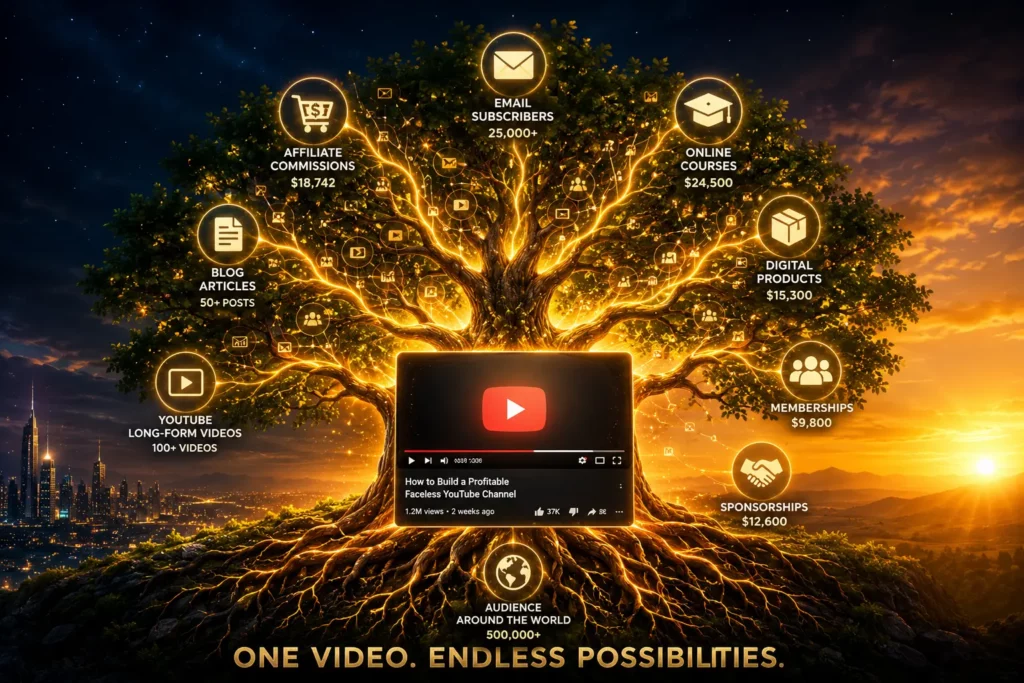
Think of your channel as the front door.
Every helpful video introduces someone to your expertise.
Some viewers will watch one video and leave.
Others will subscribe, return regularly, and eventually become loyal supporters or customers.
The goal isn’t simply to accumulate views.
The goal is to build relationships based on trust.
When people consistently learn something valuable from you, they’re naturally more interested in the resources, products, or recommendations you share.
That’s how a YouTube channel gradually evolves into a real online business.
Digital Products Scale Exceptionally Well
One of the biggest advantages of digital products is that you create them once but can sell them repeatedly.
Unlike physical products, there’s no inventory to store or ship.
If your videos solve specific problems, ask yourself:
“What additional resource would help someone take the next step?”
Depending on your niche, that might include:
- E-books
- Printable checklists
- Templates
- Worksheets
- Digital planners
- Spreadsheets
- Online courses
- Resource libraries
Each product should extend the value already provided in your videos.
Think of it as helping viewers continue their journey—not selling them something they don’t need.
Build an Email List From Day One
Many creators spend years focusing entirely on subscribers while overlooking one of the most valuable assets they can own:
An email list.
Subscribers belong to YouTube.
Your email list belongs to you.
That’s an important difference.
Algorithms change.
Platforms evolve.
Email gives you a direct way to stay connected with people who genuinely appreciate your content.
A simple lead magnet can encourage viewers to join your list.
Examples include:
- Beginner guides
- Checklists
- Templates
- Cheat sheets
- Resource collections
- Printable planners
Offer something practical that helps people achieve a quick win.
The better the resource, the more valuable your email community becomes.
For creators who also operate a money-making website setup, combining YouTube with an email list and a helpful website creates a much stronger long-term business than relying on any single platform alone.
Membership Communities
As your audience grows, some viewers may want deeper interaction.
Membership communities can provide:
- Exclusive videos
- Live Q&A sessions
- Downloadable resources
- Early access to content
- Behind-the-scenes updates
- Private discussions
These communities often develop because viewers enjoy learning together.
The emphasis should remain on delivering genuine value.
People happily support creators who consistently help them.
Online Courses
Courses allow you to organize your knowledge into a structured learning experience.
Instead of answering one question at a time, you guide students through an entire process.
Examples include:
- Learning software
- Starting a business
- Photography
- Investing
- Graphic design
- Language learning
Courses work especially well when your YouTube videos naturally introduce concepts that students later want to explore in greater depth.
Coaching and Consulting
Not every creator wants to offer personal coaching.
For those who enjoy working directly with people, however, it can become another valuable income stream.
Some viewers appreciate personalized advice because it helps them avoid mistakes and make faster progress.
As always, authenticity matters.
Offer services only where you genuinely have experience and can provide meaningful guidance.
Affiliate Marketing Continues Working in the Background
Affiliate marketing deserves another mention because it integrates so naturally with educational content.
The best affiliate recommendations usually appear when viewers already need a solution.
For example:
- Software tutorials naturally introduce software recommendations.
- Camera reviews lead to photography equipment.
- Productivity videos introduce planning tools.
- Business channels recommend useful services.
Notice the pattern.
The recommendation grows naturally from the content.
When products genuinely solve problems, everyone benefits.
Repurpose Every Video Into Multiple Pieces of Content
Creating a great video requires significant effort.
Make that effort work harder.
One video can often become several additional pieces of content.
For example:
Blog Articles
Expand your script into a detailed written guide.
Written content attracts search traffic while serving people who prefer reading.
Short Videos
Extract useful moments and publish them as short-form content.
A single tip can introduce entirely new audiences to your longer videos.
Social Media Posts
Interesting quotes, statistics, or insights often become engaging posts across social platforms.
Each one reminds people that your channel exists.
Email Newsletters
Share your newest video together with additional tips or resources.
Email subscribers appreciate thoughtful summaries that save them time.
Downloadable Resources
Transform educational content into printable checklists or quick-reference guides.
Many viewers enjoy having something they can save and revisit later.
Create Systems Instead of Chasing Motivation
Motivation comes and goes.
Systems keep your channel moving.
Many successful creators publish consistently because they’ve removed unnecessary decisions from the process.
A simple production system might look like this:
Monday
Research upcoming topics.
Tuesday
Write scripts.
Wednesday
Record narration.
Thursday
Edit videos.
Friday
Create thumbnails, optimize uploads, and schedule content.
The exact schedule isn’t important.
The consistency is.
Reliable systems reduce stress while making content creation much more manageable.
Batch Similar Tasks Together
Constantly switching between different kinds of work consumes time and mental energy.
Instead of researching one day, editing the next, and then returning to research again, consider grouping similar activities.
For example:
- Research several videos at once.
- Write multiple scripts together.
- Record several narrations in one session.
- Edit multiple videos over a dedicated period.
- Design thumbnails in batches.
This approach often feels more efficient because your brain remains focused on one type of work.
Build a Recognizable Brand
People don’t only remember individual videos.
They remember experiences.
As your channel grows, consistency becomes increasingly valuable.
That doesn’t mean every video must look identical.
It means viewers should recognize your work almost immediately.
Think about maintaining consistency in your:
- Thumbnail style
- Fonts
- Color palette
- Intro sequence
- Editing rhythm
- Narration style
- Overall tone
Familiarity builds recognition.
Recognition builds trust.
Trust encourages people to return.
Focus on Helping, Not Selling
One of the easiest ways to lose an audience is making every video feel like an advertisement.
People visit YouTube because they want information, inspiration, or entertainment.
If every upload focuses primarily on selling something, trust quickly begins to fade.
A healthier balance is simple.
Give generously.
Teach thoroughly.
Recommend thoughtfully.
When viewers repeatedly benefit from your content, they’re much more likely to explore your products, services, or affiliate recommendations when they’re genuinely relevant.
Helping first is often the most sustainable business strategy.
Learn From Your Audience
Your viewers constantly tell you what they need.
You simply have to pay attention.
Read comments carefully.
Notice recurring questions.
Observe which videos generate thoughtful discussions.
Look for patterns such as:
- Frequently misunderstood topics
- Requests for follow-up videos
- Common beginner mistakes
- Popular examples
- Areas where people remain confused
These insights become future content ideas.
Instead of guessing what your audience wants, allow them to guide your next videos.
Don’t Compare Your Beginning to Someone Else’s Middle
YouTube makes it easy to compare yourself with creators who have spent years refining their craft.
That comparison rarely helps.
Every successful channel once had:
- Zero subscribers
- Zero comments
- Zero watch hours
- Zero confidence
- Zero experience
The difference is that those creators continued improving.
Growth usually arrives gradually.
Every upload teaches something.
Every mistake becomes experience.
Viewed that way, progress becomes much easier to appreciate.
Patience Is a Competitive Advantage
Many channels disappear long before they have a realistic chance to succeed.
Not because the creators lacked talent.
Because they expected immediate results.
YouTube rewards consistency over time.
Some videos gain traction within days.
Others remain unnoticed for months before suddenly reaching a wider audience.
That’s one reason a growing library matters so much.
Each upload increases your opportunities.
One successful video often introduces viewers to many older ones.
Momentum builds gradually before becoming visible.
Measure Success Differently
Subscribers matter.
Views matter.
Revenue matters.
But early in your journey, better measurements might include:
- Publishing consistently
- Improving storytelling
- Increasing audience retention
- Producing clearer explanations
- Learning new editing techniques
- Better understanding your audience
These improvements eventually influence every other metric.
The creators who focus on becoming better usually outperform those who focus only on numbers.
The Long Game Always Wins
Building a profitable YouTube channel isn’t about finding one viral idea.
It’s about creating a library of videos that continues helping people month after month and year after year.
Each upload becomes another doorway into your content.
Each helpful explanation strengthens your reputation.
Each returning viewer increases the likelihood that your channel continues growing long into the future.
That’s the real advantage of approaching YouTube as a long-term business rather than a short-term experiment.
In Part 7, we’ll bring everything together with the most common mistakes to avoid, practical success habits followed by experienced creators, answers to frequently asked questions, and a carefully selected collection of products, tools, and resources that can help you build and grow a profitable faceless YouTube channel from home.
Common Mistakes That Hold New Creators Back
Every successful YouTube creator has made mistakes.
The difference is that they learned from them instead of allowing those mistakes to become permanent roadblocks.
Knowing what to avoid can save months of frustration and help you build momentum much faster.
Waiting Until Everything Is Perfect
This is probably the biggest obstacle for beginners.
People spend weeks choosing logos.
Months comparing microphones.
Countless hours researching software.
Meanwhile, they publish nothing.
Perfection is an impossible target because every new video teaches you something your previous one couldn’t.
The sooner you begin, the sooner you start improving.
Chasing Every Trend
Trending topics can generate temporary traffic.
Building an entire channel around trends often creates instability.
A healthier strategy is to combine evergreen content with occasional timely videos.
That way your channel continues attracting viewers long after today’s headlines have faded.
Ignoring the Audience
Some creators make videos they personally enjoy but never consider whether viewers actually need them.
Successful channels usually begin with a simple question:
“What problem can I solve today?”
When your audience consistently finds useful answers, trust naturally grows.
Uploading Without a Plan
Publishing random videos makes long-term growth much harder.
Create a content calendar.
Develop several content pillars.
Plan future videos while you’re working on the current one.
Consistency becomes much easier when decisions have already been made.
Giving Up Too Soon
Many channels stop just before momentum begins.
It’s common for creators to spend months building a valuable library before seeing meaningful growth.
Every upload increases the number of opportunities YouTube has to recommend your work.
Patience often becomes one of your greatest competitive advantages.
Habits Shared by Successful Faceless YouTube Creators
While every creator develops their own style, many long-term success stories share similar habits.
These practices aren’t complicated.
They’re simply repeated consistently.
They Continue Learning
Algorithms evolve.
Technology improves.
Viewer expectations change.
Successful creators remain curious and keep refining their skills.
They Publish Consistently
Consistency builds experience.
Experience improves quality.
Improved quality attracts more viewers.
That cycle repeats itself over time.
They Listen to Their Audience
Comments, questions, and viewer feedback often reveal exactly what future videos should cover.
Great creators treat their audience as collaborators rather than spectators.
They Improve Gradually
Instead of trying to master everything at once, they focus on steady progress.
Perhaps this week’s improvement is a better introduction.
Next week’s is cleaner editing.
The following week’s is stronger storytelling.
Small improvements compound into remarkable results.
They Think Long Term
The strongest channels aren’t built around one successful video.
They’re built around hundreds of useful videos working together.
Every upload strengthens the entire collection.
Frequently Asked Questions
Can I really start a YouTube channel without showing my face?
Absolutely.
Many successful channels focus entirely on educational content, tutorials, documentaries, animations, screen recordings, or narrated visuals.
What matters most is delivering value that keeps viewers engaged.
Do I need expensive equipment?
No.
Clear audio, organized information, and helpful content usually matter far more than expensive cameras or elaborate production setups.
You can improve your equipment gradually as your channel grows.
How often should I upload?
Choose a schedule you can maintain consistently.
For many creators, one high-quality video each week is more effective than attempting daily uploads that become difficult to sustain.
Quality and consistency generally outperform short bursts of activity.
How long does it take to earn money?
There’s no universal timeline.
Some channels reach monetization relatively quickly.
Others require considerably more time.
Factors such as niche, competition, consistency, audience engagement, and content quality all influence growth.
The creators who continue learning and publishing steadily tend to give themselves the best chance of long-term success.
Is artificial intelligence replacing creators?
No.
AI has become an excellent productivity tool, but viewers continue valuing original thinking, clear explanations, and trustworthy guidance.
Technology can improve efficiency, but it doesn’t replace human insight.
Which niches work best for faceless YouTube channels?
Educational and evergreen topics often perform exceptionally well.
Examples include:
- Personal finance
- Technology
- Artificial intelligence
- Productivity
- Home improvement
- Software tutorials
- Business
- Health education
- History
- Science
The best niche is one where audience demand, monetization opportunities, and your long-term interest overlap.
Can I combine YouTube with a website?
Yes.
Many creators use websites to publish detailed articles, collect email subscribers, share downloadable resources, and diversify their traffic sources.
A website also gives you greater control over your online business beyond any single platform.
How many videos should I expect to create before seeing meaningful results?
There isn’t a magic number.
Some channels gain traction with relatively few uploads, while others build momentum gradually over dozens of videos.
Rather than focusing on a specific number, concentrate on making each new video better than the previous one.
Products, Tools, and Resources
As your channel grows, the right tools can save time, improve quality, and help you work more efficiently.
You don’t need everything immediately.
Start with the essentials and upgrade only when it genuinely supports your workflow.
Script Writing and Research
Use AI writing assistants and research tools to brainstorm ideas, organize outlines, and speed up script creation while ensuring every video remains accurate, useful, and written in your own voice.
Video Editing Software
Choose editing software that matches your experience level.
A clean interface, reliable performance, and efficient workflow are usually more important than having hundreds of advanced features you’ll rarely use.
Screen Recording Tools
If your channel includes tutorials or software demonstrations, dependable screen recording software quickly becomes one of your most valuable resources.
Clear demonstrations help viewers follow every step.
Stock Footage Libraries
High-quality stock videos and images allow you to illustrate ideas professionally without filming everything yourself.
Select visuals that genuinely support your message instead of adding unnecessary distractions.
Graphic Design Tools
Simple graphics, thumbnails, infographics, and presentation slides can dramatically improve the viewing experience while reinforcing your brand identity.
Audio Recording Equipment
Good sound creates a more enjoyable viewing experience than almost any visual upgrade.
Even a modest microphone in a quiet room can produce excellent results when paired with careful recording techniques.
Cloud Storage
As your video library grows, organized cloud storage makes managing projects much easier while protecting valuable work through reliable backups.
Project Management
Keeping track of video ideas, scripts, publishing schedules, and future content becomes increasingly important as your channel expands.
Simple project management tools help maintain consistency and reduce unnecessary stress.
Analytics and Keyword Research
Research tools can help you understand audience interests, discover content opportunities, and evaluate performance trends.
Use them to support good decisions rather than chasing shortcuts.
Final Thoughts
Building a profitable faceless YouTube channel isn’t about hiding your identity.
It’s about putting the audience first.
Every helpful explanation, practical demonstration, and thoughtful tutorial strengthens the relationship between you and the people you’re trying to help.
You don’t need celebrity status.
You don’t need expensive equipment.
You don’t need years of experience before you begin.
What you do need is a willingness to learn, publish consistently, and improve a little with every new upload.
The creators who succeed over the long term rarely rely on luck.
They build trust.
They solve problems.
They create content that continues helping people long after the upload button has been pressed.
If you approach your channel with patience, curiosity, and a genuine desire to make each video useful, you’ll be creating much more than a collection of uploads.
You’ll be building a digital asset that has the potential to educate, inspire, and generate income for many years to come.
Valuable Bonus: A 30-Day Faceless YouTube Launch Plan
If you’re unsure where to begin, simplify the process by focusing on one achievable task each day.
Week 1: Build Your Foundation
- Choose your niche.
- Research your audience.
- Brainstorm 100 video ideas.
- Select your content pillars.
- Set up your YouTube channel.
- Design a simple channel banner and logo.
- Create a realistic publishing schedule.
Week 2: Produce Your First Videos
- Research your first topics.
- Write three scripts.
- Record narration.
- Gather visuals.
- Edit your first videos.
- Design clear thumbnails.
Week 3: Publish and Learn
- Publish your first videos.
- Write detailed descriptions.
- Add chapters where appropriate.
- Review audience retention.
- Read every comment.
- Note what worked well.
Week 4: Improve Your System
- Create additional content in batches.
- Build an email list.
- Plan your next month of videos.
- Improve one production skill.
- Analyze your best-performing content.
- Repeat the process with greater confidence.
After one month, you may not have thousands of subscribers—but you’ll have something far more valuable:
A working system, growing experience, and a content library that can continue attracting viewers long into the future.